
Why More Injured Workers Are Lawyering Up — And What It Means for Your Workers’ Comp Premium
Workers’ compensation litigation is rising sharply in 2026. More injured workers are hiring attorneys earlier in the claims process, driving up costs and complexity for every employer — regardless of industry, size, or state. Understanding why this is happening and what you can do about it is one of the highest-value conversations you can have with your insurance broker right now.
The Trend: Litigated Workers’ Comp Claims Are Climbing
Workers’ compensation was designed to be a no-fault system. An employee gets hurt on the job, the claim is filed, medical care is provided, and benefits are paid. No lawsuits. No attorneys. No courtrooms. That was the deal.
In 2026, that deal is fraying. According to Business Insurance, litigation is now creeping deeper into Workers’ Comp claims, adding cost and complexity for employers even as the line remains broadly profitable for carriers and protected by exclusive remedy.
The shift is not dramatic in any single case. It is incremental. Workers who once accepted the process are now being advised by plaintiff attorneys to challenge medical decisions, dispute claim denials, and contest return-to-work assessments. Attorneys are entering the process earlier. Minor claims that once resolved in weeks are now running for months. The cumulative effect across the system is significant.
WHAT BUSINESS INSURANCE REPORTED
Litigation is “creeping deeper” into WC claims, adding cost and complexity for employers even as the WC line remains broadly profitable and protected by exclusive remedy. The trend reflects a broader shift in how injured workers and their attorneys approach the claims process.
Why More Workers Are Hiring Attorneys
Understanding why litigation is increasing is essential for employers who want to address the root causes rather than just the consequences. Several factors are converging simultaneously.
1. Greater Awareness of Legal Rights
Digital advertising, social media, and legal referral networks have dramatically lowered the barrier to finding a Workers’ Comp attorney. Workers who previously had no idea they could challenge a claim denial or a medical decision now receive targeted advertising the moment they search for WC-related information. The plaintiff bar has invested heavily in reaching injured workers before employers or insurers do.
2. Inflation Increasing the Stakes
Rising medical costs, higher living expenses, and stagnant real wages have made the financial stakes of a WC claim much higher for injured workers. A claim that would once have been resolved with a few weeks of temporary total disability benefits now involves more expensive medical treatment and a larger income gap for the worker. Higher stakes mean more reason to hire an attorney.
3. Delays in Claim Processing
When employers or carriers are slow to respond to claims, approve medical treatment, or authorize specialists, injured workers feel abandoned. Attorney involvement frequently begins not because the worker is adversarial but because they cannot navigate the system without help. Delays are one of the most reliably documented triggers for legal representation in WC claims.
4. Claim Denials Without Clear Communication
When a claim is denied without a clear, documented explanation, workers often assume the denial is unfair rather than procedural. An attorney call typically follows. Employers who communicate claim decisions clearly and proactively — even when denying — significantly reduce the likelihood of immediate legal escalation.
5. Cumulative Trauma and Difficult-to-Prove Claims
Claims involving gradual onset injuries — repetitive stress, cumulative trauma, occupational disease — are inherently more complex and more contested. These claim types require legal representation almost by definition because the connection between work and injury must be proven through a more complex evidentiary record. As these claim types grow as a share of total WC claims, attorney involvement grows with them.
The Real Cost Difference Between Litigated and Non-Litigated Claims
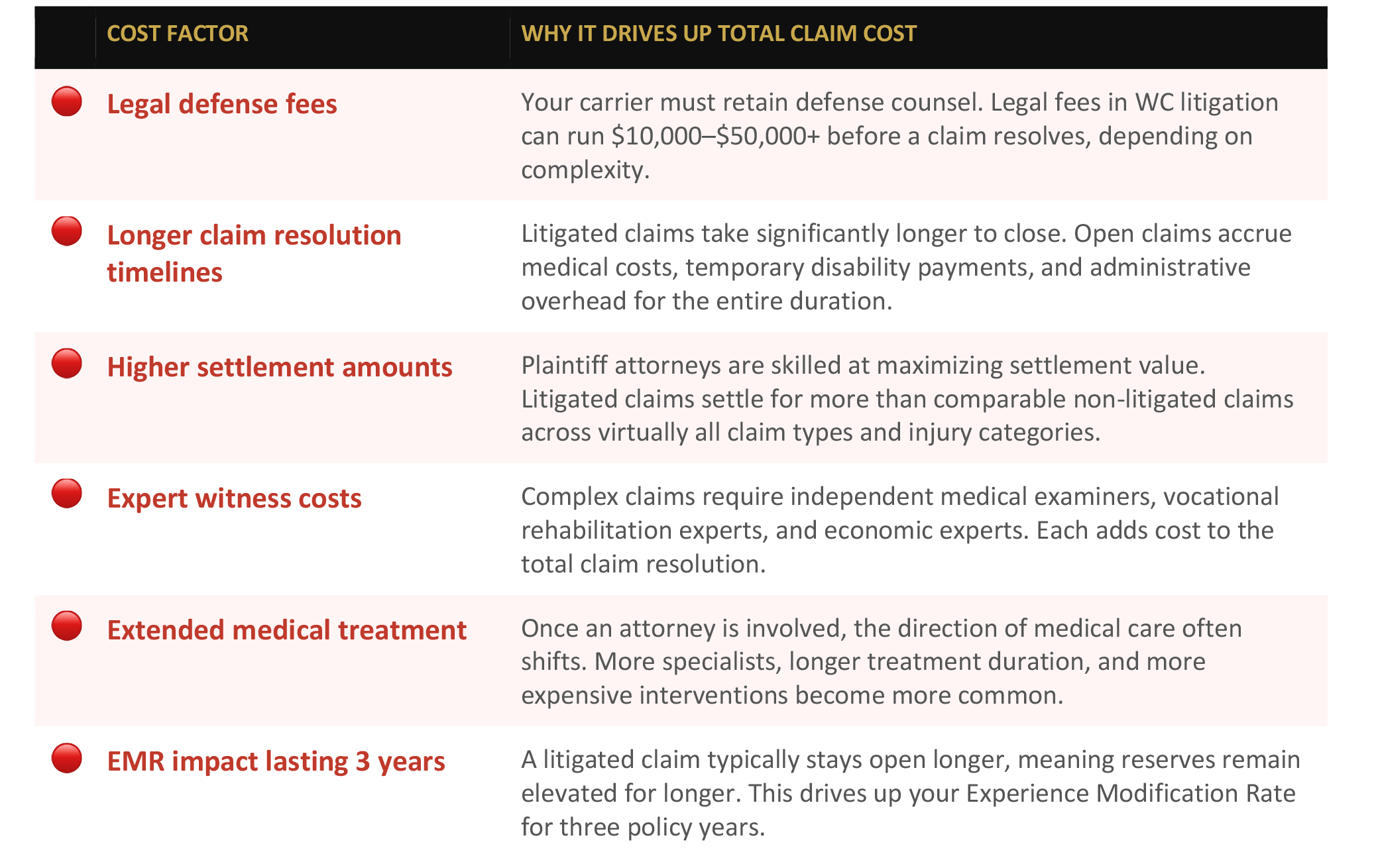
The financial impact of litigation on a Workers’ Comp claim is well documented and consistently significant. Studies of WC claim data show that attorney-represented claims cost substantially more to resolve than comparable non-represented claims, for multiple interconnected reasons.
THE EMR MULTIPLIER EFFECT
Every litigated claim that inflates your reserve totals also inflates your Experience Modification Rate. A higher EMR means a higher Workers’ Comp premium at renewal — and that higher premium persists for the three policy years that EMR calculations cover. One litigated claim today can cost you in premiums through 2029.
5 Steps Every Employer Can Take to Reduce WC Litigation Exposure
Litigation prevention in Workers’ Comp is not complicated. It is consistent. The employers with the lowest litigation rates share a common set of practices that make attorney involvement less likely and less productive for plaintiffs when it does occur.
TIP 1 | Report Every Incident Immediately — Even When It Seems Minor
✓ Implement a mandatory incident reporting policy that covers all injuries, illnesses, and near-misses regardless of perceived severity
✓ Report claims to your carrier within 24 hours of the incident — not within 24 hours of deciding it is “serious enough”
✓ Studies consistently show that early claim reporting reduces total claim costs by as much as 50% compared to delayed reporting
✓ A worker who feels their injury was taken seriously from day one has far less motivation to hire an attorney
TIP 2 | Implement a Formal Return-to-Work Program
✓ Workers who return to meaningful work faster are substantially less likely to hire attorneys and substantially less likely to become permanently disabled
✓ Develop a catalog of light duty or modified duty assignments that injured workers can perform during recovery
✓ Communicate return-to-work options to every injured worker immediately after their injury is reported — before attorney contact occurs
✓ Document all return-to-work offers, acceptances, and refusals in writing to protect yourself in any subsequent litigation
✓ RTW programs consistently rank as one of the highest-ROI investments in WC cost management
TIP 3 | Build an Ironclad Documentation System
✓ Create an incident reporting form that captures: exact time and location, witness names and statements, equipment involved, immediate medical response, and worker’s description in their own words
✓ Document every safety training session with attendance records and signed acknowledgments
✓ Maintain a log of all near-misses and property damage incidents — not just injuries
✓ Document all return-to-work communications, accommodations offered, and medical restrictions in writing
✓ When an attorney becomes involved, your documentation is your defense. Employers with complete records consistently achieve better outcomes than those relying on recollection.
TIP 4 | Communicate with Injured Workers Proactively and Consistently
✓ Assign a specific person — not a carrier adjuster — to be the primary point of contact for every injured worker
✓ Check in with injured workers weekly. Ask about their medical progress. Make them feel cared for, not managed.
✓ Never communicate in a way that feels adversarial. The single most common reason workers hire attorneys is feeling like the system is against them.
✓ If a claim is denied, explain why in plain language, document the explanation, and provide information on how the worker can appeal
✓ Workers who feel informed and respected throughout the process are dramatically less likely to escalate
TIP 5 | Review Your WC Policy and EMR Annually with a Specialist
✓ Review your Experience Modification Rate calculation annually to identify claims that are inflating your EMR beyond their actual cost
✓ Carriers sometimes hold reserves on claims at amounts higher than necessary. A specialist broker can advocate for reserve reductions.
✓ Confirm your WC policy includes adequate legal defense cost coverage for litigated claims at your actual exposure level
✓ Ask your broker to walk through every open claim and identify which ones carry litigation risk
✓ If you have a cluster of claims in a specific department or job type, that pattern is your highest priority target for intervention
Litigation-Resistant WC Documentation Checklist
Use this checklist to assess your current documentation practices. Every unchecked item is a potential vulnerability in a litigated claim.
INCIDENT DOCUMENTATION
☐ Incident reporting form covers all required fields: time, location, witnesses, equipment, worker description
☐ All incidents reported to carrier within 24 hours of occurrence
☐ Witness statements obtained and documented in writing before the workday ends
☐ Photographs taken of the incident location and any relevant equipment or conditions
☐ Supervisor incident report completed separately from worker report
☐ All near-misses and property damage documented even when no injury occurs
RETURN-TO-WORK DOCUMENTATION
☐ Catalog of available light duty and modified duty positions maintained and updated
☐ RTW offer communicated to injured worker in writing within 24 hours of medical clearance for any duty
☐ Worker’s acceptance or refusal of RTW offer documented in writing with date and signature
☐ Medical restrictions received from treating physician documented and filed immediately
☐ RTW progress tracked weekly and documented with dates and worker condition updates
Frequently Asked Questions About WC Litigation
These are the questions employers most commonly ask when they start seeing attorney involvement in their WC claims. Clear answers help you respond proactively rather than reactively.
❓ Once a worker hires an attorney, is it too late to do anything?
It is not too late, but your options narrow. The most important things you can do after attorney involvement: ensure your documentation is complete and organized, communicate exclusively through proper channels, and work closely with your carrier’s defense counsel. Do not attempt to contact the claimant directly once they have legal representation. Your best outcomes at this stage come from having strong documentation in place before the attorney arrived.
❓ Does Workers’ Comp exclusive remedy protect us from lawsuits?
Workers’ Comp exclusive remedy means injured workers generally cannot sue their employer for workplace injuries in tort — they must go through the WC system. However, exclusive remedy has exceptions in most states: intentional conduct, fraudulent concealment of a known hazard, and injuries caused by a third party (contractor, equipment manufacturer) can all create paths to civil litigation outside WC. Exclusive remedy does not protect you from WC system litigation by attorneys — it only bars the separate tort claim.
❓ How does a litigated claim affect my premium at renewal?
A litigated claim typically stays open longer than a non-litigated claim because settlement negotiations take time. The longer a claim stays open, the higher the reserve your carrier holds against it. Reserves are one of the primary inputs in your Experience Modification Rate calculation. A higher EMR means a higher premium multiplier. Depending on your payroll size, a single inflated litigated claim can increase your annual WC premium by thousands to tens of thousands of dollars for three consecutive renewal years.
❓ Are some industries at higher risk for WC litigation?
Yes. Industries with higher physical injury rates, higher cumulative trauma rates, and more adversarial labor-management relationships tend to have higher WC litigation rates. Construction, healthcare, warehousing and logistics, manufacturing, and transportation consistently see more attorney involvement than office or professional service industries. However, litigation can occur in any industry when the underlying conditions — delayed reporting, poor communication, claim denials without explanation — are present.
❓ Can I do anything about claims that are already open and being handled by an attorney?
Yes. Work closely with your carrier’s assigned defense counsel. Make sure your documentation is complete and organized. Review reserves on open claims at least quarterly with your broker and ask whether reserves are appropriate given current claim status. If a case appears headed toward trial, discuss settlement strategy with defense counsel early. Proactive reserve management by your broker and carrier can limit the EMR impact even on claims that are already in litigation.
The Bottom Line
The rise in litigated Workers’ Comp claims is not random. It is driven by identifiable, preventable factors: delayed reporting, poor communication, inadequate documentation, and failure to engage injured workers quickly and humanely. None of these are inevitable.
Every employer carrying Workers’ Comp insurance has the ability to reduce their litigation exposure through consistent operational practices. The employers who invest in those practices — early reporting, return-to-work programs, documentation systems, and proactive injured worker communication — consistently outperform their peers on WC costs year over year.
If litigation is rising across the system, the employers who pull ahead are the ones who make litigation unlikely for their workforce specifically. That is a choice that starts with how you handle the next incident that occurs in your workplace.