
California Just Extended Retaliation Protections to 1099 Contractors.
A federal court just ruled that California’s Fair Employment and Housing Act retaliation protections extend to independent contractors — not just traditional employees. The case is Lively v. Wayfarer Studios LLC, decided by the U.S. District Court for the Southern District of New York in June 2026. If your business uses 1099 contractors in California — whether you’re a film production company or a staffing firm — your retaliation exposure just expanded in ways most current insurance policies were never designed to address.
The Case: Lively v. Wayfarer Studios LLC
The Blake Lively case generated enormous public attention when it was filed. The legal ruling that emerged from it is far more significant for the business community than most of the coverage suggested.
Blake Lively was classified as an independent contractor during the production of It Ends With Us. She alleged that after raising harassment concerns during production, the defendants — Wayfarer Studios and others — coordinated a reputational campaign intended to damage her professional standing and harm her career.
The defendants moved to dismiss her California Fair Employment and Housing Act retaliation claim, arguing that FEHA’s retaliation protections applied only to employees — and that as an independent contractor, Lively had no FEHA retaliation claim.
The court disagreed. Completely.
WHAT THE COURT RULED
The U.S. District Court for the Southern District of New York ruled that FEHA’s retaliation provision protects “any person” who opposes conduct prohibited by the law. The statute’s language is not limited to traditional employees. Therefore, an independent contractor who opposes prohibited conduct — including harassment or discrimination — is protected from retaliation under California FEHA, regardless of how they are classified for employment purposes.
The court also made a second critical finding: a coordinated campaign to harm someone’s professional reputation — without any firing, demotion, pay cut, or formal adverse employment action — may constitute materially adverse action under FEHA. In other words, reputational damage itself can be the retaliation.
What California FEHA Actually Says — And Why It’s Broader Than Most People Think
The California Fair Employment and Housing Act is the state’s primary anti-discrimination statute. Most employers know it applies to employees. What the Lively ruling confirmed is that FEHA’s retaliation provision is written differently from its discrimination provisions.
FEHA’s discrimination provisions specifically protect “employees.” FEHA’s retaliation provision protects “any person” who opposes prohibited conduct. That distinction is not a drafting accident. The court found it controls the outcome: the retaliation protections extend beyond the employment relationship to anyone who opposes conduct FEHA prohibits.
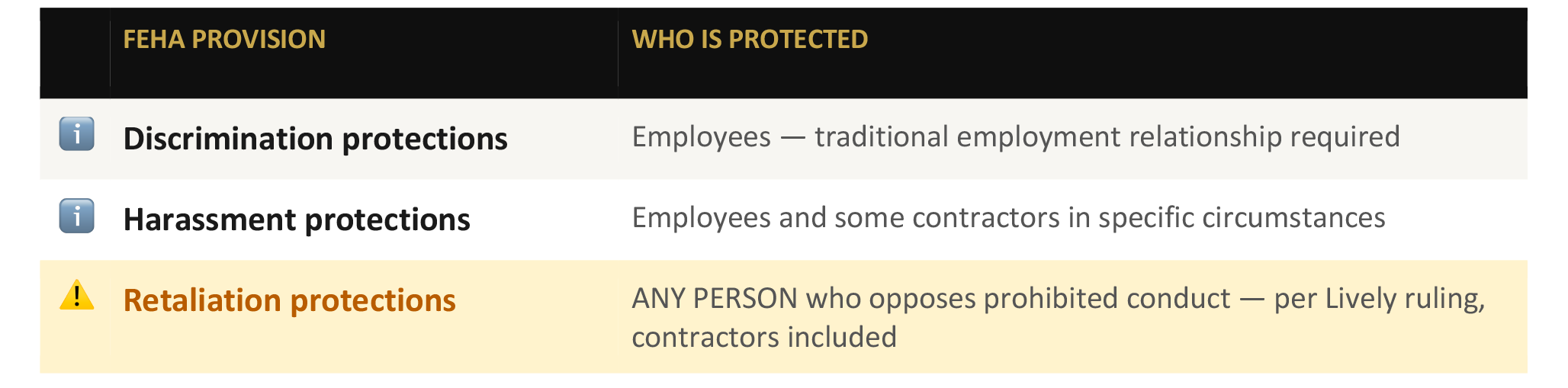
The practical implication is significant. A business can be protected from FEHA discrimination claims when using independent contractors — but exposed to FEHA retaliation claims from those same contractors when they oppose prohibited conduct. The classification that limits some liability does not limit retaliation liability.
Reputational Damage as Retaliation: The New Frontier
The second critical development in the Lively case is what the court held about materially adverse action. Traditional employment retaliation cases involve firing, demotion, pay cuts, or similar concrete employment actions. The Lively court went further.
The court found that a coordinated campaign designed to harm a contractor’s professional standing — damaging their reputation, undermining their relationships, affecting their future employment opportunities — may qualify as materially adverse action sufficient to sustain a FEHA retaliation claim. The adverse action does not have to be a formal employment decision.
How This Ruling Hits Film Production and Staffing Differently
The ruling affects both industries but through different operational structures. Understanding the specific exposure points for each is essential to building the right response.
🎬 FILM PRODUCTION EXPOSURE
⚠️ Crew members hired as 1099 contractors on any California production — which is most of them — are now covered by FEHA retaliation protections when they oppose prohibited conduct
⚠️ A producer, director, or executive who responds to a crew complaint with any form of adverse conduct — including pulling the contractor from the project, spreading negative word about them in the industry, or coordinating negative professional response — faces a FEHA retaliation claim
⚠️ The California connection does not require the production to be physically in California. Communications directed to or from California, decisions made by California-based executives, and productions with California-based participants can all trigger FEHA jurisdiction
⚠️ Film E&O (Errors and Omissions) insurance covers distribution-related liability: clearance failures, copyright issues, defamation in the content itself. It does not cover crew retaliation claims. Those claims require a separate EPL policy — and most standard EPL policies were not underwritten to include 1099 contractor retaliation exposure
📋 STAFFING FIRM EXPOSURE
⚠️ 1099 contractors placed by staffing firms at California client locations are now covered by FEHA retaliation protections. As the entity that recruited, placed, and maintains the employment relationship — or the closest analog to it — the staffing firm is in the liability chain
⚠️ If a client company takes adverse action against a placed contractor who raised harassment concerns during their assignment, the staffing firm’s role in that placement creates potential co-employer exposure
⚠️ Staffing firms that respond to client pressure to remove a contractor who complained — rather than documenting and investigating the complaint properly — face direct FEHA retaliation exposure
⚠️ Remote and hybrid arrangements complicate the California nexus analysis. A contractor working remotely for a California-headquartered client may be covered even if the contractor is physically in another state
⚠️ Most standard EPL policies for staffing firms were designed around employment relationships. Coverage for 1099 contractor retaliation claims under California FEHA is a gap that must be specifically reviewed and addressed
5 Steps Every Business Must Take After This Ruling
These steps apply to both film production companies and staffing firms. The timeline is now.
Audit Every 1099 Contractor Agreement for California FEHA Exposure - Identify every contractor relationship that has a California connection — whether the contractor is based in California, the work is performed in California, or decisions are made by California-based personnel. This is your FEHA retaliation exposure map.
Build a Documented Contractor Complaint Intake Process - Contractors need a clearly communicated, documented channel for raising concerns. Film productions need a code of conduct and reporting process that covers crew — not just employees. Staffing firms need a contractor complaint intake process separate from their employee complaint process.
Train Productions, Managers, and Recruiters on the New Rules - Any person in your organization who has authority over a 1099 contractor — or who could influence their professional reputation — must understand that adverse responses to contractor complaints carry FEHA retaliation risk. This training must be documented.
Review Your EPL Policy for 1099 Contractor Coverage - Contact your insurance broker and ask specifically: does our Employment Practices Liability policy cover FEHA retaliation claims brought by independent contractors? If the answer is unclear or no, you have a gap that needs to be addressed before your next renewal.
Document Every Contractor Complaint Response in Writing - From this point forward, every response to a contractor complaint must be documented in writing: what the complaint was, what investigation was conducted, what the outcome was, and why. If a retaliation claim is ever filed, your written record is your primary defense.
Frequently Asked Questions
These are the questions film producers, staffing firm owners, and HR directors most often ask about this ruling and its implications.
❓ Does this ruling apply to productions and placements outside California?
It can. California’s FEHA has been found to apply when there is a sufficient connection to California — which can include communications made from California, decisions by California-based executives, or contractors who are based in California even when working remotely on a production or placement that is nominally elsewhere. The safest approach is to assume FEHA applies whenever California appears anywhere in the relationship.
❓ Does calling someone a 1099 contractor protect us from this ruling?
No. The Lively ruling explicitly rejected that argument. FEHA’s retaliation provision uses the phrase “any person” — not “employee.” The classification does not determine coverage under the retaliation provision. A contractor who opposes prohibited conduct is protected from retaliation regardless of how they are classified for tax or employment purposes.
❓ What kind of response to a complaint could be considered retaliation?
The Lively case involved an alleged coordinated reputational campaign. The court found this can qualify as materially adverse action. Beyond organized reputational damage, traditional retaliation conduct — terminating the contract, refusing to hire the contractor again, reducing their assignments, making negative references to industry contacts — all carry retaliation risk. The safest practice is to treat any adverse action following a complaint as potential evidence of retaliation until you have documented, legitimate, pre-existing reasons for the action.
❓ Does our Film E&O policy cover this?
Almost certainly not. Film E&O policies are designed to cover claims arising from the content of the film: clearance failures, defamation in the work, copyright infringement. They are not designed to cover crew retaliation claims. That coverage requires a separate Employment Practices Liability policy, and even then, 1099 contractor retaliation claims are a coverage question that must be specifically addressed with your broker.
❓ What is the difference between FEHA discrimination and FEHA retaliation for 1099 contractors?
FEHA discrimination protections traditionally applied to employees — contractors had limited or no protection against discrimination itself. FEHA retaliation protections now extend to contractors under the Lively ruling because the statute uses “any person” rather than “employee” for retaliation. This means a contractor may not be able to bring a FEHA discrimination claim but may be able to bring a FEHA retaliation claim for the same incident — if they opposed prohibited conduct and experienced adverse action as a result.
The Bottom Line
The Lively case produced legal precedent that extends far beyond Hollywood. Every business that uses 1099 contractors in California — or with California connections — now operates in an environment where retaliation claims from those contractors are legally viable under FEHA.
The two industries most immediately affected are film production, where 1099 crew is the norm rather than the exception, and staffing, where independent contractor placements are a core business structure. Both industries need to act on this ruling now — not at the next renewal, not after the first claim arrives.
The good news is that the path forward is straightforward: audit your contractor relationships, build complaint intake processes, train your people, and get your insurance coverage reviewed. The businesses that do this now will be protected. The ones that wait will find out the hard way that 1099 classification was never the shield they thought it was.