
When Does a Remote Worker’s Commute Become Paid Work Time? The DOL Just Drew the Line.
The U.S. Department of Labor’s Wage and Hour Division just issued two opinion letters that redraw the line between an ordinary commute and compensable work time. For hybrid employees and field service workers, the distinction is no longer theoretical — it is a precise legal test. For staffing firms placing field technicians, service workers, installers, and mobile workers, these letters define exactly when the clock starts. If your placed workers do anything substantive before driving to their first site, you may be building uncompensated work time with every shift.
The Two DOL Opinion Letters: What They Say in Plain English
The DOL Wage and Hour Division issues opinion letters to answer specific employer questions about FLSA compliance. These letters are not binding law, but courts give them significant weight and employers who follow them receive some protection from good-faith reliance. FLSA2026-9 and FLSA2026-10 address two distinct workforce situations.
FLSA2026-9 — Hybrid Workers: Home-to-Office Travel
✅ FLSA2026-9 — GENERALLY NOT COMPENSABLE
Home-to-office travel for hybrid workers is typically non-compensable commuting time, even mid-workday, IF:
The travel is ordinary commuting time — not tied to a work-required destination
The employee is not performing work while traveling
The arrangement primarily benefits the employee rather than the employer
The employee voluntarily chose to work from home before coming to the office
The key insight from FLSA2026-9 is that a hybrid worker’s drive from home to the office does not become compensable simply because the employee already worked from home that morning. If the employee chose the remote arrangement, is not working while traveling, and the commute follows normal commuting patterns, it remains a commute. Employers who mandate hybrid schedules should review whether the arrangement primarily benefits the employer — if so, the analysis may change.
FLSA2026-10 — Field Service Workers: The Bright Line
❌ FLSA2026-10 — THE CRITICAL DISTINCTION
The workday begins when substantive work begins — not when the employee leaves home.
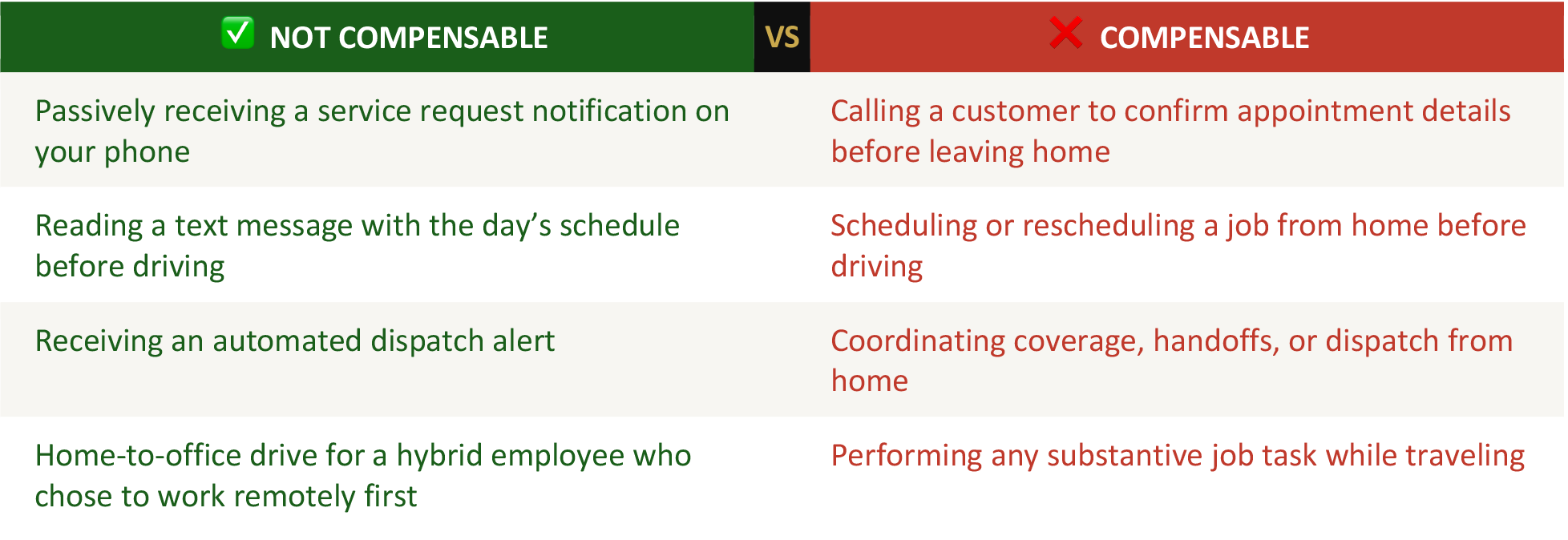
✅ PASSIVE receipt of an electronic service request or notification = NOT compensable
❌ ACTIVE calls to customers before driving = COMPENSABLE worktime
❌ Scheduling or confirming appointments before leaving home = COMPENSABLE
❌ Coordinating coverage, dispatching, or organizing workflow before driving = COMPENSABLE
❌ Any substantive job task performed before the first drive = workday has started
The DOL’s distinction is between passive receipt of information — reading a notification, seeing a schedule — and active job performance. The moment a field employee starts doing something for the employer rather than simply receiving information, the workday has begun. The subsequent drive to the job site is then not a commute but travel on company time.
Not Compensable vs. Compensable: Quick Reference
Use this table to evaluate whether your field workers’ pre-drive activities are compensable under the new DOL guidance.
Why This Matters More for Staffing Firms Than for Any Other Employer
Most FLSA compliance discussions focus on direct employers. For staffing firms, the stakes are compounded. As employer of record for placed workers, the staffing firm carries the FLSA compliance obligation for every hour those workers work — regardless of what happens at the client site.
THE STAFFING FIRM EXPOSURE
When a staffing firm places a field technician, service worker, installer, or mobile worker at a client location, that worker is on the staffing firm’s payroll. If that worker calls dispatch, confirms an appointment, or coordinates their first job before leaving home — and that time is not recorded and paid — the unpaid time is the staffing firm’s liability. Not the client’s. The staffing firm’s.
The problem is structural. Most staffing firms have their placed workers clock in when they arrive at the job site — which has always made intuitive sense. But if the worker spent 15 minutes doing substantive job tasks before getting in the car, those 15 minutes are now potentially compensable under FLSA2026-10. Multiplied across a workforce of field workers doing this consistently, the aggregate exposure is significant.
There is a second layer of exposure: client instructions. If a client requires placed workers to call in, check a job management system, or confirm assignments before driving — and the staffing firm does not pay for that time — the staffing firm is the party with the FLSA obligation. Clients can direct work, but they do not bear the wage payment obligation for placed workers. That stays with the staffing firm.
Quick Guide: 5 Steps to Audit Your Field Worker Timekeeping Today
These five steps are designed to be completed this week. They do not require outside counsel to start, though a formal audit should involve legal privilege.
Map Every Placement Where Workers May Do Pre-Drive Tasks - Identify every type of placed worker who has any contact with the job before driving to it. Field technicians, service workers, installers, home health aides, dispatch-based roles, and mobile professionals are all candidates. Create a list.
Ask: What Do Your Placed Workers Actually Do Before Getting in the Car? - This is the most important question. Talk to a sample of placed workers in each category. Ask specifically: do they call anyone, check a system, confirm appointments, or coordinate anything before starting their drive? The answer determines your exposure.
Review Your Timekeeping Policy Against the DOL Guidance - If workers clock in at the job site, determine whether any compensable activity is happening before that clock-in. Any gap between when substantive work starts and when the clock starts is potential unpaid time. Review your timekeeping system to determine whether it can capture pre-drive activities.
Review Client Agreements for Pre-Drive Requirements - Read your client staffing agreements for any language requiring placed workers to check in, call, or coordinate before traveling to the site. If the client is requiring that activity, it is compensable — and you need to build it into your payroll processes and your bill rates.
Conduct a Formal Audit Through Outside Employment Counsel - The four steps above are your initial assessment. A formal wage and hour audit conducted through outside counsel is protected by attorney-client privilege. If violations are identified, you can address them privately rather than in litigation. The cost of the audit is a fraction of the cost of defending a class action.
Frequently Asked Questions
❓ Does this DOL guidance apply to all employers or just staffing firms?
The DOL opinion letters apply to all employers subject to the Fair Labor Standards Act — which covers virtually every private employer in the United States. Staffing firms face heightened exposure because they are employer of record for placed workers, but the underlying rules apply to any employer with hybrid or field service workers.
❓ What if the client tells our placed workers to call in before driving?
The client can direct the work, but the client is not the employer of record and does not bear the FLSA wage obligation for placed workers. If a client requires pre-drive contact that is compensable under FLSA2026-10, the staffing firm must pay for that time. This should be reflected in the staffing agreement and the bill rate.
❓ Is reading a work schedule or checking a job app before driving compensable?
It depends on whether the activity is passive or substantive. Passively receiving a notification or reading a schedule without taking action is generally not compensable. Actively updating a schedule, responding to a job request, or coordinating coverage crosses into compensable territory under FLSA2026-10.
❓ Are DOL opinion letters legally binding?
DOL opinion letters are not legally binding in the same way that statutes and court decisions are. However, courts give them significant deference and employers who follow them in good faith receive some protection. FLSA2026-9 and FLSA2026-10 represent the DOL’s official position on these issues and should be treated as authoritative guidance.
❓ What is the risk if we don’t fix a pre-drive timekeeping gap?
Unpaid compensable time under the FLSA is a recoverable wage. If the gap is consistent and applies across multiple workers, it can form the basis of a collective action under the FLSA or a class action under state wage and hour law. Damages include the unpaid wages, an equal amount of liquidated damages, and plaintiff attorney’s fees. A consistent 15-minute daily pre-drive gap across a field workforce of 100 workers adds up to significant aggregate liability quickly.
The Bottom Line
The DOL’s guidance is clear and the line it draws is precise: passive receipt of information is not work, and active performance of job tasks is. For staffing firms, the practical implication is immediate — any placed field worker who does something substantive before driving has started their workday, and that time must be compensated.
The firms that act on this now — mapping their mobile workforce, reviewing their timekeeping policies, and auditing their client agreements — will find and fix any gaps before they become class actions. The firms that don’t will find out the hard way that the DOL just defined exactly what they owe.