
Arbitration Agreements Don’t Transfer: What Every Staffing Firm Must Know After Toothman v. Redwood Toxicology
A California Court of Appeal just issued a ruling that every staffing firm and host employer needs to understand. In Toothman v. Redwood Toxicology Laboratory Inc., the court held that a staffing firm’s arbitration agreement does not protect the host employer once a worker converts to direct hire. The implications are immediate: if your direct hire conversion process does not include a standalone arbitration agreement, you have a legal gap that no amount of good intentions can close.
📄 Quick Summary:
• What the court decided in Toothman v. Redwood Toxicology and why it matters beyond California
• Why a staffing firm’s arbitration agreement does not extend to post-conversion direct employment
• How this ruling exposes both staffing firms and host employers differently
• The specific legal principles that make arbitration agreements relationship-specific
• A 5-step quick guide to close the conversion gap immediately
The Case: Toothman v. Redwood Toxicology Laboratory
The fact pattern in Toothman is straightforward and the legal lesson it delivers is clear. A worker was placed at Redwood Toxicology Laboratory through a staffing firm. During that placement, the worker signed an arbitration agreement with the staffing firm. The agreement covered disputes arising from the staffing relationship.
Later, the worker converted to direct hire at Redwood Toxicology. No new arbitration agreement was signed at the time of that conversion. After becoming a direct employee, the worker filed a class action against Redwood Toxicology for alleged violations that occurred during direct employment — after the staffing relationship had ended.
Redwood Toxicology attempted to use the staffing firm’s arbitration agreement to compel arbitration and block the class action. The California Court of Appeal said no.
THE RULING
The court held that the arbitration agreement between the worker and the staffing firm covered only claims arising from the staffing relationship. Claims arising from subsequent direct employment at the host employer fall outside that agreement’s scope. The host employer cannot enforce an arbitration agreement it was not a party to when that agreement’s scope does not extend to the employment relationship at issue. The court also rejected equitable estoppel as a basis for enforcement.
The class action proceeds. The host employer has no arbitration defense for the direct employment period.
Why Arbitration Agreements Are Relationship-Specific
To understand this ruling, it helps to understand how courts interpret arbitration agreements. Courts apply a fundamental principle: arbitration is a matter of contract, and a contract binds only the parties to it and covers only the disputes within its scope.
When a worker signs an arbitration agreement with a staffing firm, that agreement is a contract between two specific parties — the worker and the staffing firm — covering a specific relationship: the staffing placement. Courts read arbitration clauses narrowly. Language such as “claims arising from this agreement” or “claims related to your employment” is interpreted to mean the employment relationship described in that agreement.
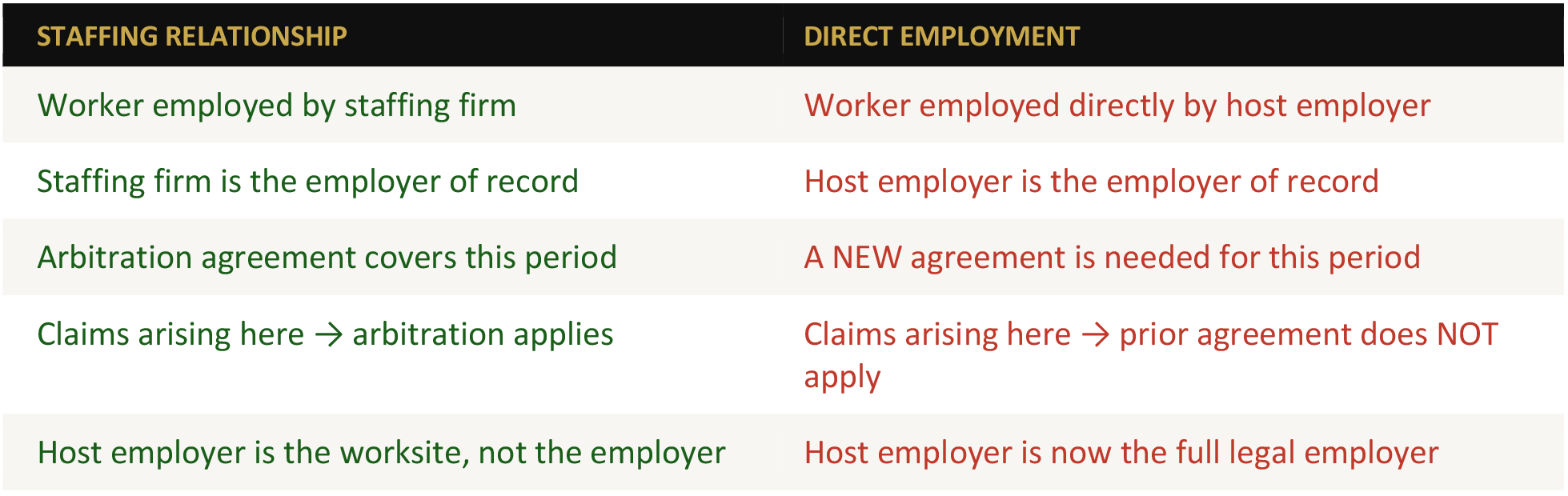
How This Ruling Exposes Both Staffing Firms and Host Employers
The Toothman ruling creates distinct exposure for both parties in the staffing-to-direct conversion structure. Understanding each party’s position helps determine the right response.
Host Employers
The most immediate exposure from this ruling falls on host employers. A host employer that converts a placed worker to direct hire without obtaining a standalone arbitration agreement has no arbitration defense for any claims arising from that direct employment period. This means any class or individual claim from a direct employee proceeds in court rather than in arbitration, with all the cost, discovery, and litigation risk that entails.
The ruling makes clear that equitable estoppel — the legal theory that would allow a non-party to enforce a contract — does not apply when the claims at issue arise from a different relationship than the one covered by the contract. Host employers cannot rely on creative legal theories to fill a gap that only a properly executed agreement can fill.
Staffing Firms
For staffing firms, the ruling creates a different but equally important concern. Your arbitration agreement protects your firm for disputes arising from your placement relationships. It does not, and cannot, extend to protect your host employer clients for what happens after the worker converts. If host employers believe your agreement covers post-conversion employment, they are operating under a dangerous misconception.
Staffing firms that send workers to host employers for potential direct hire conversion have a business interest in ensuring those conversions are legally sound. A host employer that faces a class action arising from a converted worker may look back at the staffing firm’s process for any contribution to the exposure. Having a documented conversion process that includes a standalone arbitration agreement protects both the relationship and the firm.
Quick Guide: 5 Steps to Close the Conversion Gap
These five steps apply to every staffing firm and every host employer that participates in direct hire conversion. They are straightforward to implement and the cost of not implementing them is a class action without an arbitration defense.
Audit Every Past Direct Hire Conversion
Identify every worker who converted from placement to direct hire at any host employer. Determine whether a standalone arbitration agreement was signed at the time of conversion. If not, assess your current exposure and consult employment counsel.
Add a Standalone Arbitration Agreement to Your Conversion Checklist
Every direct hire conversion must include a new, standalone arbitration agreement signed by the worker and the host employer at the time of conversion — not before, not after. Make this a required step that cannot be skipped or deferred.
Review the Scope Language in Your Current Staffing Agreements
Read what your current arbitration clause actually says. Know exactly what relationship it covers and what it excludes. Do not assume broad language extends to post-conversion employment. Courts will not make that assumption for you.
Require Host Employers to Execute Their Own Agreement at Conversion
Build into your temp-to-hire contracts a requirement that host employers obtain a signed standalone arbitration agreement at the time of any direct hire conversion. Make this a contractual obligation, not a recommendation.
Train Every Recruiter and Account Manager on Conversion Legal Requirements
The checklist is only effective if the people handling conversions follow it consistently. Train your team on what documents must be signed at conversion, why it matters, and what happens when the step is skipped.
Frequently Asked Questions
❓ Does this ruling apply outside California?
The Toothman decision is a California Court of Appeal ruling and is directly binding in California. However, the underlying legal principle — that arbitration agreements are contracts that bind only the parties and cover only the relationships described — applies in virtually every U.S. jurisdiction. Courts across the country interpret arbitration clauses narrowly. Any staffing firm or host employer that assumes a staffing agreement’s arbitration clause extends to post-conversion direct employment is taking a risk regardless of the state.
❓ Does it matter whether the arbitration agreement was signed by the worker and the staffing firm or the worker and the host employer?
Yes, it matters significantly. The Toothman ruling turned on the fact that the arbitration agreement was between the worker and the staffing firm, covering the staffing relationship. An agreement between the worker and the host employer, signed at the time of direct hire conversion, would cover the direct employment relationship and provide the protection the host employer in Toothman lacked.
❓ What is equitable estoppel and why didn’t it work in Toothman?
Equitable estoppel is a legal doctrine that can allow a non-signatory to enforce a contract in certain circumstances — typically when the party seeking to benefit from the contract also relies on it to make claims. The Toothman court rejected equitable estoppel because the worker’s claims arose from direct employment at the host employer, not from the staffing agreement. The worker was not relying on the staffing agreement to assert her claims, so the host employer could not use it to compel arbitration.
❓ Can we add language to our staffing agreement to extend the arbitration clause to direct hire conversions?
Attempting to draft arbitration language that purports to cover post-conversion direct employment creates its own risks. Courts may still find it unenforceable for the same reason — the agreement is between the worker and the staffing firm, not the host employer. The cleanest and most defensible approach is a separate, standalone arbitration agreement signed by the worker and the host employer at the time of direct hire conversion.
❓ What should a standalone direct hire arbitration agreement include?
A standalone direct hire arbitration agreement should clearly identify the parties — the worker and the host employer — describe the scope of covered claims arising from the direct employment relationship, include any class and collective action waiver language required in your jurisdiction, comply with applicable federal and state arbitration law requirements, and be signed and dated at the time of conversion. Employment counsel in the relevant jurisdiction should review any arbitration agreement before use.
The Bottom Line
Arbitration agreements are contracts. They bind the parties who signed them and cover the relationships those parties agreed to arbitrate. When a worker moves from a staffing placement to direct employment, a new legal relationship begins — and that new relationship requires its own documentation.
The Toothman ruling is a direct instruction to every staffing firm and host employer: audit your conversions, update your process, and make a standalone arbitration agreement a non-negotiable step in every direct hire conversion. The cost of getting this right is minimal. The cost of getting it wrong is a class action proceeding without the protection you thought you had.
Do your direct hire conversions include a standalone arbitration agreement?
Staffing insurance and risk management specialists. Free coverage review.