
Pay-As-You-Go Workers’ Comp for Staffing Firms: $0 Down, Half the Audit Variance, Twice as Fast
Most staffing firms don’t know that Pay-As-You-Go Workers’ Compensation exists. Those that do often assume it’s only for small employers. The reality is different: PAYG WC is one of the most financially intelligent structures available for staffing firms of any size — eliminating the large upfront deposit, tying premium to actual payroll, and delivering half the audit variance at twice the speed of traditional billing.
What Is Pay-As-You-Go Workers’ Compensation?
Pay-As-You-Go Workers’ Compensation — also called PAYG WC or pay-per-payroll WC — is a billing structure that calculates your Workers’ Comp premium based on your actual payroll each pay period rather than an annual estimate. Instead of paying a large deposit upfront and reconciling at year-end, your premium is drawn automatically each time you run payroll.
THE CORE DIFFERENCE
Traditional WC: Pay a large upfront deposit based on estimated annual payroll. Reconcile at year-end audit. Hope the estimate was close. Pay the difference — or wait months for a refund. Pay-As-You-Go WC: $0 upfront deposit. Premium calculated on real payroll data each cycle. No estimate. No gap. No surprise.
For staffing firms, the structural fit is obvious once you understand the problem. Staffing payrolls are among the most volatile in any industry — seasonal spikes, new contract wins, client losses, and workforce fluctuations can move payroll by 30%, 50%, or more within a single policy year. Traditional WC is built on an estimate that is almost certain to be wrong.
The Audit Advantage: Half the Variance, Twice the Speed
The most compelling data point supporting PAYG WC comes from WorkFirst Casualty Company’s own analysis of their insured portfolio: employers who report payroll by customer or pay period have, on average, half the audit variance and receive their audit results twice as fast compared to those on traditional billing.

Why the Audit Is Better With PAYG
With traditional WC, the year-end audit is a reconciliation exercise: the carrier compares the payroll estimate you gave them 12 months ago against what actually happened. For staffing firms, that gap is almost always significant. The more your payroll fluctuated, the larger the variance — and the larger your surprise audit bill or refund.
With PAYG, your actual payroll data flows to the carrier every cycle. By the time the annual audit arrives, the carrier already has 12 months of real payroll data on file. There is no estimate to reconcile. Variance shrinks dramatically because the premium was always based on real numbers, not projections.
The faster audit timeline is a direct consequence: when data is already current, the audit closes faster. PAYG insureds receive audit results in half the time — which means faster cash flow resolution and dramatically less administrative burden at year-end.
The Cash Flow Case for Staffing Firms
The financial argument for PAYG begins with one number: the upfront deposit. Traditional Workers’ Comp typically requires a deposit equal to 25% to 33% of your estimated annual premium before coverage even begins. For a growing staffing firm, that deposit can run into six figures.
A staffing firm with $2 million in estimated annual WC premium carries a traditional deposit of $500,000 to $660,000 sitting with the carrier rather than in the business. That capital cannot be used to hire recruiters, fund payroll gaps between client payment cycles, invest in technology, or fund business development.
PAYG eliminates that deposit entirely. Coverage starts at $0 down. The working capital that would otherwise be held by the carrier stays in the business.
Premiums That Scale With Your Actual Business
Staffing firm revenue is inherently variable. When payroll grows because you win a new contract, your PAYG premium adjusts automatically. When payroll shrinks because you lose a client or experience seasonal slowdown, your premium adjusts automatically in the other direction. No mid-term endorsements. No penalties for growth. No delayed reconciliation.
With traditional WC, winning a large new contract mid-year creates a premium problem: your estimate is locked, you are underreporting payroll, and the audit will catch the gap. PAYG eliminates that exposure entirely.
Eliminating the Year-End Audit Surprise
The year-end audit surprise is the most consistent complaint we hear from staffing firm owners about their Workers’ Comp policies. A five-figure unexpected invoice arriving in January — after a strong year of revenue growth — is a cash flow shock that affects the entire business.
With PAYG, the audit closes with near-zero variance because the estimate-versus-actual gap has been eliminated at every payroll cycle. The audit is effectively done before it starts. The invoice, when it arrives, is a formality rather than a shock.
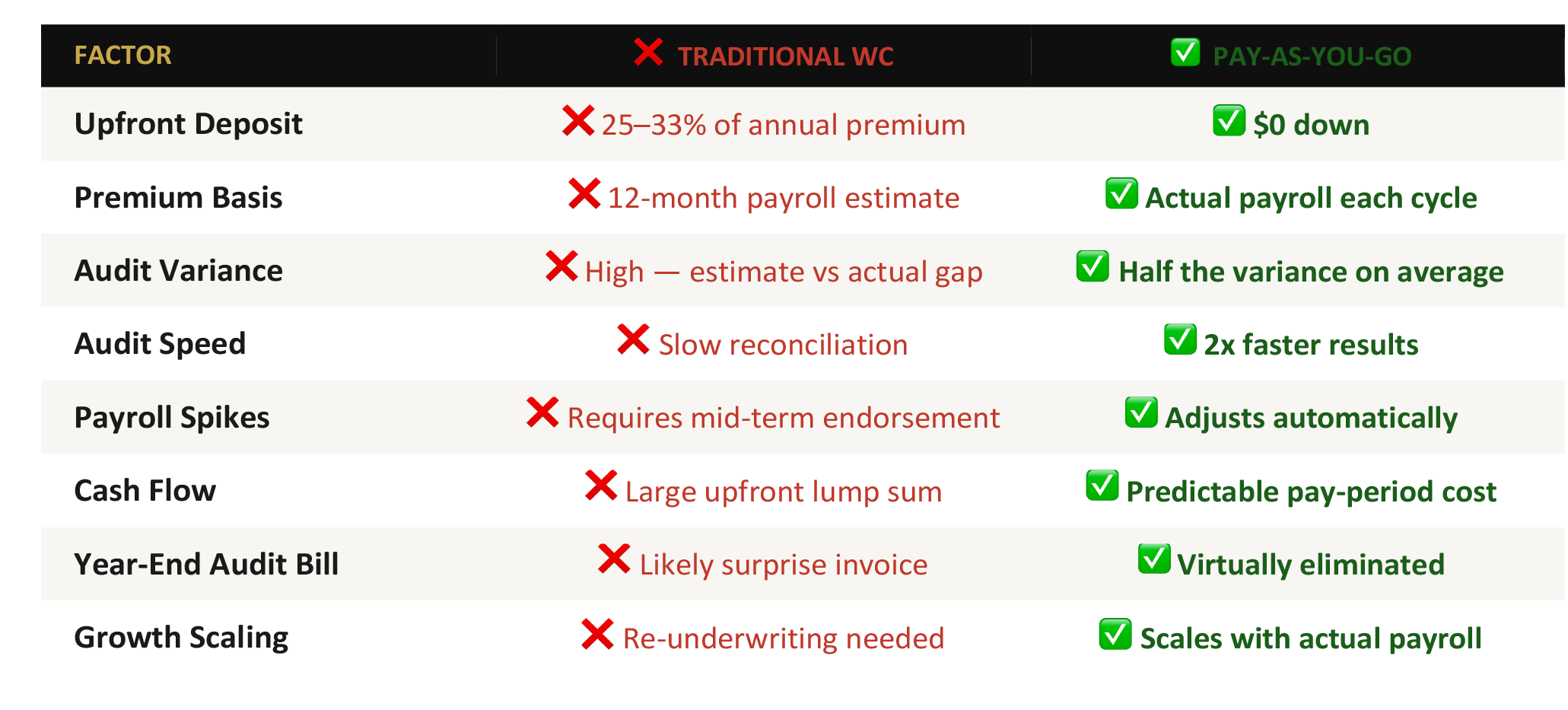
Traditional WC vs Pay-As-You-Go: Side by Side
This comparison applies specifically to staffing firms — where payroll volatility makes the traditional model particularly mismatched.
5 Questions Every Staffing Firm Should Ask Before Their Next WC Renewal
Use these questions to evaluate whether PAYG is the right structure for your firm.
How large is your current WC upfront deposit? If your deposit represents more than 25% of your estimated annual premium, you are tying up significant working capital that PAYG would return to your business.
How much did your payroll vary from your WC estimate last year? If you received a large surprise audit bill or waited months for a refund, the estimate-to-actual gap is a structural problem that PAYG directly solves.
Do you expect significant payroll fluctuation in the next 12 months? New contracts, seasonal patterns, or planned growth make traditional WC estimates particularly unreliable. PAYG adjusts in real time.
How much administrative time does your year-end WC audit consume? Faster audit closure means less staff time on reconciliation, disputes, and documentation. PAYG consistently delivers results in half the time.
Is your current WC carrier integrated with your payroll system? PAYG works most efficiently when your payroll system feeds premium calculations directly. Ask your broker whether your current carrier or a PAYG-capable carrier can integrate with your payroll platform.
Frequently Asked Questions
❓ Is Pay-As-You-Go Workers’ Comp available for staffing firms of all sizes?
PAYG WC is available to a broad range of employers including staffing firms. Eligibility varies by carrier and state, and typically depends on your payroll system’s ability to integrate with the carrier’s payment platform. Your broker can identify which carriers offer PAYG programs that match your payroll and coverage needs.
❓ Does PAYG WC cost more than traditional billing?
The premium rate itself is typically the same under PAYG as under traditional billing — you are paying the same per-$100-of-payroll rate. The difference is in how and when premium is collected. The financial benefit comes from eliminating the deposit, reducing audit variance, and aligning cash outflows with actual payroll activity.
❓ What happens if my payroll fluctuates significantly during the year?
That is precisely what PAYG is designed for. Each payroll cycle reports actual wages and class codes, and premium adjusts accordingly. A spike in payroll triggers a higher premium draw for that cycle. A slow period produces a lower draw. There is no annual reconciliation of a locked estimate against actual activity.
❓ How does the audit process work under PAYG?
Because your actual payroll data has been reported to the carrier every pay period throughout the year, the year-end audit has minimal reconciliation work to do. The carrier’s audit team can verify that reported payroll matches payroll records without the estimate-versus-actual analysis required under traditional billing. This is why PAYG insureds receive audit results approximately twice as fast.
❓ Does PAYG work for multi-state staffing operations?
PAYG programs can generally accommodate multi-state operations, though the complexity increases with the number of states involved and the carrier’s licensing footprint. Discuss your specific state mix with your broker to confirm PAYG availability and premium allocation requirements for each jurisdiction.
The Bottom Line
Pay-As-You-Go Workers’ Comp is not a niche product for small employers. It is a billing structure that addresses the specific structural mismatch between traditional WC and staffing firm operations. The combination of $0 upfront deposit, real-time premium alignment with actual payroll, half the audit variance, and twice the audit speed makes PAYG the most financially rational WC structure for most staffing firms.
The firms that are still writing large deposit checks against 12-month payroll estimates are leaving working capital on the table and accepting audit variance they do not have to accept. The firms that have moved to PAYG have eliminated both problems — and freed up capital to invest in growth.