
Why Host Employers Need the Alternate Employer Endorsement
On October 7, 2026, the North Carolina Court of Appeals revived a temporary worker’s negligence lawsuit against the company where he was placed — in a 2-1 decision that should make every business using staffing labor re-read its service agreement. Johnson Concrete Company argued it was the worker’s employer, which would have made workers’ compensation his exclusive remedy and ended the case. The court disagreed. The reason is the part that matters: the company had no contract of hire with him, and its own corporate representative testified under oath that he was not their employee, drew no wages from them, and was not on their workers’ compensation policy. Everything the staffing agency did correctly is precisely what left the host company exposed. This is the gap the alternate employer endorsement exists to address, and most host employers do not know whether they have one.
Quick Answer: Can a Temporary Worker Sue the Company Where They Were Placed?
QUICK ANSWER
Often, yes. Workers’ compensation is the exclusive remedy against a worker’s employer, but a host company (the client where a staffing agency places the worker) is only protected by that exclusivity if it qualifies as an employer under state law. In North Carolina and many other states, the threshold requirement is a contract of hire — express or implied — between the worker and the host company. Where the staffing agency alone hires, pays, insures and employs the worker, and the host company merely directs the work, courts may find no contract of hire and allow a negligence suit to proceed against the host. That is what the North Carolina Court of Appeals held on October 7, 2026 in Jefferson v. Johnson Concrete Co. Host employers who want the protection of comp exclusivity need the employment relationship documented in advance — in the staffing service agreement and through an alternate employer endorsement on the staffing agency’s workers’ compensation policy.
What Happened in Jefferson v. Johnson Concrete?
In March 2022, Labor Finders placed Robert Jefferson at Johnson Concrete Company, a concrete manufacturer. Roughly two months later, a Johnson Concrete employee directed him to clean dried cement from the blades of a cement mixer. His right arm was caught beneath a blade. He sustained extensive injuries to his arm, wrist and hand.
He did two things. He filed a workers’ compensation claim against Labor Finders, the staffing agency that employed him. And he filed suit in Rowan County Superior Court against Johnson Concrete for negligence, gross negligence and punitive damages.
Johnson Concrete moved for summary judgment on jurisdictional grounds, arguing that it was also Jefferson’s employer and that the Workers’ Compensation Act therefore barred the civil suit. The trial court agreed and granted partial summary judgment. On October 7, 2026, the Court of Appeals reversed 2-1 and remanded the negligence claims for further proceedings.
IMPORTANT — WHAT THIS RULING DID AND DID NOT DECIDE
The Court of Appeals decided a jurisdictional question only: whether the Workers’ Compensation Act bars the lawsuit. It did not find Johnson Concrete negligent, and it did not award anything. The negligence, gross negligence and punitive damages claims have not been adjudicated and now return to the trial court. The significance for risk managers is not the outcome of the case — it is that the host employer lost the defense it assumed it had.
Why Did the Host Employer Lose Its Workers’ Compensation Immunity?
North Carolina recognizes two dual-employment doctrines that can extend comp exclusivity to a second company: joint employment and the lent employee (borrowed servant) doctrine. Both share a threshold requirement. There must be a contract of hire — express or implied — between the worker and the company claiming employer status. Control over the work alone does not create one.
Johnson Concrete conceded there was no express contract of hire. So the case turned entirely on whether an implied one existed. Here is how the two companies actually divided the relationship:
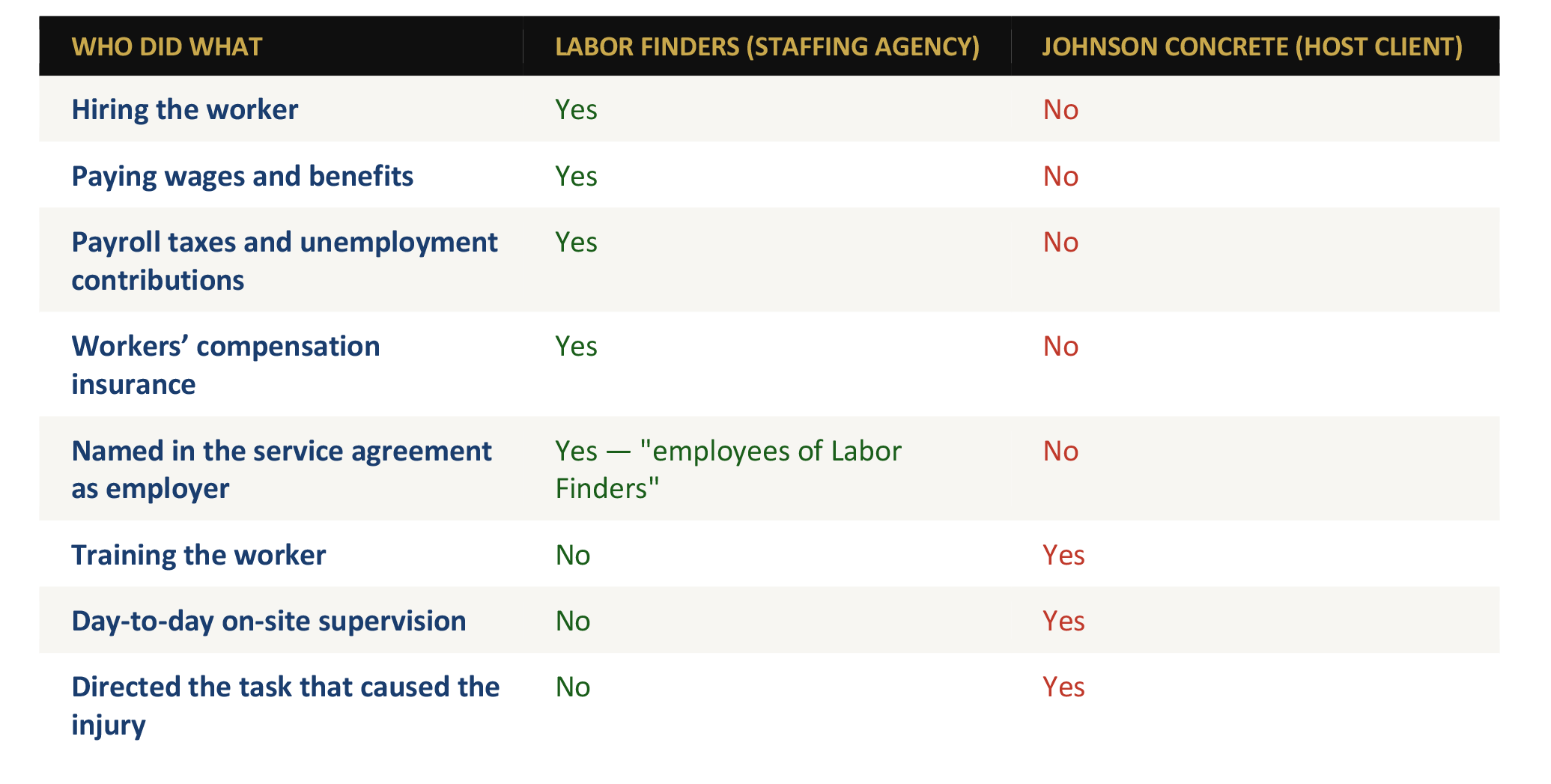
The majority found that the first six rows outweighed the last three. Supervision and training, without a contract of hire, were not enough to make Johnson Concrete an employer for workers’ compensation purposes.
The Deposition Testimony That Decided the Case
The detail every risk manager should sit with: Johnson Concrete’s own corporate representative, testifying on the company’s behalf, confirmed that Jefferson was not a Johnson Concrete employee, that he received no wages or benefits from the company, that he was not covered under its workers’ compensation policy, and that the company’s comp premiums were unaffected by his injury.
Every one of those answers was factually correct. Every one of them was also the opposite of what the company needed to establish employer status. The company spent the deposition proving it was not the employer, then asked the court to rule that it was.
This is the practical lesson. A company cannot treat a placed worker as somebody else’s employee for payroll, benefits, tax and insurance purposes and then claim employer status only when a lawsuit makes that status valuable. Courts look at what the paperwork and the testimony say, not at what is convenient after an injury.
How Close Was It? The Dissent
One vote. The dissenting judge would have found an implied contract of hire based on two things: the service agreement’s provisions assigning training and supervisory responsibility to Johnson Concrete, and the fact that the hiring clause stated the workers "are employees of Labor Finders" without ever saying "exclusively."
That is a single missing adverb carrying real weight in a dissent. It is also a reminder that these outcomes are contract-drafting outcomes as much as they are legal doctrine. The language in the staffing service agreement is not boilerplate. In this case it was the evidence.
The Tension Nobody Talks About: Clean Staffing Practice Strips Host Immunity
Here is what makes this ruling genuinely uncomfortable. Everything Labor Finders did was correct. It hired the worker, paid him, withheld his taxes, carried his workers’ compensation, and documented in writing that he was its employee. That is exactly how a professional staffing agency should operate, and it is what every client, auditor and carrier asks for.
And it is precisely why the host company lost its immunity. The cleaner the staffing agency’s employment relationship, the weaker the client’s claim to be a co-employer. The two interests pull in opposite directions, and almost nobody addresses it until a serious injury forces the question.
That is the gap. It is not closed by operating sloppily — nobody should blur payroll or comp coverage to manufacture a co-employment argument. It is closed by documenting the arrangement deliberately in two places before anyone gets hurt: the service agreement and the workers’ compensation policy.
What Is the Alternate Employer Endorsement and Why Does It Matter Here?
Alternate Employer Endorsement (WC 00 03 01 A)
The endorsement that names the client as an employer on the staffing agency’s workers’ compensation policy.
The alternate employer endorsement is attached to the staffing agency’s workers’ compensation and employers liability policy and schedules a specific client as an alternate employer for the workers placed there. Where it applies, the agency’s policy responds for that client as though the client were the insured employer for injuries to those placed workers — which is the structural support for the client’s claim to exclusive-remedy protection. It is scheduled per client; a policy that merely has the capability to issue one does nothing until the endorsement actually names the account.
Read the Johnson Concrete deposition again with that in mind. "He was not on our workers’ compensation policy. Our premiums were unaffected." Those answers were true, and they helped sink the company’s position. A scheduled alternate employer endorsement changes the factual record those questions are answered from.
Whether any specific endorsement would alter the outcome in any specific case is a question for the carrier and for counsel — coverage is determined under the policy as issued, not by a blog. What is not in question is that most host employers have never asked whether their staffing vendors have scheduled them, and most never check the certificate for it.
What This Means If You Are a Host Employer (the Client)
• Workers’ compensation exclusivity is not automatic protection just because the injured person was a temp. It depends on whether you qualify as an employer under your state’s test.
• Your exposure if it fails is a civil suit with no statutory cap — here, negligence, gross negligence and punitive damages. Punitive damages are uninsurable in many states, which means that portion is paid out of the business.
• Ask every staffing vendor whether your company is scheduled on an alternate employer endorsement, and ask for the certificate to show it.
• Review the hiring and employment-status language in the service agreement. The dissent in this case turned on one missing word.
• Align what your corporate representative would say in a deposition with what your contract says. If those two diverge, the contract is the one that will be read aloud.
• Check your general liability program for how it treats bodily injury to a staffing vendor’s workers, and raise it with your broker before you need the answer.
What This Means If You Are a Staffing Agency
• Expect the question. Clients that read this ruling will start asking to be scheduled on your alternate employer endorsement, and sophisticated ones will make it a condition of the contract.
• Know whether your workers’ compensation carrier will issue AEEs and on what terms. A staffing WC program without AEE capability is an incomplete program.
• Re-read the indemnity and hold-harmless clauses in your client agreements. When a host employer loses comp immunity and faces a tort claim, the indemnity clause is the next document its lawyers open — and many staffing agreements obligate the agency to defend the client.
• Confirm whether your policies respond to contractual indemnity obligations you have accepted, and at what limit. Review it with your broker rather than assuming.
• Document who owns site safety, equipment lockout and task-specific training in the service agreement. In this case the injury happened cleaning machinery at the client’s direction.
• Your experience mod carries the claim either way. The agency’s comp policy paid here. Severe machine-guarding injuries are high-severity losses that follow you through renewals for three years.
How This Connects to Your Mod and Your Next Renewal
The staffing agency’s workers’ compensation policy absorbed this claim, and a serious crush injury to an arm, wrist and hand is a severity loss that will sit in the experience period and influence the mod at renewal. Meanwhile the host employer, whose premiums were explicitly unaffected by the injury, is now the defendant in a tort suit. The economics of that split are worth understanding before you negotiate your next client contract: the agency carries the insured cost of the injury, and the client carries the uninsured one.
That is the honest argument for getting the documents right. Not because the paperwork prevents injuries — it does not — but because it determines who pays for them and under which policy.
Frequently Asked Questions
Q: Can a temp worker sue the company where they were placed?
In many cases, yes. Workers’ compensation is the exclusive remedy against the worker’s employer, but a host company is protected only if it qualifies as an employer under state law. In North Carolina the threshold is a contract of hire, express or implied. In Jefferson v. Johnson Concrete Co. (N.C. Ct. App., October 7, 2026), the court found no contract of hire and allowed the negligence suit against the host company to proceed.
Q: What is the lent employee or borrowed servant doctrine?
It is the rule that a worker employed by one company can become the employee of a second company for workers’ compensation purposes when placed under that company’s direction. In North Carolina, both the lent employee and joint employment doctrines require a threshold contract of hire between the worker and the second company. Supervision and control alone are not sufficient.
Q: What is an alternate employer endorsement?
An alternate employer endorsement is attached to a staffing agency’s workers’ compensation and employers liability policy and schedules a specific client as an alternate employer for workers placed at that client. Where it applies, the agency’s policy responds for the scheduled client for injuries to those placed workers. It must name the client; general capability to issue one is not the same as having one in force.
Q: Does workers’ compensation always protect a company from being sued by a temp worker?
No. Exclusive remedy protects employers. A host company that is not the worker’s employer under state law does not receive that protection and can be sued in tort. That is the central holding of the Jefferson decision.
Q: What did the Jefferson v. Johnson Concrete decision actually hold?
The North Carolina Court of Appeals held 2-1 on October 7, 2026 that no express or implied contract of hire existed between the worker and Johnson Concrete, so neither the joint employment nor the lent employee doctrine barred his suit. It reversed summary judgment and remanded the negligence claims. The court did not rule on negligence itself.
Q: Are punitive damages covered by insurance?
It varies by state and by policy. Many states prohibit insuring punitive damages as a matter of public policy, and many policies exclude or limit them. A host employer facing a punitive damages claim should assume that portion may be uninsured and confirm the position with its carrier and counsel.
Q: What should a host employer ask its staffing vendor after this ruling?
Three questions: Are we scheduled on your alternate employer endorsement, and can you show it on the certificate? What does our service agreement say about employment status, training and supervision? And who is contractually responsible for site safety and equipment procedures for your placed workers?
The Bottom Line
A company that uses temporary labor assumed it had the protection every employer has, found out on appeal that it did not, and is now defending negligence, gross negligence and punitive damages claims arising from a machine injury. The decision came down to documents and sworn testimony, not to who happened to be supervising on the day.
For staffing agencies, the takeaway is that the alternate employer endorsement and the indemnity clause are now client-facing sales issues, not back-office paperwork. For host employers, it is that you may be carrying an uninsured tort exposure on every temp worker on your floor without knowing it.
Akker places workers’ compensation and specialty coverage for staffing agencies nationwide, including alternate employer endorsement structuring and review of client service agreements against the coverage actually in force. If nobody has read your service agreement and your comp policy side by side, that review is free.