
California Workers’ Comp Just Posted a 127% Combined Ratio
The Workers’ Compensation Insurance Rating Bureau of California (WCIRB) released its latest state-of-the-system report this week, and the headline number is one the California workers’ comp market has not seen in more than twenty years: a projected combined ratio of 127% for accident year 2025. Carriers paid out $1.27 in claims and expenses for every $1.00 of premium they collected. That is the fifth straight year above 110%. Claim frequency is up again. Litigation costs are up double digits. Claims are closing more slowly. And for the first time in a decade, the average rate employers actually pay has stopped falling. For staffing agencies with California payroll, one line in the report matters more than all the others — cumulative trauma claims now make up more than a quarter of all indemnity claims, and the bureau describes them exactly the way a staffing owner would describe an end-of-assignment claim.
Quick Answer: Are California Workers’ Comp Rates Going Up in 2026 and 2027?
QUICK ANSWER
The pressure is clearly upward. According to the WCIRB report released in October 2026, California workers’ compensation carriers posted a projected 127% combined ratio for accident year 2025, the worst result in more than 20 years, and have now run underwriting losses above 110% for five straight years. The average charged rate rose to $1.64 per $100 of payroll in the first half of 2026 after a decade of declines, and the Insurance Commissioner approved a 6.6% advisory pure premium rate increase effective September 1, 2026, following an 8.7% increase the year before. Advisory rates are not the rates any specific employer pays — carriers file their own — but five years of losses at this level mean carriers must either raise rates, tighten underwriting, or leave classes of business. For staffing agencies, the most important driver is the growth of cumulative trauma claims to more than 25% of indemnity claims, many filed after termination, which is a direct end-of-assignment exposure.
What Did the WCIRB Report Actually Say?
The WCIRB is the licensed rating organization for California workers’ compensation. It collects loss and payroll data from every carrier writing in the state and advises the Insurance Commissioner on pure premium rates. Its periodic reports are the closest thing the California market has to a single scoreboard. The October 2026 report, covered by Business Insurance on October 9, 2026, lays out the following:
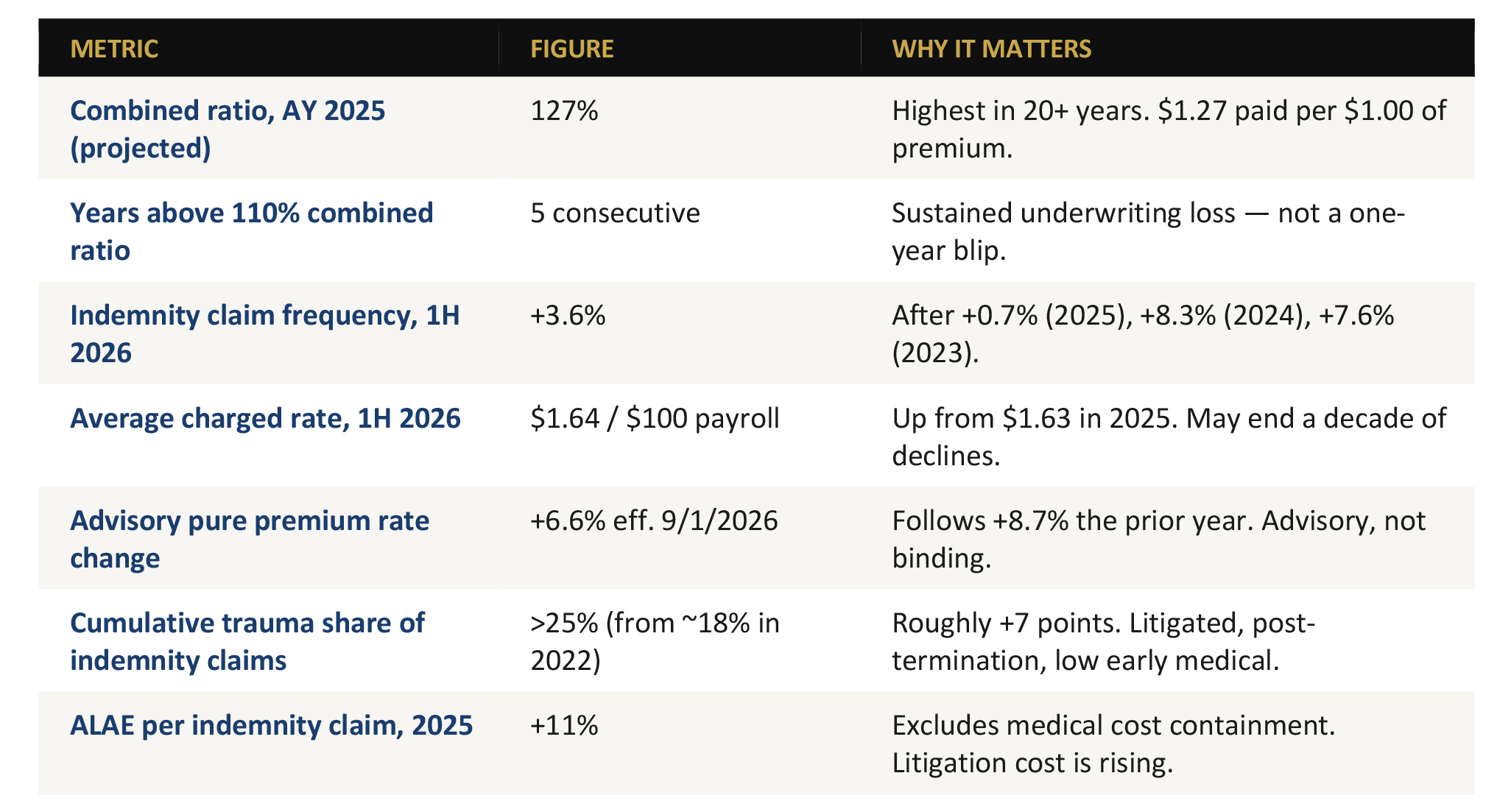
WHAT A COMBINED RATIO IS
A combined ratio adds a carrier’s losses and expenses together and divides by premium. Below 100% is an underwriting profit. Above 100% is an underwriting loss. At 127%, a carrier loses 27 cents on every premium dollar before investment income. No carrier sustains that indefinitely. The market corrects through some combination of higher rates, stricter underwriting, fewer carriers willing to write certain classes, and tighter terms on the policies that remain.
Why Has the Average California Comp Rate Stopped Falling?
For roughly ten years, California employers enjoyed steadily declining workers’ compensation rates. That was the legacy of the SB 863 reforms, falling frequency, and a competitive carrier market. The first half of 2026 shows the average charged rate at $1.64 per $100 of payroll, up a penny from 2025. A one-cent move sounds trivial. It is not. It is the first time the direction has changed in a decade, and it is happening while the advisory rate has risen 8.7% and then 6.6% in consecutive years.
The gap between a 6.6% advisory increase and a one-cent move in charged rates tells you carriers have been absorbing the loss rather than passing it through — competing for market share on price while their combined ratios ran well above 110%. The WCIRB report is, in effect, a statement that this cannot continue. The question for employers is not whether rates rise, but how much, how fast, and for which classes of business first.
What Is a Cumulative Trauma Claim and Why Does It Matter for Staffing?
Cumulative Trauma (CT) Claim
An injury alleged to result from repetitive activity over time rather than a single identifiable event.
Under California Labor Code §3208.1, a cumulative injury is one occurring as repetitive mentally or physically traumatic activities extending over a period of time, the combined effect of which causes disability or need for medical treatment. A CT claim does not require an accident, an incident report, or a witness. It requires a worker, a doctor, and — very often — an attorney. The WCIRB report notes that the growth in CT claims includes claims that are litigated, claims filed after the worker’s termination, and claims with little early paid medical activity. CT claims rose from about 18% of California indemnity claims in 2022 to over 25% today.
Read that bureau description again, slowly: litigated, filed after termination, little early medical treatment. Now describe a staffing agency’s worst claim. The temp finishes a placement — or is let go by the client — and three weeks later a law firm files an application alleging a cumulative back, shoulder or wrist injury from the work. There was no incident. There was no first report. There was no medical visit while the worker was on assignment. The claim lands on the staffing agency’s policy because the agency is the employer of record, for work performed at a client site the agency did not supervise.
Every placement ends. That is the structural reason staffing agencies carry more post-termination exposure per dollar of payroll than almost any other class. A manufacturer terminates a small percentage of its workforce in a year. A staffing agency ends hundreds or thousands of assignments. Each one is a potential CT filing window.
WHAT THE REPORT DOES NOT SAY
The WCIRB report does not break out results by industry or mention staffing agencies specifically. The connection between the CT claim profile and end-of-assignment exposure is Akker’s analysis, not the bureau’s finding. It is consistent with how post-termination claims have long behaved in staffing books, but no one should read the report as singling out the staffing class.
How Do Rising Litigation Costs Hit Staffing Agencies Differently?
Allocated loss adjustment expense — the cost of defending and adjusting a specific claim, principally attorney fees and medical-legal evaluations — rose 11% per indemnity claim in 2025. The bureau also reports claims closing more slowly, which it attributes in part to CT claims, litigation and more medical-legal services.
A litigated CT claim is expensive in a way that compounds for staffing agencies:
• The agency usually cannot produce the facts a defense needs — who supervised the worker, what the job physically required, whether the worker complained — because those facts live at the client site.
• Post-termination filings are presumptively harder to defend under Labor Code §3600(a)(10) only if the agency can show it had no notice of the injury before the termination. That requires documentation the agency may not have kept.
• Reserves on open litigated claims sit in the experience rating window for three years. A slow-closing CT claim affects the mod at every renewal until it resolves.
• Medical-legal evaluations (QME/AME) add cost and months to every disputed claim. The bureau names them as a driver of slower closures.
What Do California Staffing Agencies Need to Do Now?
The report describes a market, not a sentence. Agencies that act before rates move have real leverage; agencies that wait for the renewal quote do not. Six moves, in order of impact:
Document Every End of Assignment
The single highest-value control against post-termination CT claims.
At the end of every California placement — whether the assignment ended naturally, the client released the worker, or the agency ended it — record the date, the reason, and a signed or electronically acknowledged statement from the worker confirming whether they have any work-related injury or complaint. This is the evidence that supports a §3600(a)(10) post-termination defense and the evidence most agencies cannot produce when the application arrives.
Require Incident Reporting From Clients in the Service Agreement
Shift the facts you need onto the party that has them.
Put a clause in every California client agreement requiring the client to report any injury, complaint of pain, or modified-duty request involving a placed worker within 24 hours, and to preserve supervision and job-task records. Without it, the agency defends CT claims blind.
Audit Your Open Claims and Reserves Before Renewal
Reserves on slow-closing litigated claims are what the underwriter sees.
Pull loss runs now, not at renewal. Identify every open litigated CT claim, challenge stale reserves with the adjuster, push for closure or settlement where appropriate, and get the reserve picture cleaned up before it is valued for the experience mod. A claims review with the carrier is free; a bad mod is not.
Know Your Class Codes and State Mix
A $1.64 statewide average hides a very wide range.
Staffing agencies in California are rated on the class codes of the work performed at the client, not a single staffing code. Confirm every placement is in the correct code, confirm the payroll split between California and other states is accurate, and verify the carrier has the right governing class. Misclassification in a rising-rate market is paid for twice — at audit and at renewal.
Build the Return-to-Work Program Clients Will Actually Use
Open indemnity claims are what drive frequency and severity numbers.
A placed worker on temporary disability with no modified-duty option is an open indemnity claim with a running clock. Negotiate modified-duty availability into client agreements, or maintain alternative light-duty assignments within the agency. Converting an indemnity claim to medical-only changes how it is weighted in the mod.
Market the Account Early and Tell the Story
Underwriters price what they can see.
An agency that walks into renewal with documented end-of-assignment procedures, client incident-reporting clauses, a clean reserve review and a return-to-work program is a different risk from one that submits payroll and loss runs and hopes. In a market where carriers are losing 27 cents on the dollar, the agencies that can prove they manage CT exposure are the ones that keep competitive terms.
What This Means for Non-California Staffing Agencies
California is the largest workers’ compensation market in the country and tends to lead the cycle. The pattern the WCIRB describes — frequency creeping back up, litigation costs rising, cumulative and post-termination claims growing as a share of the book — is not unique to California even if California’s legal environment makes it more acute. Agencies placing workers in multiple states should treat the report as an early signal and apply the same end-of-assignment documentation discipline everywhere, because it costs nothing and it is the one control that works in every jurisdiction.
Frequently Asked Questions
Q: What is the WCIRB and what does its report mean for my premium?
The Workers’ Compensation Insurance Rating Bureau of California is the licensed rating organization that collects loss and payroll data from all California workers’ compensation carriers and advises the Insurance Commissioner on advisory pure premium rates. Its reports describe the health of the overall market. They do not set your premium — your carrier files its own rates — but when the bureau reports a 127% combined ratio and five straight years of underwriting losses, carriers across the market respond with higher rates, tighter underwriting, or both.
Q: What is a 127% combined ratio in workers’ compensation?
A combined ratio is losses plus expenses divided by premium. At 127%, California workers’ comp carriers paid out $1.27 in claims and expenses for every $1.00 of premium collected in accident year 2025, according to the WCIRB. It is the highest combined ratio the state has seen in more than 20 years and the fifth consecutive year above 110%.
Q: Does a 6.6% advisory pure premium rate increase mean my California comp premium goes up 6.6%?
No. The advisory pure premium rate approved by the Insurance Commissioner is a benchmark for the loss cost of each class code. Carriers file their own rates and apply their own pricing, and an individual employer’s premium also reflects its experience modification, payroll, class mix and any schedule credits or debits. The advisory increase signals the direction of the market, not a specific employer’s outcome.
Q: What is a cumulative trauma claim?
Under California Labor Code §3208.1, a cumulative injury results from repetitive physically or mentally traumatic activities over time rather than from a single incident. CT claims often have no incident report and are frequently filed with an attorney. The WCIRB reports that CT claims grew from about 18% of California indemnity claims in 2022 to more than 25%, and that this growth includes litigated claims, claims filed after termination, and claims with little early medical treatment.
Q: Why are cumulative trauma claims a bigger problem for staffing agencies?
Because every staffing placement ends, and post-termination filings are a recognized CT claim pattern. A staffing agency may end hundreds or thousands of assignments a year, each creating a window for a post-termination claim against the agency’s policy for work performed at a client site the agency did not supervise. The agency often lacks the supervision and job-task records needed to defend the claim unless it has contractually required them from the client.
Q: Can a California employer defend a workers’ comp claim filed after the worker was terminated?
California Labor Code §3600(a)(10) provides a defense to claims filed after notice of termination or layoff, subject to several exceptions — including where the employer had notice of the injury before the termination, where medical records predating the termination document the injury, or where the date of injury is after the termination date. The defense depends heavily on what the employer can document about the end of the employment relationship. Whether it applies in any specific claim is a question for the carrier and defense counsel.
Q: How does a staffing agency lower its California workers’ comp costs in a rising market?
Document every end of assignment, require clients to report incidents and preserve job records, audit open claims and reserves before renewal, verify class codes and state payroll splits, build a return-to-work program clients will use, and market the account early with that story in hand. Underwriters in a loss-making market price the controls they can see.
The Bottom Line
The WCIRB has told the California market, in numbers, that the decade of falling rates is over. A 127% combined ratio, five years of underwriting losses, rising frequency and 11% growth in litigation cost per claim leave carriers no room to keep absorbing it. Rates follow losses.
For staffing agencies, the report is more specific than it looks. The growth of cumulative trauma claims — litigated, post-termination, light on early medical — is the growth of the end-of-assignment claim. That exposure is structural to the staffing model, and it is also the most controllable, because the defense is documentation the agency can start keeping tomorrow.
Akker places workers’ compensation and specialty coverage for staffing agencies nationwide, including California, and reviews end-of-assignment procedures, client agreements and open-claim reserves against the coverage actually in force. If nobody has looked at your California loss runs through the lens of this report, that review is free.