
Workers’ Comp Renewal 2027: What Every Business Owner Needs to Know Before January 1
January 1, 2027 is the most common workers’ compensation renewal date in the country. Across every industry -- construction, manufacturing, healthcare, retail, transportation, home services, and beyond -- millions of business owners will receive a WC renewal notice in the next 90 days. Most of them will do nothing until December. That decision costs money. Workers’ comp renewal is not a passive process where your carrier rolls your policy forward and you sign off. It is an annual underwriting decision that rewards preparation and punishes procrastination. This guide walks through exactly what happens at WC renewal, what documents you need, what the timeline should look like, and how to position your business for the most competitive outcome when January 1 arrives.
What Actually Happens at Workers’ Comp Renewal
Most business owners think of WC renewal as an automatic process -- the carrier sends a notice, the premium goes up or down by some percentage, and the policy rolls forward. That is not what is actually happening.
At renewal, your carrier’s underwriter reviews your account from scratch. They look at your updated payroll, your class codes, your loss history for the expiring year, and your experience modification rate. They assess whether your premium reflects the actual risk your business presents. If your losses have been high, they may surcharge the policy, add exclusions, or decline to renew. If your losses have been favorable, the renewal is an opportunity to negotiate better terms -- but only if you are positioned to shop the market and have competing options to compare.
THE SINGLE MOST IMPORTANT THING TO UNDERSTAND ABOUT WC RENEWAL
Your current carrier is not automatically your best option at renewal. WC carriers re-underwrite your account every year. A carrier that wanted your business three years ago may be exiting your industry this year. A carrier that declined you two years ago may be aggressively competing for your class now. The only way to know whether you are getting competitive pricing is to shop the market with a complete submission -- not accept your renewal offer as the starting and ending point of the conversation.
Renewal is also when your experience modification rate -- the EMR or mod -- is recalculated with your most recent loss year added and your oldest loss year dropped. Your mod directly determines your premium surcharge or credit. A mod of 1.0 is the industry average. A 0.85 mod reduces your premium by 15 percent. A 1.25 mod increases it by 25 percent. Understanding where your mod is heading before renewal arrives is one of the highest-leverage actions you can take.
Why January 1 Is the Highest-Pressure WC Renewal Date
January 1 is by far the most common WC policy effective date in the country. Businesses that started their policies at the beginning of a calendar year, businesses that aligned to fiscal year accounting, and businesses that were placed on January 1 programs by prior brokers all renew at the same time. That means every underwriter in the country is processing the largest submission volume of the year in October and November.
WHAT HAPPENS WHEN YOU WAIT UNTIL DECEMBER
A submission that arrives on a carrier’s desk in mid-November for a January 1 effective date is competing with dozens of other submissions for the same underwriter’s attention. Incomplete submissions get pushed back. Late submissions get rushed quotes with less underwriter engagement. The business that submitted in September with complete documentation gets the underwriter’s full attention, more thorough pricing, and in many cases better terms. The business that submits in December gets whatever the carrier can put together in 30 days. For a $200,000 premium account, the difference between a September submission and a December submission can easily be $15,000 to $30,000 in annual premium.
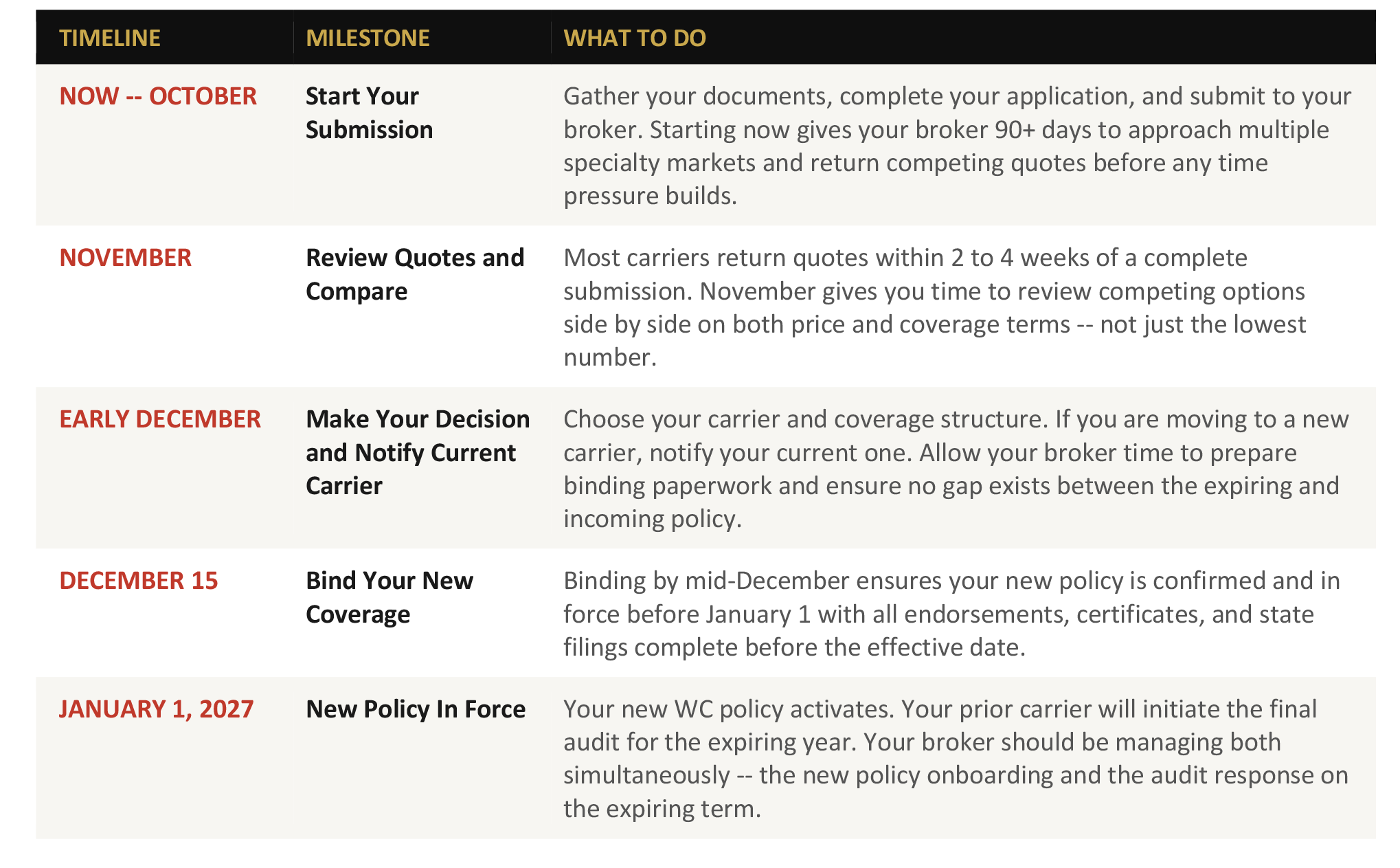
Your January 1, 2027 Renewal Timeline
This is the timeline that produces the best outcomes for businesses with a January 1 WC effective date.
The 6 Documents Every Business Needs for a Complete WC Renewal Submission
A complete submission is what separates businesses that receive competitive quotes from those that receive one rushed option. Every document below serves a specific purpose for the underwriter evaluating your account.
Completed Workers’ Compensation Application
Your signed application is the foundation of every carrier submission. It covers your business operations, payroll by class code, states where employees work, number of employees, ownership structure, and any subsidiary or related entities. Carriers will not quote without it -- and an incomplete application is the most common reason submissions get delayed.
Current Policy Declarations Page and Full Policy Copy
Your existing policy shows the incoming carrier exactly what you have in place -- coverages, limits, endorsements, exclusions, carrier, and premium. It also confirms your current effective and expiration dates so any new policy can be structured to align precisely with your renewal without a coverage gap.
Loss Runs for the Prior 3 to 5 Years
Loss runs are your complete claim history from your current and prior carriers -- every claim opened during each policy year, the date of loss, claim type, amount paid, and current reserve on open claims. Most carriers require a minimum of 3 years. 5 years is ideal and gives the underwriter the full picture of your loss trend. Your current carrier is required to provide loss runs upon request, typically within 10 business days.
Current Payroll Records or Year-to-Date Payroll Summary
WC premium is calculated on actual payroll -- so carriers need to verify that the payroll in your application reflects what you actually pay employees, by class code. A year-to-date payroll summary broken out by class code, a recent payroll register, or prior year W-3 form all serve this purpose. Accurate payroll documentation prevents large audit surprises at year-end.
Three Years of Business Tax Returns or Financial Statements
Carriers use financials to confirm that the business is operating at the scale described in the application, that the ownership structure matches the application, and that the business is financially stable. For new accounts or accounts with significant premium, some carriers also use financials to evaluate credit risk under pay-as-you-go or large deductible program structures.
Description of Operations and Client or Customer Types
A one-to-two paragraph written description of what your business does, who your customers are, and how your employees interact with the public, clients, or other contractors gives the underwriter context that a class code alone cannot convey. Businesses with unique or mixed operations -- where employees perform multiple types of work -- benefit most from a clear written description that guides the underwriter to the right codes and the right market.
Understanding Your Experience Modification Rate at Renewal
What the EMR Is and How It Is Calculated
Your experience modification rate is a multiplier applied to your base WC premium. It is calculated by NCCI -- the National Council on Compensation Insurance -- by comparing your actual losses over a three-year period to what was expected for a business of your size and classification. The calculation excludes the most recent completed policy year and uses the three years before that.
What the Numbers Mean
A mod of 1.0 means your losses are exactly what is expected for your industry and payroll size -- you pay the base rate. A mod below 1.0 means you are doing better than average and you receive a credit on your premium. A mod above 1.0 means your losses exceed what is expected and you pay a surcharge. For most businesses, moving the mod by 0.10 in either direction represents a meaningful annual premium change.
What You Can Do Before Renewal to Improve Your Mod
The EMR calculation is based on data that already exists -- the claims that were filed during your prior policy years. But there are still actions that affect your renewal position. Open claims that close before the EMR calculation date no longer contribute their full reserve to the calculation. Disputed claims that can be successfully challenged reduce your loss history. A documented safety program and incident reduction plan demonstrates to underwriters that your loss trend is improving -- which matters even before the mod catches up.
THE THREE-YEAR FINANCIAL IMPACT OF A BAD CLAIMS YEAR
A severe claim or a cluster of claims in a single policy year enters your EMR calculation and stays there for three full renewal cycles. If a bad year adds 0.20 points to your mod and your base premium is $150,000, you pay $30,000 more per year for three years -- $90,000 total for claims that may have cost the carrier far less. This is why claim management is not just a safety issue. It is a three-year financial exposure that compounds across every renewal until the bad year drops out of the calculation.
5 Things You Can Do Right Now to Get the Best January 1, 2027 Renewal
Request Your Loss Runs Today
Contact your current WC carrier and request loss runs for the prior 3 to 5 policy years. You are entitled to them. Getting them early gives you and your broker time to review your claim history, identify any errors or disputes, and understand what the underwriter will see when your submission arrives.
Review Your Class Codes Before You Submit
Your WC class codes determine your base rate. If any employees have changed roles, if you have added new types of operations, or if your current codes do not accurately reflect what your employees actually do -- those discrepancies will surface at audit. Reviewing your classification schedule with your broker before submission prevents retroactive audit adjustments.
Check Your Open Claims and Push for Closure
Every open claim on your loss runs carries a reserve that feeds into your EMR calculation. Work with your carrier’s claims team to identify any claims that can be settled and closed before the EMR calculation date. A claim closed at $15,000 is far better for your mod than the same claim sitting open at a $40,000 reserve.
Document Any Safety Improvements Made Since Your Last Renewal
If you have implemented safety training, hired a safety coordinator, reduced your incident rate, or changed operational practices that reduce injury exposure -- document all of it before your submission. A narrative that accompanies your submission explaining what changed and why your loss trend is improving gives the underwriter context that the raw numbers cannot convey.
Give Your Broker Enough Lead Time to Approach Multiple Markets
A specialist broker with access to multiple carriers can only leverage that access if they have time to use it. Submitting to your broker in September gives them 90 days to approach several markets simultaneously, receive and compare quotes, and present you with a genuine choice. Submitting in November gives them 30 days and far fewer options.
Frequently Asked Questions
Q: When should I start my January 1 workers’ comp renewal?
September is the ideal starting point for a January 1 WC effective date. Starting in September gives your broker 90+ days to approach multiple specialty markets, receive competing quotes, compare coverage terms, and bind coverage without time pressure. October is manageable. November limits your options significantly. December puts you at risk of a rushed decision or a forced rollover with your current carrier on their terms.
Q: How do I get my workers’ comp loss runs?
Contact your current WC carrier directly and request loss runs for the prior 3 to 5 policy years. You can make this request yourself or through your broker. Carriers are required to provide loss runs within a reasonable timeframe -- typically 10 business days. Request them in writing via email and ask for PDF format. Loss runs show every claim that was opened, the date of loss, the claim type, total paid to date, and the current reserve on any open claims.
Q: Can my workers’ comp carrier decline to renew my policy?
Yes. WC carriers re-underwrite every account at renewal. Carriers can decline to renew for reasons including excessive loss history, an EMR above their underwriting guidelines, changes in your operations that fall outside their appetite, or market-wide decisions to exit a particular industry or state. If your carrier non-renews your policy, you typically receive 60 days advance notice and your broker should be working on replacement options before that notice arrives -- not after.
Q: What is a workers’ comp experience modification rate and how does it affect my premium?
Your experience modification rate -- also called the EMR or mod -- is a multiplier applied to your base WC premium. It is calculated by NCCI based on your actual losses compared to what is expected for a business of your size and industry. A mod of 1.0 is average. A mod of 0.85 reduces your premium by 15 percent. A mod of 1.25 increases it by 25 percent. Your mod is recalculated every year at renewal using your most recent three-year loss history.
Q: Does shopping my workers’ comp renewal hurt my relationship with my current carrier?
No. Requesting competitive quotes from other carriers is standard practice and carriers expect it. Your current carrier cannot penalize you for getting other quotes. If your current carrier offers the best terms -- on both price and coverage -- you renew with them. If another carrier offers meaningfully better terms, you move. The only way to know is to shop. A broker who discourages you from getting competing quotes is not serving your interests.
The Bottom Line
January 1, 2027 is exactly 100 days from today. If your workers’ compensation policy renews on January 1, the window to achieve the best possible outcome is open right now -- and it closes faster than most business owners expect.
The businesses that start in September get multiple competing quotes, real leverage, and time to make a thoughtful decision. The businesses that start in December get whatever is available on a rushed timeline.
Gather your documents. Review your loss runs. Check your open claims. Give your broker the lead time they need to do their job properly. The premium you pay on January 1, 2027 is the result of the work you do in September and October 2026.