
OSHA Just Ruled a Personal E-Cigarette Fire Is a Work-Related Injury.
OSHA just issued a letter of interpretation confirming that an employee’s injury from a lithium-ion battery fire — from a personal e-cigarette the employee brought from home — qualifies as a work-related injury. The reason: the employee was at the workplace during assigned work hours. That’s it. That’s the rule. And most employers have never heard of it.
The Rule Most Employers Don’t Know Exists
OSHA’s regulations require employers to record work-related injuries and illnesses on the OSHA 300 log. Most employers know this. What most employers do not know is exactly what “work-related” means under OSHA’s framework.
The answer is broader than most people expect. It is governed by what OSHA calls the geographic presumption.
THE GEOGRAPHIC PRESUMPTION RULE
An injury or illness is presumed to be work-related if it results from an event or exposure occurring in the work environment. The work environment is defined as the establishment and other locations where employees are working or are present as a condition of their employment. This presumption applies unless a specific OSHA exception is met.
In practical terms: if your employee is at the workplace during assigned work hours, any injury that occurs there is presumed to be work-related. The burden then shifts to the employer to demonstrate that a specific exception applies.
OSHA’s June 2026 letter of interpretation made this concrete in a way that surprised many employers. An employee brought personal lithium-ion batteries from home for an e-cigarette. The batteries caught fire at the workplace during the employee’s shift. OSHA ruled: work-related. The injury goes on the OSHA 300 log.
4 Facts Every Employer Must Understand Right Now
Personal items do not create an exemption - An employee’s personal property — phone, vape, charger, bag, food — does not automatically exempt an injury from recordability if the incident occurs during assigned work hours at the work location.
Pre-existing conditions do not create an exemption - If the workplace environment caused, contributed to, or significantly aggravated a pre-existing condition, the resulting injury or illness must be recorded. The pre-existing condition alone is not an exception
Not recording is itself an OSHA violation - Failure to properly record a qualifying injury on OSHA Forms 300, 300A, or 301 is a separate recordkeeping citation — on top of any underlying safety violation. Each missed entry can be cited independently.
The geographic presumption applies beyond your facility - Employees working offsite, at client locations, at job fairs, or traveling for work are in the “work environment” when present as a condition of employment. Injuries at those locations may also be recordable.
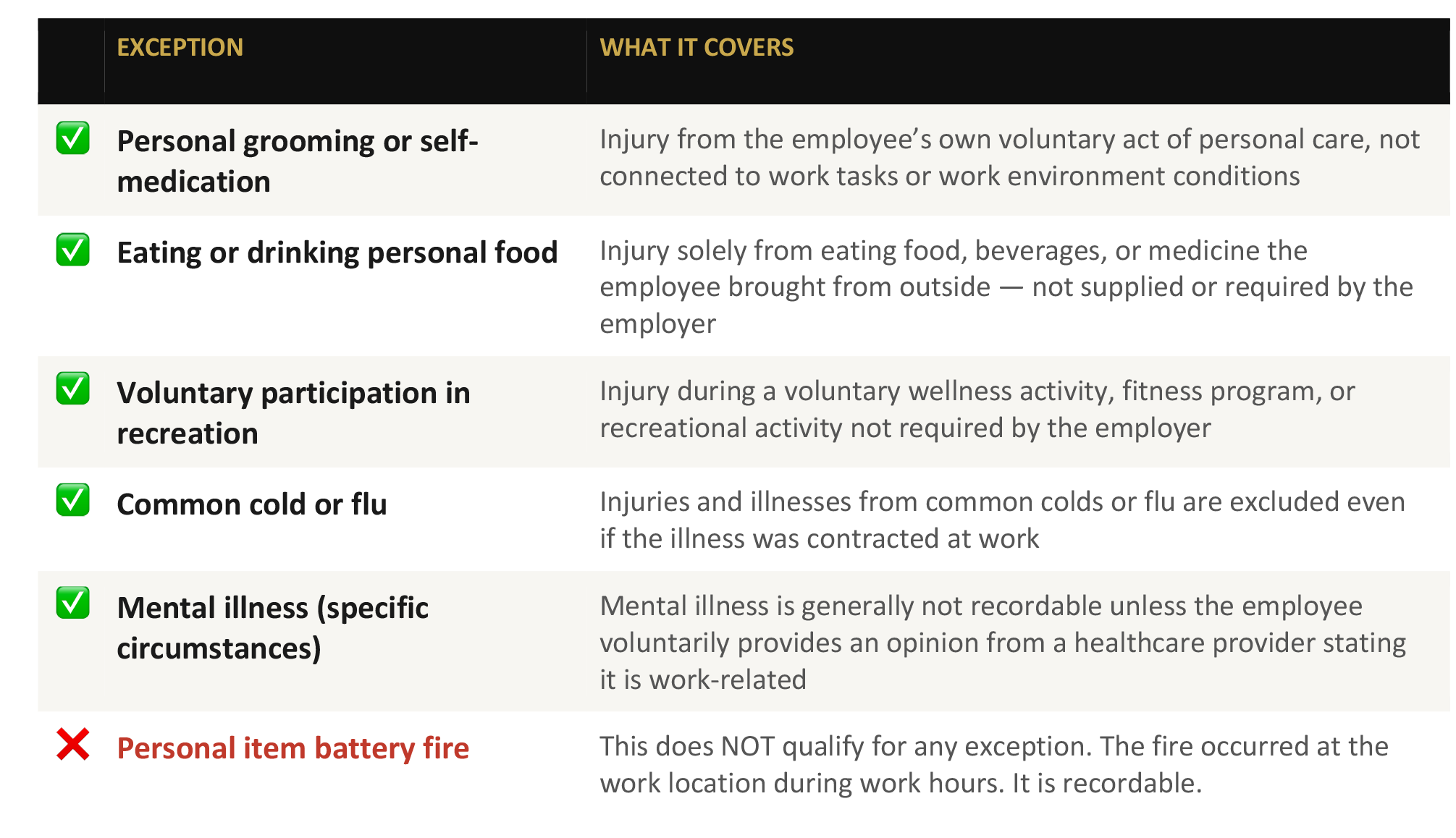
What the Exceptions Actually Are
OSHA does provide exceptions to the geographic presumption. They are narrow, specific, and must be documented. An employer cannot simply decide an injury is not recordable without being able to point to one of these exceptions.
How OSHA Recording Connects to Your Workers’ Comp
OSHA recordkeeping and Workers’ Compensation are separate systems with separate requirements. But they are deeply connected in practice. Here’s how.
THE CONNECTION EMPLOYERS OFTEN MISS
Every Workers’ Comp claim involves the same threshold question that OSHA recordkeeping does: was this injury work-related? Getting the OSHA analysis right from the start sets the foundation for the WC claim. Inconsistent OSHA recordkeeping — recording some injuries and not others — creates documentation conflicts that can hurt you in WC disputes.
Your EMR uses claim data — Every WC claim — particularly those involving recorded OSHA injuries — factors into your Experience Modification Rate. Accurate OSHA recording builds consistent claim documentation that supports fair EMR calculation.
Inspectors review 300 logs on any visit — OSHA inspectors routinely request and review your OSHA 300 log during any inspection — even one triggered by an unrelated complaint. Gaps or underreported entries are a red flag that opens broader scrutiny.
WC carriers look at your OSHA history — Commercial WC underwriters review OSHA inspection history and recordkeeping compliance as part of underwriting. A history of citations — including recordkeeping citations — affects your premium and carrier options.
Repeat violations compound fast — If OSHA cites you for a recordkeeping violation and the same type of error appears at a different location within three years, the second citation is a repeat violation — up to $165,514 per instance.
5 Steps to Get OSHA Recording Right Starting Today
None of these steps are complicated. They require consistency more than expertise. Build these into your operations and your OSHA recording will be both accurate and defensible.
Train Every Supervisor on the Geographic Presumption Rule - If an injury happened at the workplace during assigned work hours — your starting assumption must be “recordable” until you confirm that a specific OSHA exception applies. This assumption must be the reflex of every supervisor before any other analysis begins.
Document Every Non-Recording Decision in Writing - Any time you decide NOT to record an injury, write down why. Identify the specific OSHA exception you are applying. Date it. File it. If OSHA ever questions the decision, your written analysis is your defense. An undocumented non-recording decision cannot be defended.
Report All Injuries to Your WC Carrier Within 24 Hours - OSHA recordability and WC compensability are separate determinations. Report every injury to your carrier immediately regardless of which way the OSHA analysis goes. Late reporting is one of the top reasons claims become more expensive and more litigated.
Review Your Last 12 Months of OSHA 300 Log Entries - Go back through your 300 log and look for injuries that were not recorded because they involved personal items, pre-existing conditions, or outside factors. Apply the geographic presumption analysis retroactively. Correct any missed entries now — before an OSHA inspector does it for you.
Build a Temperature, Hazard, and Personal Device Policy - The e-cigarette ruling puts lithium-ion batteries in the spotlight. If employees are bringing personal devices, chargers, batteries, or other items into your workplace — your safety policy should address them before an incident, not after.
Quick Answers: OSHA Recordkeeping Questions Employers Ask Most
These are the questions we hear most often when OSHA recording comes up in coverage reviews.
❓ How long after an injury do I have to decide if it is recordable?
You must record a work-related injury or illness within seven calendar days of receiving information that the recordable injury or illness occurred. The clock starts when you learn about the injury, not when it happens.
❓ Does every recorded injury have to be filed with OSHA?
No. Recording on your OSHA 300 log is an internal requirement. You only need to submit data to OSHA electronically if you are required to use OSHA’s Injury Tracking Application — which applies to employers with 20 or more employees in certain industries and all employers with 100 or more employees in high-hazard industries.
❓ Does a recorded injury automatically trigger a WC claim?
No. OSHA recordability and WC compensability are separate legal determinations. An injury can be OSHA-recordable but not compensable under WC, or compensable under WC but not technically OSHA-recordable. They are parallel systems that often overlap but do not automatically track each other.
❓ What happens if OSHA finds a recording error during an inspection?
An incorrect or missing OSHA 300 log entry is a recordkeeping violation. The penalty for serious recordkeeping violations is up to $16,550 per entry. Willful or repeat recordkeeping violations can reach $165,514 per citation. The inspector will also look at whether the underlying failure to record reflects a pattern across your locations.
❓ Can an employee’s own negligence make an injury non-recordable?
No. Employee negligence or fault is not a basis for excluding an injury from OSHA recordkeeping. If the injury meets the work-related threshold, it must be recorded regardless of whether the employee caused it, contributed to it, or was violating a workplace rule at the time.
The Bottom Line
Most employers think of OSHA’s work-related definition as common sense — work caused the injury, so it’s work-related. The e-cigarette battery ruling shows the reality is more demanding. Work-related means occurred at the workplace during work hours, and the exceptions are far narrower than most people assume.
The employers who get this right are not the ones with the most sophisticated safety programs. They are the ones who apply a consistent, documented process to every injury — starting with the geographic presumption — and maintain records that can withstand scrutiny.
OSHA’s interpretation letters set the standard. This one just moved the line for every employer in America. The only question is whether your recordkeeping is keeping up.