
NCCI released a report this week that every staffing owner who places retirees, semi-retired tradespeople, per-diem nurses or seasonal warehouse workers should read twice. Lost-time workers’ compensation claims involving workers 65 and older have doubled as a share of all claims — from 4% in 2012 to 8% in 2025 — and each of those claims requires 21% more medical care on average than a claim for a younger worker. NCCI is careful to say the driver is not age itself but what age brings with it: the diagnosis, the comorbidities, and the job. The same slip that bruises a 30-year-old fractures a 68-year-old. For a staffing firm that recruits older workers on purpose — and should — this report explains why the comp math on those placements is different, what it does to the experience mod, and how to keep placing older workers without paying for it three years later.
Quick Summary:
• NCCI (Oct. 29, 2026): workers 65+ are now 8% of lost-time claims, up from 4% in accident year 2012; their claims need 21% more medical care than younger workers’ claims
• Male workers’ claims need 28% more medical care than female workers’ claims — driven by industry mix, not gender; female share of claims rose from 33% to 36%
• NCCI’s finding: the cost difference is “attributable to the injury diagnosis,” treated comorbidities and job type — not age alone
• Earlier NCCI research: older workers are injured less often but their injuries cost more, with falls, slips and trips the leading cause
• Staffing is where older workers go to keep working part-time — the industry carries this exposure first and in concentrated form
• The fix is job-matching, day-one medical direction and a modified-duty bench built for a 65-year-old’s recovery — not a hiring policy
Quick Answer: What Did NCCI Find About Older Workers’ Comp Claims?
QUICK ANSWER
In a report released October 29, 2026, the National Council on Compensation Insurance found that workers’ compensation lost-time claims involving workers aged 65 and older doubled as a share of all claims — from 4% in accident year 2012 to 8% in 2025 — and that those claims require 21% more medical care on average than claims involving younger workers. Claims involving male workers require 28% more medical care than claims involving female workers, a difference NCCI attributes to industry mix rather than gender. NCCI states that the higher medical utilization for older workers is driven by injury diagnosis, treated comorbidities and job type, not by age itself: the same accident produces a more serious diagnosis in an older worker. NCCI warns that a changing workforce could change expected medical utilization and medical severity across the system.
What Does the NCCI Data Show?
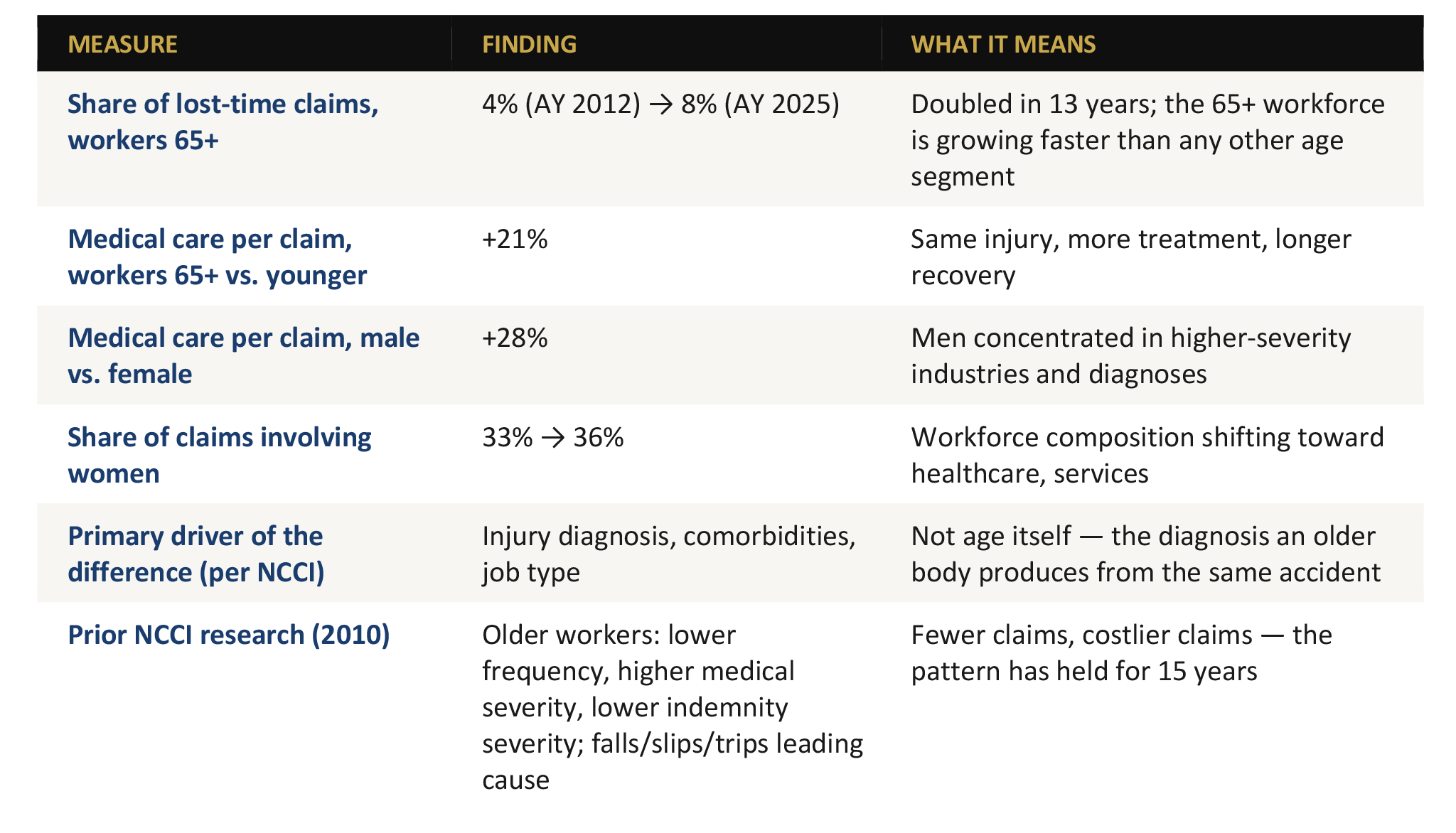
Two things in the data matter more than the headline number.
First, the share doubled. A 21% medical premium on 4% of claims was a rounding error. On 8% of claims it is a line item — and the share is still rising as the workforce ages and more people work past 65 by choice or necessity.
Second, NCCI’s own explanation points to what can be managed. If the cost difference were age itself, nothing an employer does would change it. Because it is diagnosis, comorbidity and job type, the employer who matches the job to the worker, directs care early and plans the recovery can move the number. That is the whole opportunity in this report.
Why Do Older Workers’ Claims Cost More to Treat?
NCCI’s example is the right one. A worker slips on a wet dock. At 30, the diagnosis is a contusion: ice, ibuprofen, back on light duty in three days. At 68, the same fall is a hip fracture or a wrist fracture: imaging, surgery, hardware, physical therapy, and a recovery measured in months. The accident was identical. The claim was not.
Three mechanisms sit underneath the 21%:
• Diagnosis severity. Bone density, tissue elasticity and balance decline with age. The same force produces a more serious injury. Falls, slips and trips — the leading cause of older-worker injuries in NCCI’s earlier research — are precisely the mechanism where this gap is widest.
• Treated comorbidities. Diabetes, hypertension, cardiovascular conditions and prior orthopedic history do not cause the injury, but they are treated alongside it. Surgery is delayed for clearance, healing is slower, complications are more common, and every one of those is a billable medical line on the comp claim.
• Job type. Older workers in staffing cluster in a specific set of placements: warehouse and distribution, light manufacturing, hospitality, healthcare support, school and transportation support. Several of those are the occupations where NCCI found older-worker frequency is actually higher, not lower.
WHAT THIS IS NOT
This is not an argument against hiring or placing older workers, and Akker does not advise it. Older workers have lower injury frequency overall, lower indemnity costs per NCCI’s prior research, better attendance and far better retention. Age is a protected characteristic under the ADEA and most state laws; a placement decision based on age is a discrimination claim, not a safety program. The point of this article is that older-worker placements carry a different claim profile — and the firms that manage the profile keep the workers and the mod.
Why Do Staffing Firms Feel This First?
Because staffing is where the older workforce goes. A retiree who wants three days a week on a forklift does not apply to the distribution center; he applies to the staffing firm that supplies it. A nurse who left full-time practice at 62 takes per-diem shifts through an agency. A retired electrician does seasonal work through a trades staffing firm. The flexibility that makes staffing attractive to older workers is the same flexibility that concentrates them in staffing payrolls.
The result is that a staffing firm’s share of 65+ claims is often well above the 8% national figure — and in light industrial, hospitality and healthcare support, the placements are exactly the ones where falls are the dominant injury mechanism. The firm is also the employer of record, so the claim, the medical bills and the mod impact land on the staffing firm’s policy, not the client’s — even though the client controls the floor, the dock, and the wet spot.
What Does a 21% Medical Premium Do to the Experience Mod?
The experience mod is built on three years of claims, with medical and indemnity costs entering the formula through primary and excess losses. A claim that costs 21% more to treat is a larger primary loss, which is the part of the formula weighted most heavily. Stack that on the 4% medical severity increase NCCI reported for 2025 and the 4.1% hospital inpatient price growth it reported this month, and the older-worker claim is the one most likely to cross the split point and inflate the mod disproportionately.
A worked example. A staffing firm has two warehouse falls in a policy year. One is a 32-year-old with a contusion: $1,800 medical, closed in two weeks, medical-only, 70% reduction in the mod formula where the state allows it. The other is a 66-year-old with a wrist fracture requiring surgery: $38,000 medical plus eight weeks of indemnity. The second claim enters the mod at full primary value, stays for three rating years, and can move a mid-sized firm’s mod by several points on its own. Two accidents. One mod event.
How Do Staffing Firms Place Older Workers Safely?
Six controls, in the order they pay back. None of them is an age limit.
Match the Job to the Worker, Not the Shift to the Opening
Physical-demand matching is the single biggest lever.
Every placement order should carry a physical demand profile — lifting, climbing, standing duration, surface conditions, equipment. Every candidate should be matched to it, regardless of age. A 66-year-old on a picking line with anti-fatigue mats and no ladder work is a good placement. The same worker on a dock with wet surfaces and a 50-pound lift requirement is a claim waiting to happen — and so is a 25-year-old with a bad back.
Put Nurse Triage in Front of Every Claim
Day-one medical direction matters more on a 65+ claim than any other.
The first 48 hours decide whether a fall becomes a sprain or a surgical case. A nurse triage line gets the worker to the right provider, flags comorbidities to the treating physician, and starts the return-to-work conversation before the worker has a lawyer. Most specialty staffing carriers offer it. Use it on every claim and especially on older-worker claims.
Build a Modified-Duty Bench That Fits a Real Recovery
Return-to-work for a 65-year-old is longer and lighter — plan for it.
A modified-duty program that offers “light duty” at the same client site for two weeks does not help a worker in a cast for eight. Build a bench of genuinely light assignments — inventory counts, quality checks, administrative work at your own office — that can run for the length of a longer recovery. Every week on modified duty is a week not on indemnity.
Treat Slips, Trips and Falls as Your Primary Hazard
The leading cause of older-worker injury is the one you can see from the door.
Walk every client site for surface conditions, lighting, transitions and housekeeping before the first placement and after any change. Require the client to document wet-floor response. Put slip-resistant footwear in the onboarding kit for warehouse and food-service placements. These are the cheapest controls in the program and they target the exact mechanism NCCI identifies.
Train Site Supervisors on Early Reporting — for Every Worker
An older worker who “walks it off” on Monday is a surgical claim on Friday.
Late reporting is worse on older-worker claims because the injury that seemed minor often is not. Make same-shift reporting the client’s contractual obligation and the worker’s onboarding instruction, and reward it instead of punishing it. The claim reported in hour one is the one that closes.
Know Your Own Numbers
If you do not know the age profile of your placements, your carrier does.
Pull the age distribution of active placements by client and class code. Pull the last three years of claims by age band. If 65+ placements are 15% of your payroll and 30% of your medical spend, that is the conversation to have with your safety program, your clients and your broker — before the carrier has it with you at renewal.
What Should Staffing Firms Ask Their Broker and Carrier?
• Does the carrier offer nurse triage, and is it on every claim by default or only on request?
• How are medical-only claims treated in the mod in each state we operate in — and are we getting the reduction on every claim that qualifies?
• What is our loss experience by age band, and how does it compare with the carrier’s book for our class codes?
• Does our return-to-work program meet the carrier’s standard for a premium credit, and what would it take to qualify?
• Are there client sites where our older-worker claims cluster — and should those sites be re-rated, re-inspected, or exited?
Frequently Asked Questions
Q: How much more do workers comp claims for older workers cost?
According to NCCI’s October 2026 report, claims involving workers aged 65 and older require 21% more medical care on average than claims involving younger workers. Earlier NCCI research found older workers have lower claim frequency and lower indemnity severity but higher medical severity, with falls, slips and trips the leading cause of injury.
Q: What share of workers comp claims involve workers over 65?
Workers 65 and older accounted for 8% of lost-time workers’ compensation claims in accident year 2025, up from 4% in accident year 2012, per NCCI.
Q: Why do older workers’ injuries cost more to treat?
NCCI attributes the difference to injury diagnosis, treated comorbidities and job type rather than age itself. The same accident — a slip or fall — tends to produce a more serious diagnosis in an older worker (a fracture rather than a bruise), and conditions such as diabetes or cardiovascular disease are treated alongside the injury and slow recovery.
Q: Can a staffing firm screen out older workers to reduce workers comp costs?
No. Age is protected under the federal Age Discrimination in Employment Act and most state laws, and placement decisions based on age are discrimination claims. The appropriate controls are physical-demand job matching applied to every candidate, early medical direction, modified-duty return-to-work, slip-and-fall hazard control, and early reporting.
Q: How does an older worker’s claim affect a staffing firm’s experience mod?
A claim that costs 21% more in medical enters the experience rating formula as a larger primary loss, which is weighted most heavily, and remains in the mod for three rating years. A single surgical fall claim for an older worker can move a mid-sized staffing firm’s mod by several points on its own.
Q: Do men’s workers comp claims cost more than women’s?
NCCI found claims involving male workers require 28% more medical care than claims involving female workers, and attributes the gap primarily to how men and women are distributed across industry classifications — and therefore injury diagnoses — rather than gender itself.
The Bottom Line
The older workforce is not a trend that is coming. It doubled its share of lost-time claims in the last thirteen years and it is still growing. For most employers that is a demographic footnote. For staffing firms — where older workers go to keep working on their own terms — it is a claims profile that lands on the firm’s policy and the firm’s mod, placement by placement.
NCCI’s report gives the industry a gift: it says the cost is in the diagnosis and the job, not the birth date. That means it can be managed. Match the job to the worker, direct the care on day one, build a recovery bench that fits a real recovery, and go after the falls. The firms that do that will keep placing the most reliable workers in the labor market and keep their mod where it belongs.
Akker places workers’ compensation for staffing firms nationwide and reviews claims by age band, class code and client site as part of every renewal — along with nurse triage, return-to-work and modified-duty programs that carriers credit. If you have never seen your own loss runs broken out by age, that review is free.