
This week the California Division of Workers’ Compensation released a revised proposal to set statewide maximum hourly rates for the attorney fees employers must pay when they depose an injured worker — up to $500 an hour for certified specialists, with travel and transcript review now billable on top. Between the January draft and the October revision, every cost control was removed and every rate went up. Deposition fees are small money on one claim. But California already runs a 127% combined ratio, cumulative trauma claims are approaching a quarter of indemnity, and the cost of a California claim is set less by the injury than by the process around it. This is one more piece of that process, and it is a preview of how 2027 — the year California has flagged for structural comp reform — is likely to go. Comments are due November 9.
Quick Summary:
• Under Labor Code §5710, when an employer or insurer deposes a represented injured worker, the employer pays the worker’s attorney a reasonable fee. Rates have been set by local presiding-judge memoranda, many 10–15 years old
• DWC’s revised proposal (8 CCR §9795.6) sets statewide maximums: $500/hr certified specialists, $450/hr 10+ years, $400/hr 5–10 years, $350/hr under 5 years
• Versus the January draft: rates rose, travel and transcript review became billable at half rate, limits on billing increments and minimum/flat fees were dropped, and the $250 non-attorney cap was eliminated
• Prior district memoranda ran roughly $300–$400/hr; defense counsel report demands of $500–$600+ even from junior attorneys. The new rule codifies the top of that range
• Every employer with California payroll pays this — through claims cost, the experience mod and the next WCIRB rate filing
• Public comment closes 5 p.m. November 9, 2026
Quick Answer: What Is California’s Labor Code 5710 Deposition Fee Proposal?
QUICK ANSWER
California Labor Code §5710 requires an employer or insurer that deposes a represented injured worker (or a person claiming dependent benefits) to pay that worker’s attorney a reasonable fee for attending. The rate has historically been set by local policies of each district’s presiding workers’ compensation judge. In January 2026 the Division of Workers’ Compensation proposed a statewide schedule under 8 CCR §9795.6; on October 28, 2026 it released a revised proposal with maximum hourly rates of $500 for State Bar certified workers’ compensation specialists, $450 for attorneys with 10 or more years of California comp experience, $400 for 5–10 years, and $350 for under 5 years. The revision also allows billing for transcript review and travel at up to half the applicable rate, removes the January draft’s limits on billing increments and minimum or flat fees, and drops a proposed $250 cap for non-attorney representatives. Public comments are due by 5 p.m. November 9, 2026. The rule takes effect only after formal rulemaking is complete.
How Do Deposition Attorney Fees Work in California Workers’ Comp?
A deposition is the employer’s most important discovery tool in a contested comp claim. It is where the adjuster’s attorney asks the injured worker, under oath, about the injury, the job, prior injuries, other employment, and the medical history that decides whether a claim is compensable and how much it is worth. In most litigation each side bears its own attorney cost. California workers’ comp is different: under Labor Code §5710(b)(4), when the employer or insurer takes the worker’s deposition, the employer pays the worker’s attorney a reasonable fee for the time — plus the worker’s lost wages and mileage.
What “reasonable” means has never been defined statewide. Each district’s presiding judge issued a memorandum, often a decade or more old, suggesting a range. Applicant attorneys billed above it; defense attorneys objected; judges resolved the dispute case by case. Defense firms report that the cost of litigating a fee dispute sometimes exceeds the fee itself. The statute directs the Administrative Director to set the range, and that is what this rulemaking does.
What Does the Revised Proposal Say?
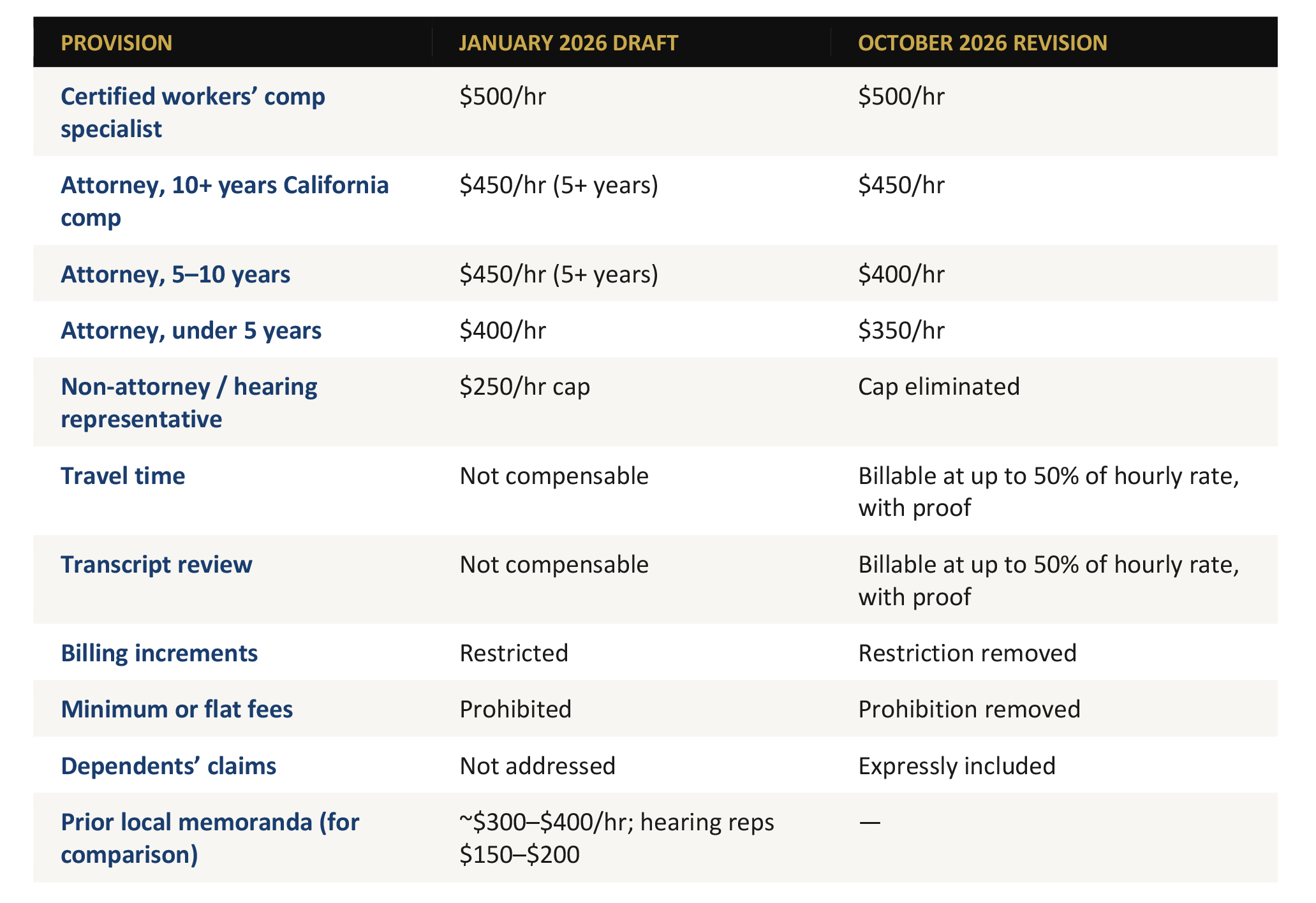
The tier structure got more granular — a fourth band was added at the bottom — but read the right-hand column. The travel and transcript bars came out. The increment and flat-fee rules came out. The non-attorney cap came out. The January draft was a fee schedule with cost controls. The October revision is a fee schedule.
Why Does a $500-an-Hour Deposition Fee Matter?
On a single claim it does not, much. A four-hour deposition with a certified specialist is $2,000 plus travel and transcript time — real money, but not what moves a claim. The significance is in what it does to the system.
It Prices the Employer Out of Its Own Discovery
Every deposition becomes a cost-benefit decision the adjuster makes before taking it.
When the employer pays the other side’s lawyer to answer the employer’s questions, the adjuster weighs the fee against the expected value of what the deposition will find. At $500 an hour plus travel and transcript review, marginal depositions do not get taken. Fewer depositions means weaker defense on the claims where discovery would have changed the outcome — the cumulative trauma claim with a prior-injury history, the post-termination claim, the claim with undisclosed concurrent employment.
It Codifies the Top of the Current Range
What was a demand is now the schedule.
Defense counsel report applicant-side demands of $500–$600 per hour today, frequently from attorneys who do not meet the top tier. Presiding-judge memoranda sat around $300–$400. A statewide maximum of $500 with no increment or flat-fee limits does not split the difference. It validates the high end and removes the tools judges used to trim it.
It Lands in a System Already Losing Money
California is at a 127% combined ratio with litigation as the engine.
WCIRB projects a 127% combined ratio for accident year 2025, the worst in more than twenty years. Cumulative trauma claims are approaching a quarter of indemnity claims; they are almost always litigated and almost always deposed. Litigation cost per claim rose double digits last year. A fee schedule that raises the price of defense discovery in that environment is a severity input, not a procedural footnote.
It Is a Preview of 2027
California has flagged next year for structural comp reform. This is the direction of travel.
Permanent disability calculations, cumulative trauma standards, QME reporting, the SIBTF assessment climbing toward $1.5 billion — 2027 is expected to be a reform year in Sacramento. Between January and October, this proposal moved entirely in one direction. Employers and carriers should read that as a signal about where the larger negotiations are likely to start.
Who Pays for This?
Every employer with a worker in California, in three ways.
• Directly, on litigated claims. Deposition fees are allocated loss-adjustment expense charged to the claim. They raise the incurred cost that enters the experience mod and stay there for three rating years.
• Through the mod. Higher incurred cost on California claims means a higher mod on the entire policy — including payroll in states that have nothing to do with California. A multi-state employer with 15% of payroll in California is rated as a California risk.
• Through the rate filing. WCIRB builds litigation and loss-adjustment expense into its advisory pure premium rate. Charged rates were already about 6% above 2025 levels in early 2026. Anything that raises defense cost system-wide shows up in the next filing.
AND IF YOU ARE OUTSIDE CALIFORNIA
California is more than 20% of the national workers’ compensation market and the most-copied comp jurisdiction in the country. Its medical fee schedule, its QME process, its cumulative trauma rules and its presumption statutes have all been adopted in some form elsewhere. A statewide deposition fee schedule with $500 at the top is the kind of rule that other states’ applicant bars will cite. Employers everywhere should know it exists.
Frequently Asked Questions
Q: What is Labor Code 5710 in California workers’ compensation?
Labor Code §5710 governs depositions in California workers’ compensation cases. When an employer or insurer takes the deposition of a represented injured worker or dependent claimant, §5710(b) requires the employer to pay the worker’s reasonable attorney fees for attending, along with the worker’s lost wages and mileage. Subdivision (b)(4) directs the DWC Administrative Director to set the range of reasonable fees.
Q: What hourly rates does the DWC propose for 5710 deposition fees?
The October 2026 revised proposal sets maximum hourly rates of $500 for State Bar certified workers’ compensation specialists, $450 for attorneys with 10 or more years of California comp experience, $400 for 5–10 years, and $350 for under 5 years. Travel and transcript review may be billed at up to half the applicable rate with proof.
Q: How did the October 2026 proposal change from the January draft?
The January draft set $450 for attorneys with 5+ years and $400 for under 5, barred fees for travel and transcript review, restricted billing increments, prohibited minimum or flat fees, and capped non-attorney representatives at $250. The October revision added a tier, made travel and transcript review billable at half rate, removed the increment and flat-fee limits, eliminated the non-attorney cap, and expressly included dependents’ claims.
Q: Does the employer have to pay the injured worker’s attorney for a deposition?
Yes. Under Labor Code §5710, when the employer or insurer requests the deposition of a represented injured worker, the employer pays a reasonable attorney fee to the worker’s counsel. The proposed regulation sets statewide maximums for that fee.
Q: When do the new California deposition fee rules take effect?
No effective date has been set. Public comment on the revised proposal closes at 5 p.m. on November 9, 2026. The DWC must complete formal rulemaking before the regulation can take effect.
Q: How do deposition fees affect an employer’s workers comp premium?
Deposition attorney fees are allocated loss-adjustment expense charged to the claim. They raise incurred cost, which enters the experience modification factor for three rating years, and they are part of the litigation expense WCIRB builds into advisory pure premium rates. Higher system-wide defense cost reaches every California employer through the mod and the rate filing.
The Bottom Line
A deposition fee schedule is not a headline. It is the kind of rule that gets finalized quietly and shows up two years later as a few points on a combined ratio that is already the worst in two decades. Between January and October, California’s proposal lost every cost control it started with and kept every rate increase. That is the pattern to watch as the state heads into a reform year.
For employers with California payroll, the response is the same as for every other California cost driver: keep claims out of litigation with early reporting and fast benefits, make sure the claims that are litigated are defended with real documentation, and know what is coming before the renewal does.
Akker places workers’ compensation for employers and staffing firms nationwide, including California, and tracks DWC and WCIRB rulemaking as part of every California renewal. If your California litigated-claim rate has never been reviewed against your mod, that review is free.