
Los Angeles logged 4,171 on-location shoot days in Q3 2026 — 38.5% below the five-year average. The U.S. share of global production fell from 52% in 2022 to 38%. And yet production budgeted under $5 million grew 39% to $1.22 billion, and tax-credit projects doubled their share of LA scripted filming. The market did not disappear. It moved — down-budget and to wherever the credit is. The insurance market did not move with it: roughly ten carriers, two or three in some lines, and the new capacity that arrived in 2026 is chasing $100 million slates, not $2 million features. Here is what 2026 did to film insurance, and the eight pitfalls — four for every production, four for the independent — that will decide what you pay in 2027.
Quick Answer: What Changed in Film Production Insurance in 2026?
QUICK ANSWER
In 2026 the production market shrank at the top and grew at the bottom: Los Angeles filming ran 38.5% below its five-year average and the U.S. share of global production fell to 38%, while production under $5 million grew 39% and California’s $750 million tax credit doubled the share of incentive-driven projects. Capacity stayed thin — about ten carriers, two or three in some lines — and new entrants priced only large budgets. Three changes landed on policies: ISO generative-AI exclusions (CG 40 47, CG 40 48, CG 35 08) plus absolute AI exclusions on E&O and D&O; SAG-AFTRA’s 2026 consent, storage and notice rules for digital replicas; and California AB 2321’s mandatory Cal/OSHA criminal investigation of serious set injuries from January 1, 2027. The IATSE and Teamsters agreements expire July 31, 2027, creating the next strike-contingency exposure.
What Happened to Film Production and Its Insurance Market in 2026?
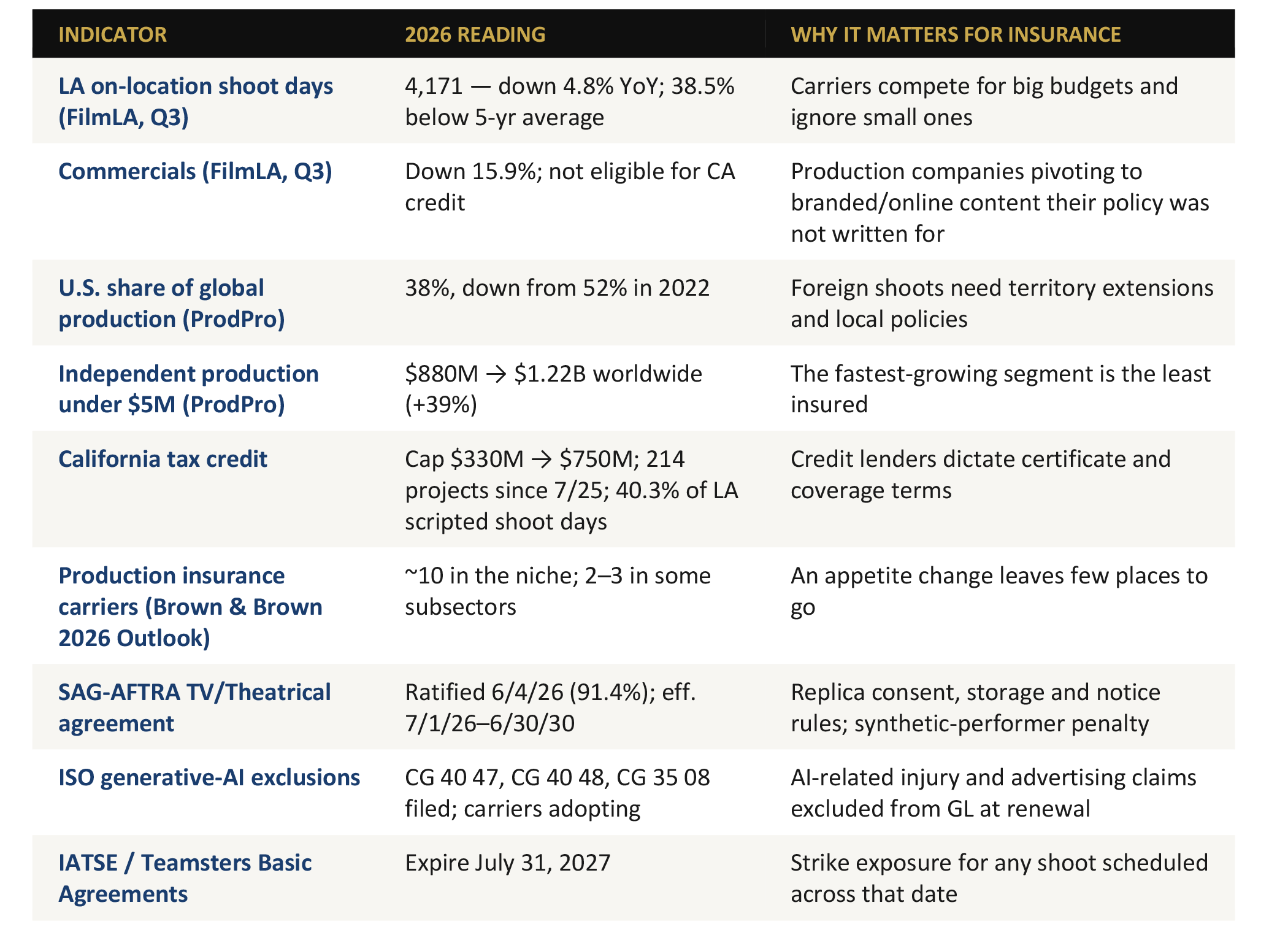
Why does production insurance ignore a commercial market where rates have fallen eighteen straight quarters? Three reasons.
• It is a specialty line with no standard-market bench. Ten carriers — two or three in cast, completion and some E&O segments — set the price among themselves.
• The new capacity that arrived in 2026 wants scale. Lower rates and deductibles are real for $50 million and up; a $3 million feature pays a minimum premium that has not moved in years.
• Production is a California payroll business, and California workers’ comp is running a 127% combined ratio. A crew of 80 on a 30-day shoot is a California comp account whether the producer thinks of it that way or not.
The 8 Pitfalls That Will Decide Your 2027 Production Insurance Budget
The first four apply to every production. The second four are where independents under $5 million lost money in 2026 — mostly on claims that were not covered.
Every production — studio slate to indie
Pitfall 1: AI Exclusions Arrived on Your Renewal — Whether or Not You Use AI
ISO filed three generative-AI exclusions in 2026 and carriers are adopting them; an “absolute AI exclusion” already reaches E&O and D&O at one major specialty carrier. The SAG-AFTRA agreement now requires informed consent, secure storage and third-party-training notice for digital replicas, and California AB 2602 voids blanket likeness clauses. A production that used AI for previs, de-aging or a background crowd has an exposure its E&O and GL may both exclude — and the distributor’s $1M/$3M E&O requirement has no AI carve-out.
WHAT TO DO BY Q1 2027
→ Read the GL and E&O renewal for CG 40 47 / 40 48 / 35 08 or an absolute AI exclusion before binding; get the carrier’s position on AI use in writing.
→ Inventory every AI tool used, document performer consent to the SAG-AFTRA and AB 2602 standard, and disclose it on the application — undisclosed AI use is the rescission argument.
Pitfall 2: Chasing the Credit Without the Coverage Following
Tax credits now decide where productions shoot — California’s $750M, New York’s $800M, Georgia, Texas, the UK’s 40%, Mexico’s new 30%. Every move is a new jurisdiction — a new comp state, a territory the GL and equipment policy may not cover, a lender with its own certificate language, an incentive audit that wants payroll by state. In 2026 productions discovered at audit that half their crew payroll was in a state their policy did not list.
WHAT TO DO BY Q1 2027
→ Before committing to a jurisdiction, confirm in writing that comp lists the state, that GL, equipment and auto extend to the territory, and that the credit lender’s requirements are matched by endorsement — not just by certificate.
→ Track payroll and vendors by state and country from day one of prep — the incentive auditor and the comp auditor want the same file.
Pitfall 3: The July 31, 2027 Labor Cliff
The WGA came within days of a strike in May 2026; SAG-AFTRA ratified a four-year deal in June. The IATSE and Teamsters Basic Agreements are next — they expire July 31, 2027. The standard package does not cover a work stoppage: it is not an insured peril under cast, negative or extra expense unless strike contingency is added, and completion bonds exclude it outright.
WHAT TO DO BY Q1 2027
→ For any shoot scheduled within 60 days of July 31, 2027, price strike contingency now and build a contingency calendar with the bond company.
→ Confirm whether cast and extra expense respond to a delay from a labor action at a vendor or facility — most do not without endorsement.
Pitfall 4: California Comp at 127% — and Set Safety Is Now a Criminal Exposure
California comp rates rose about 6% in 2026 on a 127% combined ratio, with a reform year expected in 2027. AB 2321 takes effect January 1, 2027: a serious on-set injury triggers mandatory Cal/OSHA Bureau of Investigations review, immediate district attorney notice, and Labor Code §6425 penalties up to $1.5 million for a corporation. SB 132 already requires a safety advisor and set-safety training on credit-funded productions. The producer, the payroll company and the production entity can each be investigated.
WHAT TO DO BY Q1 2027
→ Map the employer of record for every crew member and performer (payroll company vs. production entity), confirm California comp on each, and schedule the production as alternate employer where it is not the employer.
→ Put the SB 132 safety advisor, incident-response plan and evidence-preservation steps in the binder before day one — the comp claim and the Cal/OSHA investigation now run on the same documents.
The independent production under $5 million Pitfall 5: E&O Bought at Delivery — After the Chain-of-Title Problem Is Baked In
Distributors require E&O of at least $1 million per claim and $3 million aggregate. Independent producers buy it last, at delivery, because that is when the distributor asks — after the title, music, life rights and AI-assisted elements are already locked. Underwriters added AI disclosure and clearance questions in 2026; a production that cannot answer them pays a surcharge, takes an exclusion, or misses delivery.
WHAT TO DO BY Q1 2027
→ Order the E&O application and clearance review in pre-production; problems are cheaper to fix while the script can still change.
→ Budget E&O at the $1M/$3M distributor minimum from the first budget draft and treat the AI-use inventory as a delivery document.
Pitfall 6: No Completion Bond — and No Bond-Grade Paperwork Either
Most sub-$5M productions do not bond — fine until a credit lender, gap financier or pre-sale requires it, or until a cast or weather claim exposes that the production never had the locked budget, schedule, contracts and certificates a bond company would have demanded. Bond companies have published no AI criteria as of 2026, so an AI-assisted indie that needs a bond is negotiating from scratch.
WHAT TO DO BY Q1 2027
→ Assemble the bond-grade package anyway — locked budget and schedule, executed cast and key crew agreements, chain-of-title binder, full certificate set. Every financier and every adjuster asks for it.
→ If a bond may be required, talk to the bond company in development — before AI elements and financing are fixed.
Pitfall 7: Equipment: Rented, Borrowed, Under-Scheduled
Equipment loss is the most frequent claim on small productions and the one most often uninsured. The rental contract makes the production liable for full replacement value; the floater was bound at $150,000 for a package that reached $400,000 once lenses, the drone and a second body were added. Borrowed gear is usually not scheduled at all.
WHAT TO DO BY Q1 2027
→ Set the equipment limit to rental replacement value plus owned and borrowed gear — and update it when the package changes, not at wrap.
→ Read the rental contract for deductible, in-transit and unattended-vehicle conditions, and loss-payee requirements; make the policy say the same thing.
Pitfall 8: The Crew Is 1099 — Until Someone Gets Hurt
Small productions pay crew as contractors or through loan-outs and assume workers’ comp is someone else’s problem. The state does not agree: a grip injured on a $2 million shoot in California, Georgia or New York is an employee for comp purposes in almost every case, and if no policy responds the production entity — often the producer personally — pays the claim plus penalties. A production with a payroll services company gets quoted; one that says “we have no employees” gets declined.
WHAT TO DO BY Q1 2027
→ Run every crew member and performer through a payroll services company or carry comp on the production entity at a payroll estimate that matches the budget — loan-outs included unless counsel confirms otherwise.
→ Schedule the production entity, payroll company and locations correctly across comp, alternate employer and GL so one injury does not produce three denials.
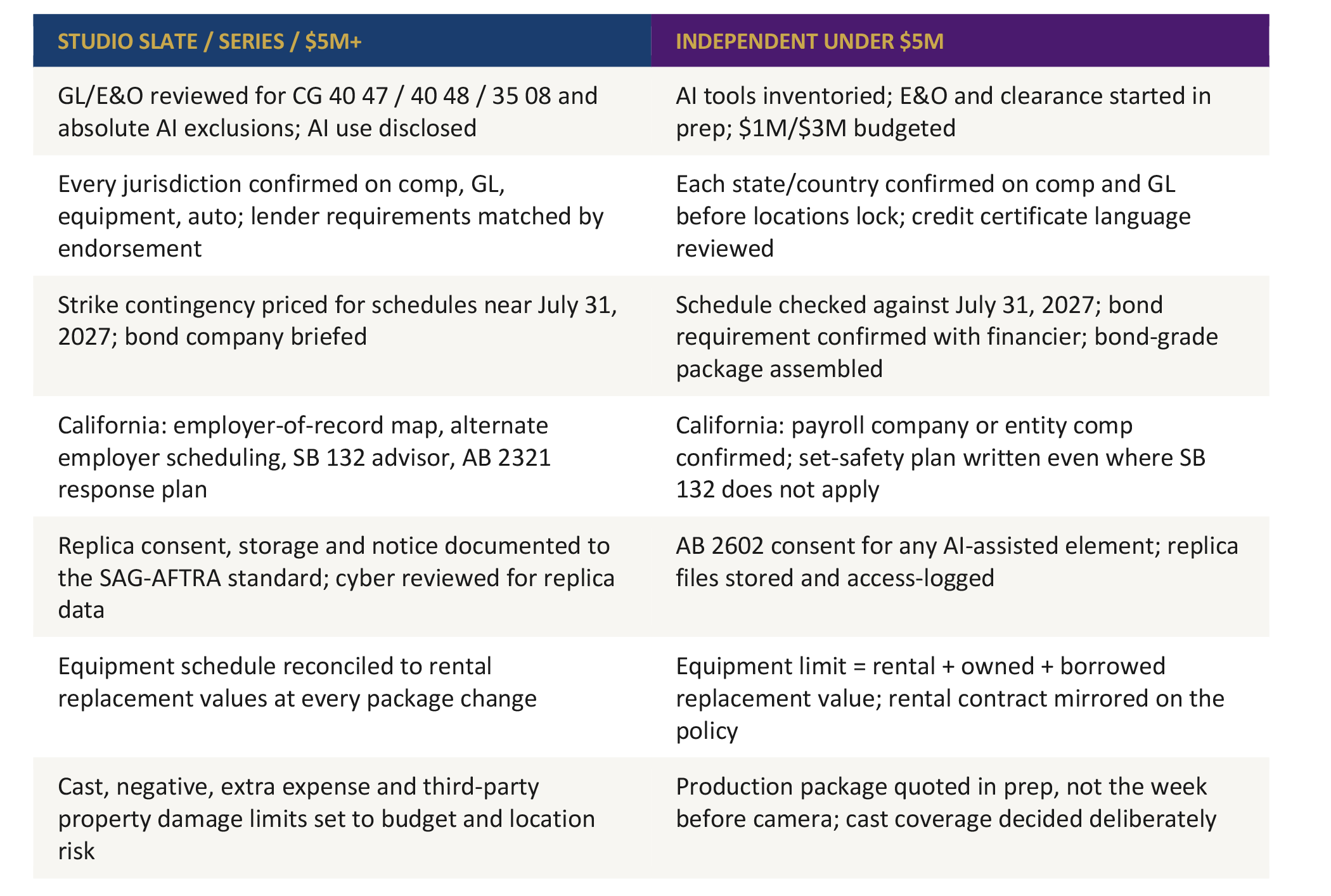
Pre-Production Insurance Checklist: Studio/Series vs. Indie Under $5M
Same questions, different answers. Work down whichever column describes your next project.
2027 DATE CALENDAR
January 1, 2027: California AB 2321 criminal set-safety enforcement and AB 1961 workplace-wide restraining orders. 2027: California Film Commission allocation rounds; federal credit legislation pending. July 31, 2027: IATSE and Teamsters Basic Agreements expire. The full one-page 2027 production insurance calendar is available as a PDF at the end of this post.
Frequently Asked Questions
Q: Is film production insurance getting more expensive in 2027?
For large budgets, no — new carriers in 2026 lowered rates and deductibles on $50M-plus productions. For independents under $5M, effectively yes: minimum premiums have not fallen, AI exclusions restrict E&O and GL, California comp rose about 6%, and a pool of about ten carriers leaves little room to shop.
Q: Do generative-AI exclusions apply if my production only used AI for previs or post?
They can. ISO CG 40 47 excludes injury and advertising claims “arising out of” generative AI under the GL, and absolute AI exclusions on E&O reach AI-generated content. Whether a specific use is excluded depends on the policy as issued; disclose every AI tool and get the carrier’s position in writing.
Q: What insurance does an independent film under $5 million actually need?
At minimum: general liability, workers’ compensation for crew and performers, equipment at full replacement value including rented and borrowed gear, hired and non-owned auto, and E&O at the distributor’s $1M/$3M minimum. Cast, negative, extra expense and third-party property damage are decided by budget and risk; a completion bond when a financier requires it.
Q: How does the July 31, 2027 IATSE contract expiration affect my production?
The IATSE and Teamsters Basic Agreements expire July 31, 2027. A work stoppage is not covered by standard cast, negative or extra-expense coverage and is excluded by completion bonds. Productions scheduled across that date should price strike contingency and build a contingency schedule with the bond company.
Q: Does California AB 2321 apply to a production based outside California?
Yes, if it has a worker on a California set, regardless of headquarters. From January 1, 2027, a serious on-set injury triggers mandatory Cal/OSHA Bureau of Investigations review and immediate district attorney notice, and willful violations causing serious injury carry penalties up to $1.5 million for a corporation.
The Bottom Line
The production market did not collapse in 2026. It relocated — to lower budgets and to wherever the credit is — while the insurance market stayed put: ten carriers, priced for scale, adding AI exclusions and watching a California comp line that loses money on every dollar. The producers who get hurt in 2027 will be the ones who bought the package the week before camera, scheduled $150,000 of equipment on a $400,000 package, paid the crew as contractors, and learned at delivery that the E&O carrier wanted an AI inventory.
Akker places production insurance for studios, series, commercials and independent films nationwide and reviews AI exposure, multi-jurisdiction coverage, equipment schedules and employer-of-record structure on every quote. If your 2027 slate includes a California shoot, an AI-assisted element, or a date near July 31, that review is free.