
Your Budget Is Small. Your Liability Isn’t.
Why Short Film & Indie Producers Are the Most Underinsured People in the Entertainment Industry — And What to Do About It
Here is a scenario that plays out dozens of times every year in the indie film world:
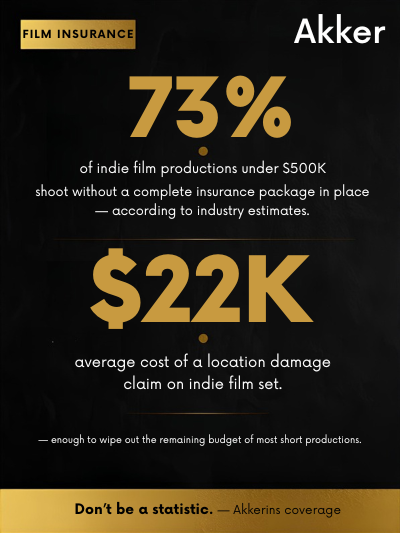
A filmmaker spends 18 months writing, prepping, and fundraising for a $150,000 short film. They find a beautiful house to shoot in. They rent $40,000 worth of camera and grip gear. They hire a crew of 12. They call “action” on day one — and two days into the shoot, a grip truck backs into the side of the location house. The location owner is furious. The damage is $22,000. The filmmaker has no insurance. The production shuts down.
This is not a rare edge case. It is one of the most common ways independent productions collapse — not because of creative problems, not because of budget overruns, but because of an uninsured incident that a $1,200 insurance policy would have covered completely.
The Myth That Film Insurance Is Only for Big Budgets
The single biggest misconception in the independent film community is that production insurance is a big-budget luxury — something that Netflix specials and studio productions need, but that a $200K indie short can skip. This belief is not just wrong. It is financially dangerous.
The reality is that liability exposure does not scale with your budget. A $150,000 short film shooting in a rented residential location with a crew of 12 people and $40,000 worth of rented equipment has nearly identical third-party liability exposure to a $5 million feature. The location owner does not care about your budget when their hardwood floors get scratched. The rental house does not adjust their damage claim based on how much you raised on Kickstarter.
The liability you carry is determined by what you do on set — not by how much money you spent making the film. A small budget buys you less forgiveness, not less exposure.
The Three Moments That Catch Indie Producers Off Guard
Most indie producers do not think about insurance until one of three specific moments forces the conversation. By then, it is usually too late to avoid a problem or expensive to get last-minute coverage.
Moment 1: The Location Agreement
You find the perfect location. The owner loves the idea. Then they send over their location agreement and there it is on page two: “Production must provide a Certificate of Insurance with a minimum of $1 million general liability coverage, with the property owner named as additional insured.” You now have 48 hours to get a policy in place or lose the location. Scrambling for last-minute insurance is always more expensive and more stressful than planning for it from the start.
Moment 2: The Equipment Rental House
You show up at the rental house to pick up your camera package. The counter staff hands you a rental agreement. Buried in the fine print is a requirement that you carry equipment rental coverage or pay a damage deposit equal to the full replacement value of everything you are renting. A RED Monstro package can run $85,000 in replacement value. That deposit is not coming back if anything happens to the gear.
Moment 3: The City Film Permit
You are shooting a scene on a public street, in a park, or on public property. You apply for a film permit through the city or county. The permit application requires a Certificate of Insurance listing the municipality as an additional insured. No insurance, no permit. No permit, no location. No location, no scene. Your entire production schedule just shifted.
None of these moments are surprises if you plan ahead. All three of them become emergencies if you don’t. The cost of emergency last-minute insurance is always significantly higher than the cost of getting a policy at the beginning of pre-production.
What “Underinsured” Actually Looks Like
Being underinsured is not always the same as having no insurance at all. Many indie producers carry one policy — usually a basic general liability policy they bought online — and assume they are covered. They are not fully covered. They are just insured enough to feel comfortable while still being significantly exposed.
Here is what underinsured typically looks like on an indie production:
• General liability policy in place, but no equipment rental coverage. The production is protected if a crew member injures a bystander, but has no coverage if the rented camera package gets stolen from a car overnight.
• Equipment rental coverage in place, but no third-party property damage coverage. The gear is protected, but if the production causes damage to the filming location, there is no coverage beyond the general liability policy limits — which may not be enough.
• General liability and equipment coverage in place, but no workers’ compensation. The moment you pay anyone on your crew — including day players, PAs, and hired drivers — you are legally required to carry workers’ comp in most states. Without it, you are personally liable for any crew injury, and you may be in violation of state labor law.
• All production-phase coverages in place, but no E&O insurance. The film gets finished, gets into festivals, attracts a distributor — and the distributor requires E&O before they will sign the deal. The producer then discovers that E&O requires a chain-of-title review, a clearance report, and several weeks of underwriting. The distribution timeline slips by months.
What a Complete Short Film Insurance Package Actually Costs
This is where most indie producers are genuinely shocked — not by how expensive it is, but by how affordable it actually is relative to the protection it provides.
For a short film production under 60 days with a budget under $1 million, a complete production insurance package through Akker typically includes:
• General Liability ($1M per occurrence / $2M aggregate)
• Equipment Rental Coverage (scheduled to match your rental value)
• Third-Party Property Damage
• Workers’ Compensation for hired crew
• Auto Liability for production vehicles
The total cost for a package like this on a standard short film production often falls between $1,000 and $3,500 depending on budget size, crew count, locations, and specific coverage limits required. On a $150,000 production, that is less than 2-3% of your total budget — and it covers you against claims that can easily reach $20,000, $50,000, or more.
Film insurance is not a cost center. It is risk transfer. You are paying a known, manageable amount to avoid an unknown, potentially catastrophic amount. Every experienced producer knows this. Every first-time producer learns it the hard way.
The COI: Your Production’s Most Important Document
A Certificate of Insurance — COI — is the document that proves your coverage is in place. It is what location owners, rental houses, permitting agencies, and co-producers ask for before they will allow your production to move forward. Without a COI, you cannot confirm to anyone that your insurance exists.
At Akker, we issue COIs quickly — typically same-day or next-day for standard requests — and we can add additional insureds, adjust limits, and address specific location or rental house requirements as they come up throughout your production. We understand that film productions move fast and that insurance paperwork cannot be the thing that holds up your shoot.
Short-Term Film Insurance: Built Specifically for Indie Productions
Akker offers a short-term film insurance product designed specifically for productions that are 60 days or under with budgets under $1 million. This is not a stripped-down version of a larger policy. It is a complete, properly structured production insurance package built around the actual risk profile of an independent short film, music video, branded content piece, or documentary.
You get the same quality of coverage that major productions carry — from carriers that specialize in entertainment insurance — at a price point that works for an indie budget. And you get a broker who understands the industry, speaks the language, and knows that “call time is 6 AM” is not something that can wait until the next business day.
Your budget is small. Your liability isn’t. Let’s make sure your coverage matches your exposure.