
The Bureau of Labor Statistics released its 2025 workplace injuries data on November 18, 2026, and the headline is good: 2.4 million nonfatal injuries and illnesses in private industry, down 3% and the lowest count since the series began in 2003. Staffing firm owners reading that number are asking a fair question: if workplace injuries are at a record low, why is the workers comp premium flat or higher? The answer is in the detail. Most of the decline came from illnesses, not injuries. The injuries staffing firms pay for barely moved, each one costs more than it did a year ago, and a national count does not set your rate. Your own claims do.
Quick Summary:
• BLS 2025: 2.4 million nonfatal workplace injuries and illnesses, down 3%, the third straight annual decline and the lowest since 2003
• Illnesses fell 26.1%, driven by a 67.6% drop in respiratory cases. Injuries fell only 1.5%, and the injury and illness rate was unchanged at 2.3 per 100 full-time workers
• Cost per claim is rising: NCCI reported medical and indemnity severity each up about 4% in 2025
• Your premium is driven by your own loss history and class codes, not by the national count
• 558,300 cases involved job transfer or restriction. That is modified duty, and it is the most effective tool a staffing firm has for controlling claim cost
• In most NCCI states, a medical-only claim counts at 30% of its value in the experience mod
Quick Answer: Why Hasn’t My Workers Comp Premium Dropped If Injuries Are at a Record Low?
QUICK ANSWER
Workplace injuries and illnesses fell 3% in 2025 to 2.4 million, the lowest since 2003, according to the Bureau of Labor Statistics. But most of that decline was a 26.1% drop in illnesses, mainly respiratory cases. Injuries fell only 1.5%, and the overall rate was unchanged at 2.3 cases per 100 full-time workers. At the same time, the average cost of a claim rose: NCCI reported medical and indemnity severity each up about 4% in 2025. A staffing firm’s workers comp premium is based on its payroll by class code, its state’s rates and its own experience modification factor, which compares the firm’s actual losses to expected losses for its classes. A lower national injury count does not reduce the premium unless the firm’s own claims and claim costs come down.
What Did the BLS Report for 2025?
The Survey of Occupational Injuries and Illnesses covers private industry employers. These are the main figures from the November 18, 2026 release.
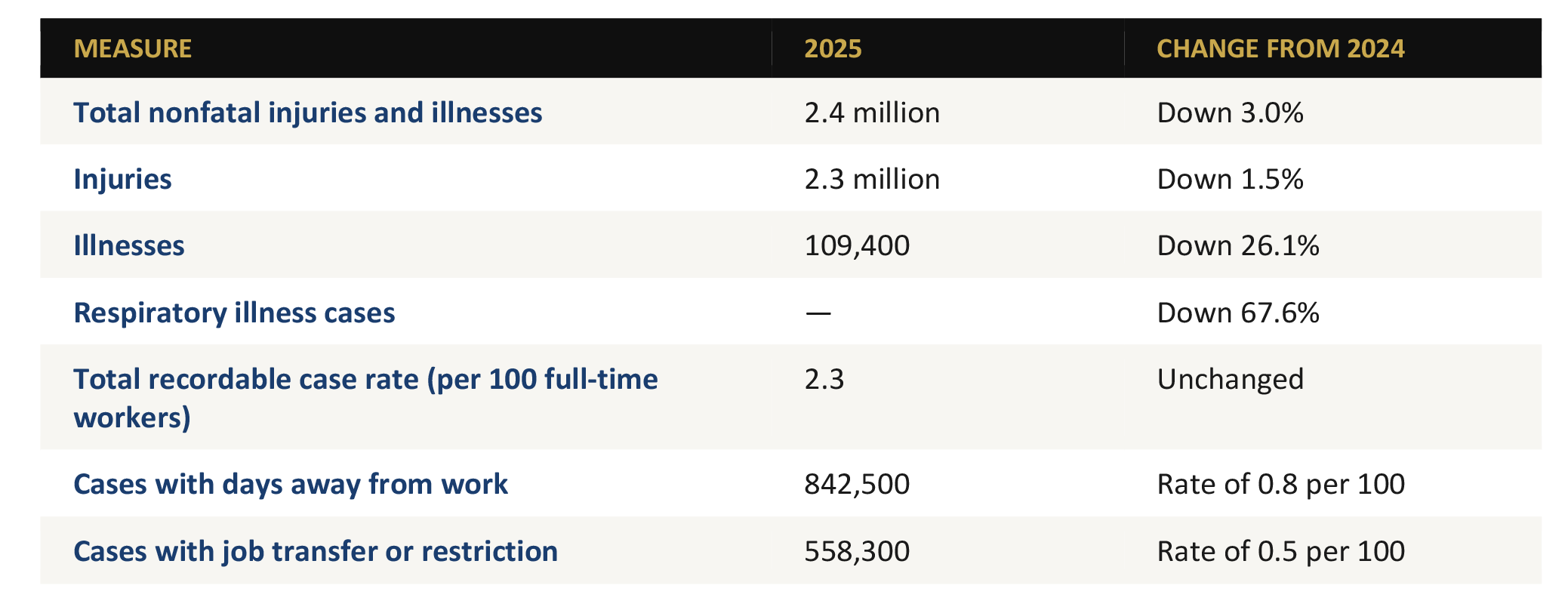
This is the third consecutive annual decline: 2.8 million cases in 2022, 2.6 million in 2023, 2.5 million in 2024 and 2.4 million in 2025.
Why Is the Headline Number Misleading for Staffing Firms?
Three details in the release change how a staffing owner should read it.
The Drop Came From Illnesses
Injuries barely moved.
Illness cases fell 26.1% to 109,400, and respiratory illness cases fell 67.6%. That is the tail end of pandemic-era reporting working its way out of the data. Injuries, which are more than 95% of all cases, fell only 1.5%. Strains, falls, struck-by incidents and lacerations are the claims a staffing firm pays, and they are roughly where they were a year ago.
The Rate Did Not Improve
2.3 cases per 100 full-time workers, the same as 2024.
The count fell, but the rate that adjusts for hours worked was unchanged. A flat rate means the average workplace was no safer in 2025 than in 2024 once illnesses are set aside.
Some Staffing-Heavy Sectors Went the Other Way
Averages hide the sectors where temps work.
Warehousing and storage improved, but its rate is still 4.4 per 100, nearly double the private-industry average. Couriers and messengers moved in the wrong direction: cases rose 11.4%, and job transfer or restriction cases in that sector rose 47.5%. A staffing firm placing into logistics and last-mile delivery is not in the part of the economy that produced the record low.
If Claims Are Flat, Why Is the Cost Going Up?
Because each claim costs more. NCCI’s 2026 State of the Line reported that medical severity and indemnity severity each rose about 4% in 2025, while lost-time claim frequency fell about 2%. For years, falling frequency outran rising severity and loss costs came down. That gap has narrowed.
For a staffing firm the arithmetic is simple. The same number of injuries at 4% more per injury is a 4% increase in losses. If the firm also grew payroll in 2025, total losses grew faster than that.
Why Doesn’t the National Number Lower My Premium?
A workers comp premium has three main inputs, and none of them is the national injury count.
• Payroll by class code. More placements and higher wages mean more premium, whatever happens to injury counts.
• The rate for each class code in each state. Rates reflect the loss experience of that class in that state, filed a year or more in arrears.
• Your experience modification factor. The mod compares your actual losses over a three-year window to the losses expected for a firm of your size and classes. It moves on your claims.
REQUENCY AND SEVERITY
The experience mod formula gives the most weight to the first dollars of every claim, so the number of claims affects the mod more than one large claim does. Underwriters look at both. A firm with frequent small claims pays for it in the mod. A firm with a severe claim pays for it in the carrier’s pricing and appetite at renewal. Rising cost per claim makes both worse.
What Does the 558,300 Number Mean?
BLS counted 558,300 cases in which the injured worker did not go home but was moved to a different job or given restricted duties. That is modified duty, and it is the most useful number in the release for a staffing firm.
Modified duty matters because of how claims are counted. A claim where the worker loses wages is a lost-time claim. A claim where the worker is treated and keeps working is a medical-only claim. In most NCCI states, the Experience Rating Adjustment reduces a medical-only claim by 70% in the mod calculation.
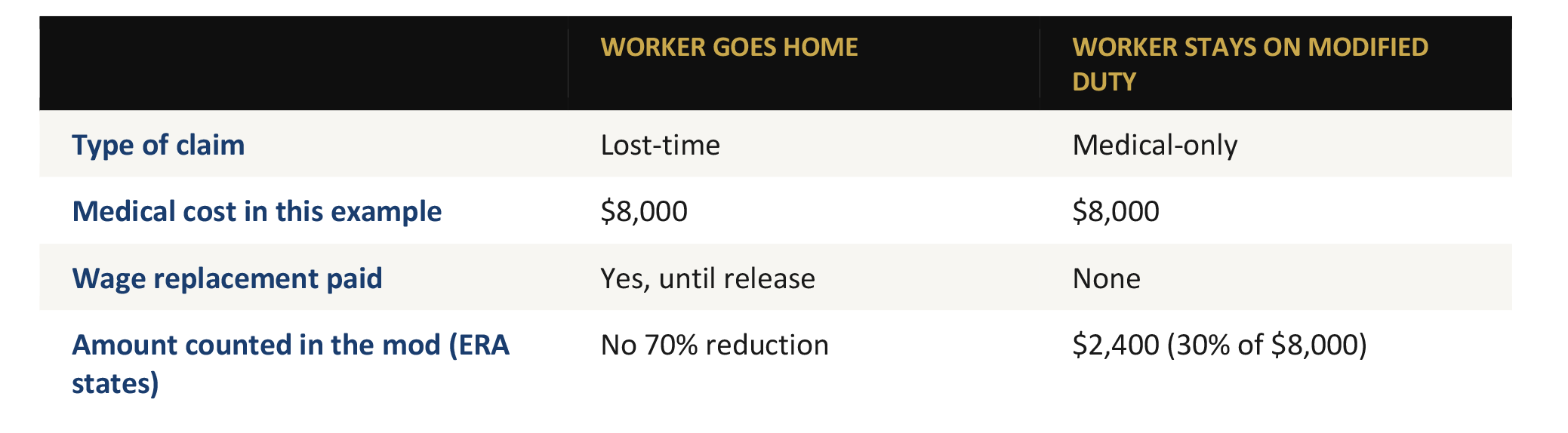
Staffing firms have a harder time with this than other employers, because the assignment often ends when the worker is hurt and the client has no obligation to offer light duty. That is why the option has to be arranged before the injury, not after. The Experience Rating Adjustment applies in most NCCI states; California and some other independent-bureau states use different rules.
What Should a Staffing Firm Do With This Data?
• Compare your own rate to the benchmark. Total recordable cases divided by hours worked, times 200,000, gives your rate per 100 full-time workers. The private-industry figure is 2.3; warehousing is 4.4.
• Put modified duty in the client agreement. Ask each client to identify light-duty tasks in advance, or keep your own bank of transitional assignments, including work in your office.
• Report every injury the same day. Late reporting is the most common reason a medical-only claim becomes a lost-time claim.
• Review open claims and reserves before your mod is calculated. Reserves on open claims count in the mod at their current value.
• Check class codes against the work placed. Payroll in the wrong class changes both the premium and the expected losses in your mod.
• Take the records to renewal. Underwriters give credit for a documented return-to-work program and site reviews.
Frequently Asked Questions
Q: How many workplace injuries were there in 2025?
Private industry employers reported 2.4 million nonfatal workplace injuries and illnesses in 2025, down 3.0% from 2024 and the lowest since the BLS series began in 2003. Of those, 2.3 million were injuries and 109,400 were illnesses.
Q: Did the workplace injury rate go down in 2025?
No. The total recordable case rate was 2.3 per 100 full-time equivalent workers, unchanged from 2024. The count fell mainly because illness cases fell 26.1%.
Q: Why is my workers comp premium going up when injuries are down?
Premium is based on your payroll, your state’s class code rates and your own experience mod. National injury counts do not enter the calculation. Claim costs are also rising: NCCI reported medical and indemnity severity each up about 4% in 2025.
Q: What is a job transfer or restriction case?
It is a recordable injury or illness where the worker stays at work but is moved to another job or has duties restricted. BLS counted 558,300 of these cases in 2025.
Q: How does modified duty lower workers comp costs?
Keeping an injured worker on modified duty can keep the claim medical-only, with no wage replacement paid. In most NCCI states a medical-only claim is reduced by 70% in the experience mod calculation.
Q: Does frequency or severity affect the experience mod more?
Frequency. The mod formula gives full weight to the first dollars of each claim and less weight to the rest, so several small claims raise the mod more than one large claim of the same total. Carriers still weigh severe claims when they price and decide whether to renew.
The Bottom Line
The record low is real, but it was produced by fewer illness cases. Injuries are about where they were, they cost about 4% more each, and your premium follows your own claims. The number worth acting on is 558,300: the workers who were hurt and kept working. A staffing firm that can keep an injured worker on modified duty turns a lost-time claim into a medical-only one, and that shows up in the mod.
Akker places workers’ compensation for staffing firms nationwide. We review loss runs, class codes and return-to-work options before renewal, at no cost.