
Short-term vs. annual production insurance is a decision most producers make by price on the day they need a certificate. That is how a company ends up buying five short-term policies in a year when one annual would have cost less, or greenlighting a feature on an annual DICE policy that excludes feature films. The right structure depends on three things: what you are shooting, the budget, and how many projects are on the slate. For a feature under roughly $1 million, a short-term policy is usually the best fit. For a feature over $1 million, the answer is a longer-term production package written for that one film. For a company shooting multiple commercials, documentaries, industrials or branded projects a year, an annual DICE policy is usually the efficient choice — as long as you know what it leaves out.
Quick Summary:
• Short-term policy: one project, prep through wrap, flat premium, no year-end audit. Usually the best fit for a feature under about $1M and for one-off shoots
• Feature over about $1M: a longer-term production package written for that film, typically 60 days to 12 months, with cast, extra expense, E&O and often a completion bond in the picture
• Annual DICE: one policy for every Documentary, Industrial, Commercial and Educational project in the year. Usually the right structure for companies shooting several qualifying projects
• The trap: most DICE programs exclude feature films and scripted TV. A feature needs its own policy, even if you already carry an annual
• Break-even: at two projects a year, price both. By three or four qualifying projects, the annual usually wins
• Mixed slate: carry the annual DICE for the commercial work and add a separate policy for the feature
Quick Answer: Should I Buy Short-Term or Annual Production Insurance?
QUICK ANSWER
Buy a short-term production policy when you have one project, such as a feature film under roughly $1 million or a single commercial or short. It covers that production from prep through wrap for a flat premium. Buy a longer-term production package, usually written for 60 days to 12 months, for a feature film over roughly $1 million; it is underwritten on that film’s budget and schedule and adds coverages such as cast, extra expense and errors and omissions. Buy an annual DICE policy (Documentary, Industrial, Commercial, Educational) when your company shoots several non-feature projects a year, typically three or more. Most DICE programs exclude feature films and scripted television, so a production company with an annual DICE policy still needs a separate policy when it shoots a feature. Budget thresholds and eligibility vary by program.
What Is the Difference Between Short-Term and Annual Production Insurance?
Both structures can carry the same core coverages: general liability, rented and owned equipment, third-party property damage, hired and non-owned auto, props, sets and wardrobe, and workers’ compensation. The difference is what the policy is attached to.
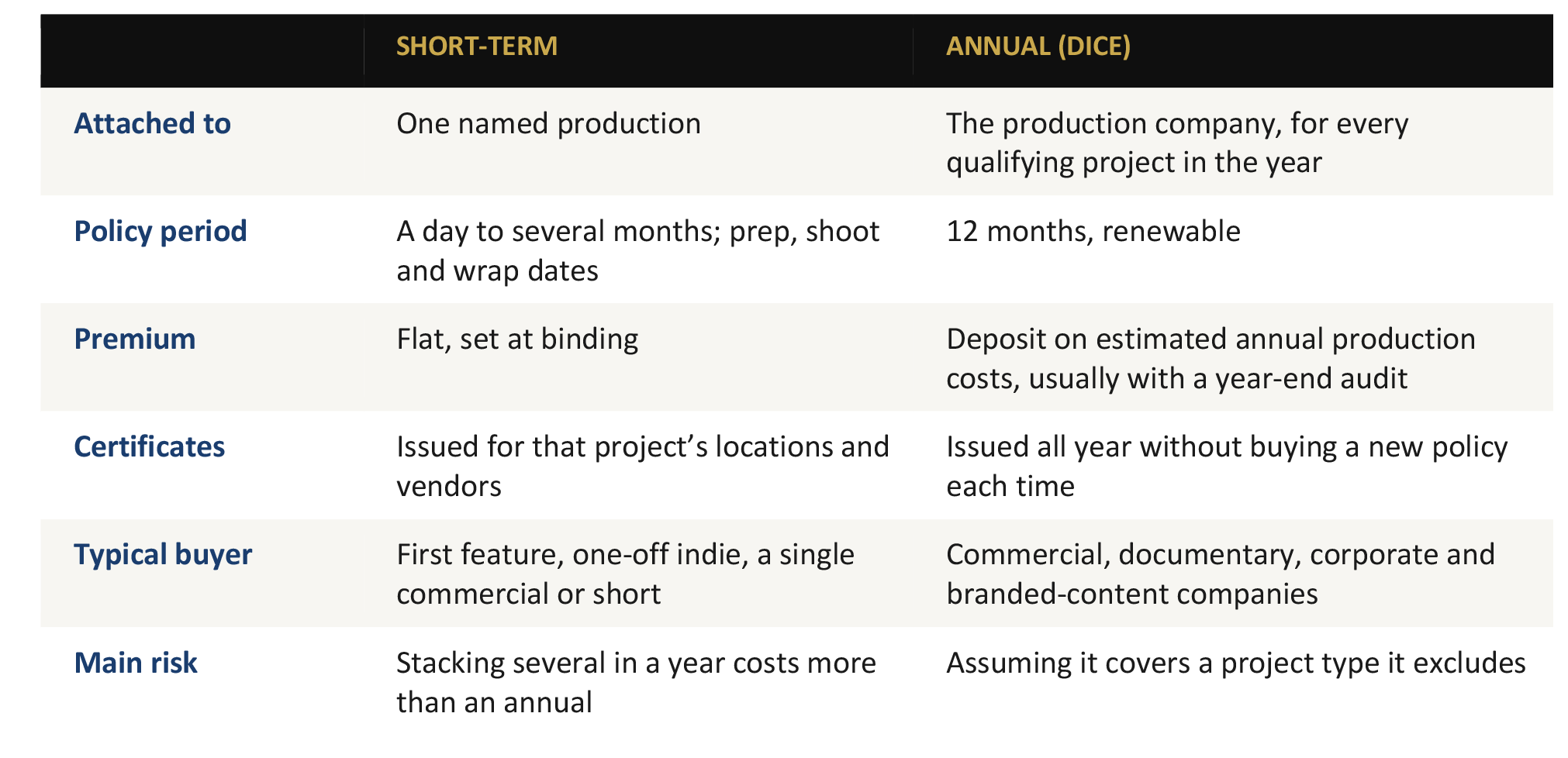
There is a third structure producers often lump in with “annual”: the feature film production package. It may be written for up to 12 months, but it covers one film. It is not a slate policy.
Which Policy Fits Which Project? The Three Lanes
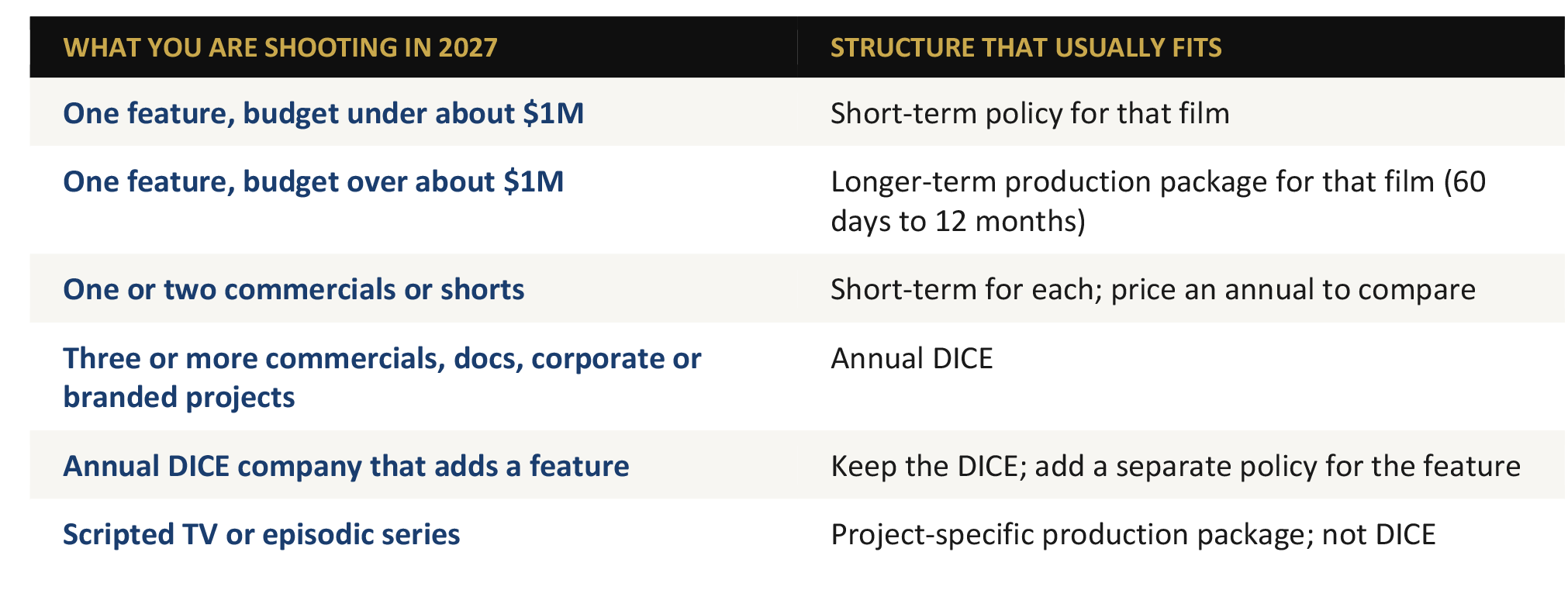
Find the lane that matches what you are shooting in 2027. The budget lines are working thresholds; each program sets its own.
Feature Film Under About $1 Million: Short-Term
One film, defined dates, flat premium.
A micro- or low-budget feature usually has a short schedule, a small cast, limited stunts and no bond or lender requirements. A short-term policy written for the prep, principal photography and wrap dates is typically the cleanest fit. The premium is set when you bind and there is no audit afterward. Build the full schedule into the policy period, including prep days, pickup days and equipment returns, because extending a short-term policy after the fact costs more than getting the dates right at the start. If the distributor or sales agent requires errors and omissions coverage, that is a separate policy.
Feature Film Over About $1 Million: Longer-Term Production Package
Still one film, but underwritten as a full production.
Past roughly $1 million, the film has more to lose and more parties with requirements: financiers, a completion guarantor, unions, distributors. The right structure is a project-specific production package, commonly written for 60 days to 12 months so it covers prep, the shoot and post. This is where cast insurance, extra expense, negative and faulty stock, and higher liability limits come in, alongside E&O for delivery. Some programs will not offer their short-term form at all once the budget passes this level. Expect underwriters to ask for the script, budget top sheet, schedule and stunt breakdown.
Multiple Projects a Year: Annual DICE
One policy for the company’s commercial and non-fiction work.
DICE stands for Documentary, Industrial, Commercial and Educational. It is the annual structure built for companies that shoot often: commercials, corporate and branded content, documentaries, music videos and training films. One policy covers every qualifying project in the year, certificates go out on request, and the cost per project drops as volume rises. The premium is based on your estimated annual production costs, so an honest projection matters; under-project and the year-end audit will bill you for the difference.
Does a DICE Policy Cover Feature Films?
THE DICE TRAP
Usually not. Most DICE programs exclude feature films and scripted television by default. A minority of programs will add a low-budget feature by endorsement, depending on the budget and content, but that is something to confirm in writing before the shoot, not assume. A production company that carries an annual DICE policy and then shoots a feature without a separate policy may have no production coverage on that film.
The feature exclusion is the one that catches established companies, because they already have a policy and already issue certificates. It is not the only limit. DICE programs commonly restrict or exclude:
• Feature films, scripted TV and reality series
• Productions above a per-project budget cap set by the program
• Stunts, fight scenes, pyrotechnics, squibs and firearms
• Animals, aircraft, watercraft and drones unless scheduled
• Shooting outside the United States and Canada
None of these is a reason to avoid DICE. They are a reason to send your broker the project details before each shoot that is out of your normal pattern. Most restricted activities can be added for an additional premium or placed on a separate policy.
How Many Projects Before an Annual Policy Is Cheaper?
There is no single number, because short-term pricing depends on budget, shoot days and equipment values. The working guidance across the market is consistent:
• One project in the year: short-term.
• Two projects: get both quotes. Two short-terms can already approach the cost of an entry-level annual.
• Three or four qualifying projects: the annual usually wins on cost, and always wins on speed, since certificates are issued without a new application each time.
For planning, not quoting: a bare-bones short-term policy for a small shoot starts in the hundreds of dollars, and a short film with a real package runs roughly $1,200 to $2,500. An annual DICE program with a full producer’s package generally starts around $5,000 a year, with stripped-down liability-and-equipment annuals advertised for less. A feature in the $1 million to $3 million range typically runs $15,000 to $45,000 for production coverage. The long-standing rule of thumb is to hold about 3% of the budget for insurance on a feature, including workers’ compensation and E&O; very small budgets run higher as a percentage because of minimum premiums.
What Should a Mixed Slate Do?
Many production companies pay the bills with commercial and corporate work and develop a feature on the side. The structure for that slate is two policies, not one:
• Annual DICE for the commercial, documentary and branded work that runs all year.
• A separate short-term policy (under about $1M) or production package (over about $1M) for the feature, bound before prep starts.
• Workers’ compensation confirmed for both. Crew on the feature are employees of the production whether payroll runs through a payroll company or not.
• E&O for the feature, underwritten from the chain of title, in time for delivery.
If the feature is produced through a single-purpose LLC, as most are, that entity needs to be the named insured on the feature policy. The parent company’s DICE policy does not automatically extend to a new entity.
What Are the Most Common Mistakes?
• Shooting a feature on a DICE policy. The most expensive mistake on this list, because it is discovered at claim time.
• Stacking short-term policies. Four or five in a year usually costs more than one annual, and each one is a new application.
• Buying an annual for one project. You pay for twelve months of coverage and use three weeks.
• Leaving prep, pickups or post out of the policy dates. Losses outside the policy period are not covered, and equipment is often on rent before day one.
• Under-projecting annual production costs to lower the deposit. The audit collects the difference at year end.
• Not telling the broker about a stunt, firearm, drone, vehicle or international shoot until the certificate request. Restricted activities need to be underwritten before the shoot day.
Frequently Asked Questions
Q: Is short-term or annual production insurance cheaper?
For one project, short-term is cheaper. For a company shooting three or more qualifying projects a year, an annual policy is usually cheaper per project. At two projects, compare both quotes.
Q: What does DICE stand for in production insurance?
Documentary, Industrial, Commercial and Educational. It is the annual policy structure for production companies that shoot multiple non-feature projects in a year.
Q: Does DICE insurance cover feature films?
Usually not. Most DICE programs exclude feature films and scripted television. Some will add a low-budget feature by endorsement, which should be confirmed in writing before the shoot. Otherwise a feature needs its own policy.
Q: What insurance does a feature film under $1 million need?
Typically a short-term production policy covering prep through wrap, with general liability, equipment, third-party property damage, hired and non-owned auto and workers’ compensation. Errors and omissions is purchased separately if a distributor requires it.
Q: What changes for a feature film over $1 million?
The film is usually written on a longer-term production package, commonly 60 days to 12 months, with cast insurance, extra expense and negative coverage added. Financiers may require a completion bond, and distributors will require E&O.
Q: Can I have an annual DICE policy and a short-term policy at the same time?
Yes. That is the normal structure for a company with year-round commercial work and a feature in production: the annual covers the qualifying projects and a separate policy covers the feature.
The Bottom Line
Match the policy to the slate, not to the first quote. A feature under about $1 million belongs on a short-term policy. A feature over $1 million belongs on a production package written for that film. A company shooting commercials, documentaries and corporate work all year belongs on an annual DICE policy, with a separate policy for any feature it takes on.
Akker places production insurance for independent features, production companies and rental houses nationwide. Send us your 2027 slate and we will tell you which structure fits each project and where the gaps are.