
Cal/OSHA’s Set-Safety Law Is in Force:
Four years after a cinematographer was killed by a live round on the set of Rust, California has the strictest set-safety law in the country — and most productions shooting in the state still cannot describe what it requires. Since January 1, 2025, every motion picture production in California has been subject to Labor Code Part 13 (Sections 9150–9161), enacted by SB 132: firearms stay in the exclusive custody of a qualified armorer or property master, live ammunition is banned on set with narrow exceptions, and every employee handling or near a firearm must complete a CSATF-level safety course. Since July 1, 2025, productions receiving the California tax credit must also hire a dedicated safety advisor with written risk assessments for firearms, pyrotechnics, stunts, aircraft, watercraft and 60-hour-plus workweeks. Cal/OSHA enforces it, with penalties up to $25,000 per serious violation and $162,851 per willful or repeat violation. This is the second post in our set-safety series — the first covered why weapons scenes can void a production policy. This one covers the law that now sits underneath that policy.
Quick Answer: What Does California’s SB 132 Require on a Film Set?
QUICK ANSWER
SB 132 added Part 13, “Safety in Motion Picture Productions,” to the California Labor Code. For all productions in California since January 1, 2025: a qualified property master, armorer or assistant property master must have sole custody of every firearm and be the only person who hands it to a performer; live ammunition is banned on set except for listed situations such as range training or documentary footage; and every employee who handles or works near firearms must complete the CSATF Firearms Safety Course or an equivalent. For productions receiving the California tax credit, a Safety on Set pilot program (July 1, 2025 – June 30, 2030) requires a dedicated safety advisor, written risk assessments, daily safety coordination, and a final safety evaluation report filed with the Industry-Wide Labor-Management Safety Committee and the California Film Commission. Cal/OSHA enforces all of it.
How Did We Get Here — From Rust to SB 132?
The October 2021 shooting on the set of Rust produced a $136,793 New Mexico OSHA citation (later settled at $100,000), a criminal conviction for the armorer, a civil settlement with the family of cinematographer Halyna Hutchins, and two competing California bills. SB 831 (Cortese) would have required a dedicated safety supervisor on every production and effectively banned functional firearms; it stalled in 2022. What passed instead, in 2023, was SB 132 — a tax-credit trailer bill that attached set-safety requirements to the extension of California’s Film and Television Tax Credit Program and wrote firearms rules into the Labor Code for every production in the state. The firearms provisions took effect January 1, 2025. The safety advisor pilot began July 1, 2025.
Our earlier post explained how a weapons scene can void a production policy when the armorer, the ammunition or the procedure fall outside what the carrier agreed to insure. SB 132 now makes most of those procedures a matter of state law — which changes what “reasonable care” means to an underwriter and to a plaintiff’s attorney.
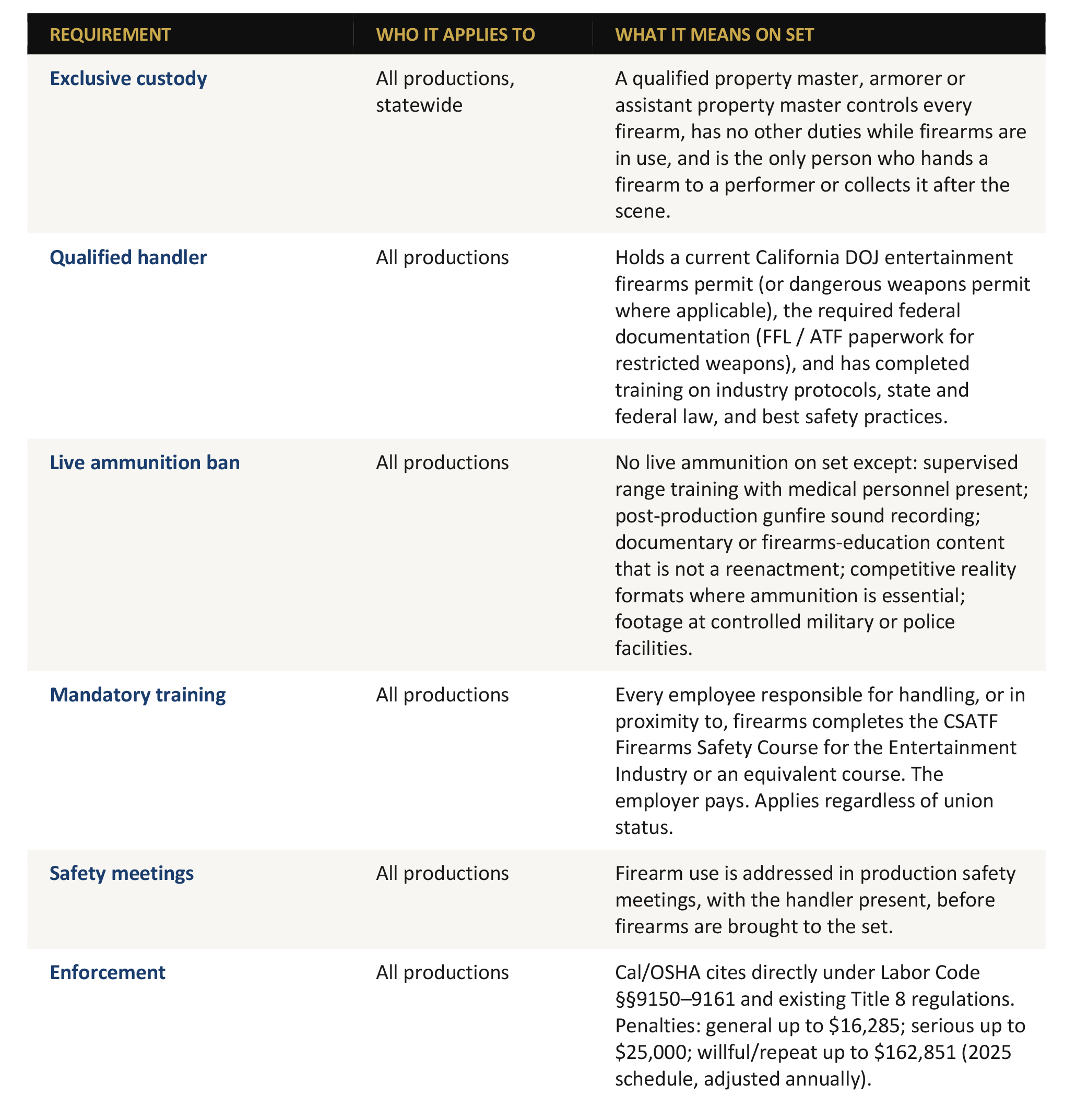
What Are the Firearms Rules for Every Production in California?
What Does the Safety Advisor Pilot Require of Tax-Credit Productions?
Productions that receive a credit under Program 4.0 — which, with the cap now at $750 million and 147 productions approved in the first cycle, is a growing share of California shoots — are subject to the Safety on Set pilot from July 1, 2025 through June 30, 2030:
• A dedicated safety advisor hired for that production alone, with no other role. Qualifications: two years in a safety-related entertainment position, or 500 verifiable crew days with specialist safety knowledge, or five years of safety work in another industry — plus the joint labor-management safety advisor training and an OSHA 30-hour general industry card.
• A general risk assessment: a written review of the script and production plan identifying hazardous activities and locations, started when department heads begin pre-production planning, and updated whenever activities or locations materially change.
• Specific risk assessments for firearms, major pyrotechnics and explosives, major stunts, process shots, aircraft and trains, off-road vehicles, open-water and underwater work, and any workweek over 60 hours — with precautions, control measures and re-evaluation documented.
• Assessments developed with department heads and specialists and made available electronically to performers, crew and their labor representatives.
• A final safety evaluation report filed within 60 days of the end of filming with the Industry-Wide Labor-Management Safety Committee and the California Film Commission, plus an addendum for any reshoots.
OUT-OF-STATE PRODUCTION COMPANIES: THIS APPLIES TO YOU
The firearms provisions apply to any motion picture production taking place in California, regardless of where the production company is domiciled. A Georgia LLC shooting three days in Los Angeles is subject to the exclusive-custody rule, the ammunition ban and the training requirement for those three days. If that production is also claiming the California credit, the safety advisor and risk assessment requirements attach as well.
How Does SB 132 Change Your Production Insurance?
The Weapons Warranty Now Has a Statute Behind It
What used to be a carrier condition is now also the law.
Most production packages carry a weapons warranty or endorsement: firearms handled by a licensed armorer, no live ammunition, documented safety protocols. Before 2025, a producer who cut corners was in breach of a policy condition. Today that same producer is in breach of the Labor Code. A carrier reviewing a firearm-related claim will ask for the SB 132 compliance file — the handler’s permits, the CSATF certificates, the safety-meeting records — and a production that cannot produce it has given the carrier a much easier coverage argument. Whether a specific policy would respond is a question for the carrier, not a blog; the point is that the file now has to exist.
Workers’ Compensation and the Serious-and-Willful Exposure
The claim that sits outside the normal WC bargain.
An on-set injury is a workers’ compensation claim. In California, an employee injured because of an employer’s serious and willful misconduct can recover an additional 50% of compensation directly from the employer — uninsurable and outside the policy. A documented violation of a specific set-safety statute is the kind of evidence those petitions are built on. SB 132 compliance is not just a Cal/OSHA matter; it is how a production keeps a workers’ comp claim inside the policy.
General Liability and Third-Party Claims
Crew are employees; everyone else is a third party.
Background performers hired through a payroll service, location owners, vendors, visitors and the public are third parties to the production company. A firearms or pyrotechnics incident that injures any of them is a general liability claim, and the plaintiff’s first discovery request will be the production’s risk assessment and firearms log — which SB 132 now requires the production to have. A production with the file defends from strength. One without it defends from a statutory violation.
Underwriting: Compliance Is the New Baseline
What carriers ask before they quote a weapons scene.
Entertainment underwriters already ask for the armorer’s credentials, the weapons schedule and the safety plan before they agree to cover a firearms scene. Since SB 132, the productions that get the best terms are the ones that show the compliance package unprompted: handler permits, CSATF certificates for the crew list, the specific risk assessment, and — for tax-credit productions — the safety advisor’s name and qualifications. Productions that cannot show it see higher deductibles, exclusions on the weapons scene, or a declination.
Budget: The Safety Advisor Is a Line Item, Not an Overhead
And it belongs in the insurance conversation.
A dedicated safety advisor on a tax-credit production is a full-time hire for the length of the shoot. Treat it as a line item in the budget the underwriter reviews — because it is one of the first things the underwriter will credit. The cost of the advisor is small against the premium differential on a production with stunts, pyro and firearms, and smaller still against the first Cal/OSHA citation.
An SB 132 Compliance Checklist Your Broker and Underwriter Will Want to See
• Qualified handler on file: California DOJ entertainment firearms permit, federal documentation, training certificate
• Written confirmation that the handler has no other duties while firearms are in use
• CSATF Firearms Safety Course (or equivalent) certificates for every employee handling or near firearms — matched to the crew list
• Ammunition log confirming no live rounds on set, with any exception documented against the statutory list
• Safety-meeting records covering every day firearms are present
• For tax-credit productions: safety advisor name, qualifications, OSHA 30 card, and confirmation of exclusive assignment
• General risk assessment and every required specific risk assessment, dated and updated
• Proof the assessments were made available to crew and labor representatives
• Final safety evaluation report and any reshoot addendum, with proof of filing
• A copy of the weapons endorsement or warranty from the production policy, read against the above
How This Ties Back to Workers’ Comp, Claims and Your Next Renewal
Every requirement in SB 132 is a document, and every document is evidence — for Cal/OSHA, for a plaintiff, and for your carrier. A production that builds the compliance file as a matter of routine has a cleaner claim when something goes wrong, a stronger defense when a third party sues, a workers’ comp claim that stays inside the policy, and an underwriting submission that earns better terms at the next renewal. A production that treats SB 132 as a California-only nuisance is carrying an uninsured exposure it does not know about until the first incident.
Frequently Asked Questions
Q: Does California’s set-safety law apply to all productions or only those receiving tax credits?
The firearms provisions of SB 132 (Labor Code §§9150–9161) apply to every motion picture production in California since January 1, 2025, regardless of where the production company is based or whether it receives a credit. The Safety on Set pilot — the dedicated safety advisor, risk assessments and final report — applies only to productions receiving a credit under California’s Film and Television Tax Credit Program, from July 1, 2025 through June 30, 2030.
Q: Who is allowed to handle firearms on a California film set?
A qualified property master, armorer or assistant property master who holds the required California DOJ permit and federal documentation and has completed the required training. That person must have no other duties while firearms are in use and is the only person permitted to hand a firearm to a performer or collect it afterward.
Q: Is live ammunition banned on film sets in California?
Yes, with narrow exceptions: supervised range training with medical personnel present, post-production recording of gunfire sound, documentary or firearms-education footage that is not a reenactment, competitive reality programs where ammunition is essential, and footage at controlled military or police facilities.
Q: What training does SB 132 require?
Every employee responsible for handling, or in proximity to, firearms must complete the Contract Services Administration Trust Fund (CSATF) Firearms Safety Course for the Entertainment Industry or an equivalent course, paid for by the employer. Registered security guards and sworn peace officers on the set perimeter are exempt if they hold their own firearms qualifications.
Q: What are the penalties for violating California’s set-safety law?
Cal/OSHA enforces SB 132 directly. Under the current penalty schedule, general violations carry up to $16,285, serious violations up to $25,000, and willful or repeat violations up to $162,851, adjusted annually for inflation.
Q: How does SB 132 affect a production insurance policy?
Production policies typically carry a weapons warranty requiring a licensed armorer, no live ammunition and documented protocols. SB 132 makes those practices state law, so a production that cannot document compliance faces both a Cal/OSHA exposure and a harder conversation with its carrier on any firearms-related claim. Underwriters now expect the compliance file as part of the submission for any production with firearms, stunts or pyrotechnics. Whether coverage applies in a specific situation is determined by the carrier under the policy terms.
The Bottom Line
California did not pass the bill that would have put a safety supervisor on every set. It passed the one that put firearms rules in the Labor Code for every set, and safety advisors on every tax-credit set — and it gave Cal/OSHA the authority to enforce both. For producers, that moves set safety from a best practice to a compliance file, and the same file is what your carrier, your underwriter and the other side’s attorney will ask for first.
If your production has firearms, pyrotechnics or major stunts on the schedule — in California or anywhere else — we can read your weapons endorsement against the law and tell you where the gaps are before the shoot, not after the claim.