
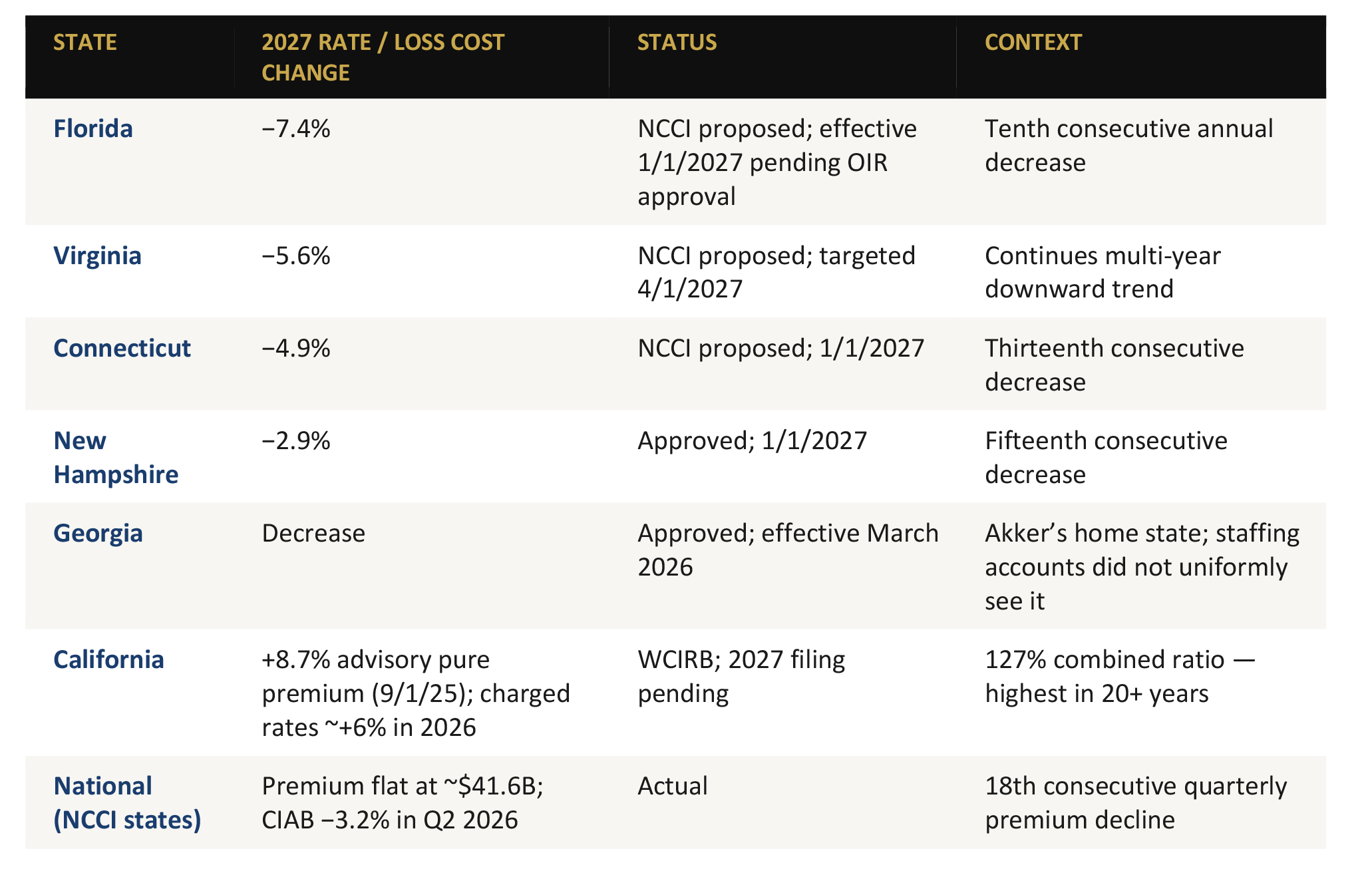
Florida’s rating bureau just proposed a 7.4% cut to workers’ compensation rates for 2027 — the tenth straight year of decreases. Virginia is looking at 5.6% down. Connecticut 4.9% down, its thirteenth cut in a row. New Hampshire 2.9% down, its fifteenth. Nationally, premiums have fallen for eighteen consecutive quarters and private carriers have posted a combined ratio under 100 for twelve consecutive years. So when your CFO reads those headlines and then opens a staffing renewal that came in 8%, 12%, or 20% higher — with a non-renewal notice on one class code and a new minimum premium on another — the question is fair: how can rates be falling everywhere except here? This article answers that question with the 2026 data, explains why staffing firms are the first to feel a market that is quietly turning underneath the headline numbers, and lays out the eight pitfalls most likely to decide your 2027 premium — each with what to do about it before the end of Q1.
Quick Answer: Why Are Workers Comp Rates Falling While Staffing Renewals Go Up?
QUICK ANSWER
Statewide workers’ compensation rate decreases for 2027 — Florida −7.4%, Virginia −5.6%, Connecticut −4.9%, New Hampshire −2.9% — are averages across every industry in each state, driven by a decade of falling claim frequency and years of favorable reserve development. Staffing firms rarely see those decreases because their premium is set by three things the headline rate does not capture: the specific class codes they place into (light industrial, warehouse, construction and healthcare codes where medical severity is rising 4% a year), their experience modification factor (which lags claims by two years), and the appetite of the small number of specialty carriers that write temporary staffing. In 2026 those carriers saw reserve cushions shrink to the lowest level since 2021, California losses run at 127 cents per premium dollar, and loss ratios climb to a five-year high — and they repriced staffing accounts, raised minimum premiums, and non-renewed marginal classes ahead of any bureau filing. The result is a soft headline market and a hardening staffing market at the same time.
What Actually Happened to Workers Comp Rates in 2026?
Start with the numbers your CFO is reading. They are real, and they are not wrong — they are just not about you.
Now the numbers underneath them — the ones the carriers that write staffing are reading.
• Private carriers posted a calendar-year combined ratio of about 91 for 2025 — the twelfth straight year under 100. But the accident-year combined ratio was 102, meaning the current year’s business is already losing money before reserve releases from prior years paper over it.
• The industry’s reserve redundancy — the cushion that has funded a decade of rate cuts — fell to roughly $14 billion at year-end 2025 from $16 billion a year earlier. That is the lowest level since 2021, and rating agencies have said publicly that reserve adequacy concerns “could begin driving the need for significant changes.”
• Medical severity rose 4% in 2025 and indemnity severity rose 4% — outpacing the medical price index, which means utilization is climbing, not just prices. Claim frequency is flat. The claims are not more numerous; each one costs more.
• The direct incurred loss ratio through the second quarter of 2026 was the highest in five years.
• The largest workers’ compensation writer in the country deliberately shrank its book in 2025 and lost the top spot. When the biggest carrier in the line decides to write less, the carriers that write staffing notice.
• California, which accounts for more than 20% of all U.S. workers’ comp premium, is projected at a 127% combined ratio — the worst in more than two decades — with cumulative trauma claims approaching a quarter of indemnity claims and reserve cushion down from $17 billion to $3 billion since 2017.
WHY THESE TWO SETS OF NUMBERS COEXIST
Bureau rate filings look backward. NCCI and the state bureaus set 2027 loss costs on claim experience from 2023 and 2024 — years that were still benefiting from post-pandemic frequency declines and generous reserve releases. Specialty staffing carriers price forward. They set your 2027 premium on what they expect 2027 claims to cost, on the class codes you actually place into, and on how much capacity they want to deploy in a line where their cushion just shrank. When those two views diverge, the bureau number goes down and your renewal goes up — and both are rational.
Why Is Staffing the First Industry to Feel a Turning Workers Comp Market?
Three structural reasons, none of which have anything to do with how well you run your firm.
You Are Concentrated Where Severity Lives
Statewide averages are dominated by clerical and professional payroll. Yours is not.
A −7.4% statewide average in Florida blends millions of dollars of 8810 clerical payroll with warehouse, manufacturing, construction and healthcare codes. Staffing payroll skews heavily toward the second group — the codes where a 4% medical severity increase lands hardest and where a single $150,000 claim is more common than ten $1,500 claims. Your “average” rate never looked like the state’s, and in 2026 the gap widened.
You Carry California Whether or Not You Are in California
One client site in Fresno is a California exposure.
Any staffing firm with a client that has a California location is a California risk in the eyes of an underwriter — and California is where the market is actively hardening. A 127% combined ratio, cumulative trauma litigation, the SIBTF assessment climbing toward $1.5 billion, and now AB 2321 criminal enforcement from January 1, 2027. A national specialty carrier pricing a multi-state staffing account prices the California piece first.
You Are Underwritten by a Small Pool That Reprices Fast
Standard carriers decline staffing. Specialty programs set the price.
Most standard-market carriers will not write temporary staffing at all. The handful of specialty programs that do know each other, watch the same loss data, and adjust appetite account by account — raising minimum premiums, excluding class codes, and non-renewing marginal risks months before any bureau files anything. In a soft general market their decisions look like outliers. They are the leading indicator.
What Else Changed for Staffing Firms in 2026 Besides Rates?
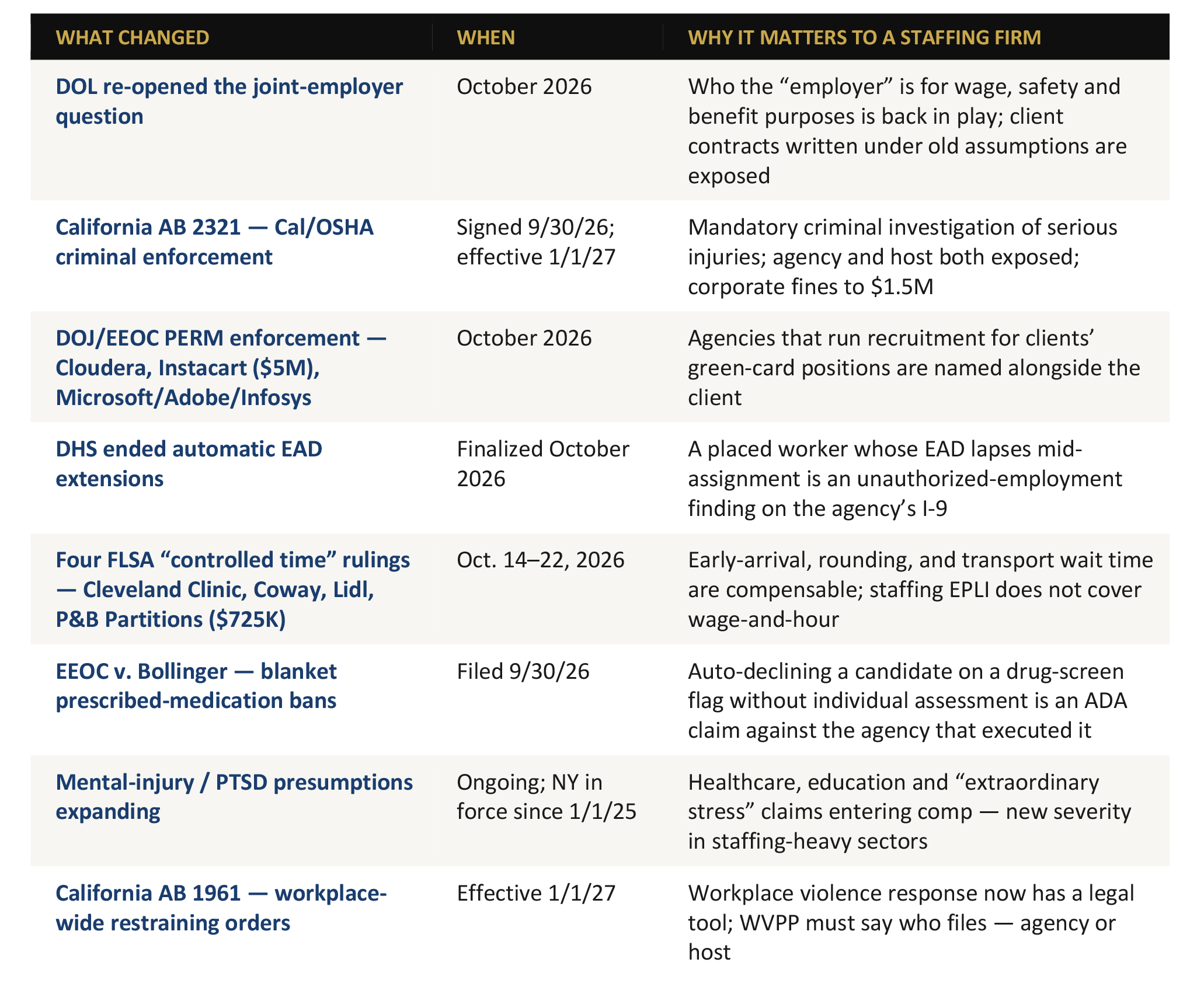
The premium conversation is only half of 2026. The other half is a run of legal and enforcement changes that redefined what it means to be the employer of record — and almost none of it is covered by a workers’ compensation policy.
The 8 Pitfalls That Will Decide Your 2027 Staffing Workers Comp Premium
Each pitfall below is something we watched cost a staffing firm money in 2026. Each comes with the specific moves to make before the end of the first quarter of 2027 — early enough to change the outcome at a mid-year or Q3 renewal.
Pitfall 1: The Mod Lag Trap — Your 2024 and 2025 Claims Are About to Hit
The experience modification factor uses three policy years and excludes the most recent one. The claims your firm had in 2024 and 2025 — the years medical severity jumped 4% — are the claims that drive your 2027 mod. Improvements you made in 2026 will not show up until 2028. Firms that assume a good 2026 means a good 2027 renewal get surprised, and a mod moving from 0.95 to 1.15 is a 20% premium increase before the carrier changes a single rate.
WHAT TO DO BY Q1 2027
→ Order your 2027 experience rating worksheet from NCCI (or the state bureau) as soon as it is available — typically 60–90 days before the rating effective date — and reconcile every claim on it against your loss runs.
→ Challenge open reserves on 2024–2025 claims now. A claim reserved at $80,000 that should close at $35,000 is inflating your mod; carriers will revisit reserves if asked with documentation.
→ Check every claim for subrogation, second-injury-fund, or recoverable status — and verify that any claim that paid under $2,000 medical-only is receiving the 70% ERA reduction where your state allows it.
→ Project your 2027 mod before the carrier does. If it is rising, walk into renewal with the explanation and the 2026 corrective actions documented, not with the surprise.
Pitfall 2: Class-Code Drift — Your Placements Moved, Your Policy Did Not
Data centers, construction, healthcare and logistics were where the staffing growth was in 2026. If your firm followed the demand, your payroll mix shifted toward higher-rated codes — but the policy was issued on last year’s estimate. The audit catches it, usually as an additional premium invoice six months after the policy expires, and the carrier catches it too, sometimes as a mid-term class-code exclusion or a non-renewal of the code you now depend on.
WHAT TO DO BY Q1 2027
→ Run a payroll-by-class-code report for the trailing twelve months and compare it, line by line, to the estimated payroll on your current policy declarations.
→ For every code that grew more than 20%, confirm in writing that your carrier has approved the class — before you accept the next placement order in it.
→ Tighten the documentation that defends your classifications at audit: job descriptions by assignment, client site descriptions, and the split between clerical and non-clerical payroll on the same client.
→ If you are on an annual estimate with volatile payroll, ask for pay-as-you-go reporting. It will not change the rate, but it eliminates the $60,000 audit invoice nobody budgeted for.
Pitfall 3: California Concentration — One Client Can Flip Your Renewal
A multi-state staffing firm with 15% of payroll in California is underwritten as a California account. In 2026 that meant a carrier looking at a 127% combined ratio, cumulative trauma claims that convert a sprain into a multi-year litigated case, and from January 1, 2027, the possibility that a serious injury at a client site triggers a mandatory criminal investigation under AB 2321. Many firms do not know which of their clients have California locations until the audit asks.
WHAT TO DO BY Q1 2027
→ Inventory every client site by state, including client locations where your placed workers travel. Know your exact California payroll percentage before your underwriter does.
→ For every California client agreement, add or update the written allocation of safety responsibility — site-specific training, equipment, incident reporting — and the indemnity language. AB 2321 makes silence the worst outcome.
→ Require California clients to report any placed-worker injury within hours and preserve records; cumulative trauma claims are won or lost on early documentation.
→ Review employers liability (Part Two) limits. The standard $100K/$500K/$100K was not designed for a 2027 California exposure, and the increase is usually inexpensive relative to the limit.
Pitfall 4: Following the Work Across State Lines — Monopolistic States, Texas and the Audit
Construction employment grew in 34 states in 2026, and data-center and infrastructure work pulled staffing firms into states they had never placed in — Louisiana, Ohio, Texas, the Carolinas. Workers’ compensation is state by state. Ohio, Washington, North Dakota and Wyoming require coverage from the state fund and your national policy cannot write it; Texas comp is optional and non-subscribers face tort exposure; every new state is a separate payroll report at audit and a separate carrier approval before the first placement.
WHAT TO DO BY Q1 2027
→ Before accepting a placement in a new state, confirm the state is listed in Item 3.A of your policy (or 3.C for incidental exposure) and that the carrier has approved the class code in that state.
→ For Ohio, Washington, North Dakota and Wyoming, open the state-fund account before the first worker reports — and add stop-gap employers liability to your general liability or comp policy, because the state funds do not provide it.
→ Build state-level payroll tracking into your back office now so the 2027 audit does not require reconstruction.
→ Register with each new state’s unemployment and workers’ comp authority at the same time; the question “where is your Ohio certificate” arrives on day one of the first claim.
Pitfall 5: The Quiet Carrier Exit — Non-Renewal Without a Market Signal
In a soft headline market, a non-renewal looks like an anomaly. It is not. Specialty staffing carriers adjusted appetite throughout 2026: higher minimum premiums (six figures for heavy class codes), excluded codes, tighter loss-ratio thresholds, and non-renewal of accounts that were profitable two years ago. The notice typically gives 60 to 90 days. A staffing firm that starts shopping on day one of the notice period, with incomplete loss runs and no payroll-by-class, is negotiating from the weakest possible position — and the assigned-risk pool is the alternative.
WHAT TO DO BY Q1 2027
→ Start every renewal 120 days out, not 60. For a Q3 2027 renewal, that means the submission package is built by Q1.
→ Assemble the package now: current policy, three years of loss runs (currently valued), payroll by class code and by state, a description of worksites and pre-placement screening, and your safety program — written, dated, and actually in use.
→ Ask your broker a direct question: how many staffing-specialty carrier appointments do you hold, and which of them wrote new staffing business in 2026? A broker without staffing markets cannot replace a non-renewing carrier in 60 days.
→ Know your assigned-risk fallback before you need it — the rate, the deposit, the servicing carrier — so that if it comes to that, it is a decision and not a scramble.
Pitfall 6: Medical Severity and the Health-Plan Shift — The Claim That Should Have Been a Doctor Visit
Medical severity in workers’ comp rose 4% in 2025 while worker contributions to employer health premiums rose 9% to $7,471 and real wages fell 2%. When a worker’s health coverage gets more expensive or disappears, the injury that would have been a Monday-morning doctor visit becomes a Monday-morning comp claim — because comp is where the coverage is. Layer on mental-injury and PTSD presumptions expanding into healthcare and education staffing, and the cost per claim in staffing-heavy sectors is climbing faster than any bureau filing reflects.
WHAT TO DO BY Q1 2027
→ Track your claims by day of week and time from hire. A cluster of Monday and first-week claims is a screening and onboarding problem, and carriers will price it as one.
→ Put a nurse triage line in front of every claim. Early medical direction is the single most effective lever on severity, and most specialty staffing carriers offer it — ask.
→ Build a return-to-work program that works for temporary workers: a bench of modified-duty assignments at cooperative clients, or at your own office, so an indemnity claim converts to medical-only.
→ If you place in healthcare or education, read the mental-injury presumption rules in each of those states now and document the support programs (EAP, training) that carriers are beginning to reward.
Pitfall 7: Joint-Employer Reality vs. Your Client Contract
The DOL re-opened joint employment in October. AB 2321 makes the staffing agency and the host both investigable after a serious injury. Jefferson-style host-employer suits, third-party-over actions, and the alternate employer endorsement question — is the client actually scheduled? — all got sharper in 2026. Most staffing client agreements were drafted when none of this was true, and most of them are silent on who owns site-specific training, who reports an injury, who preserves evidence, and who indemnifies whom when a regulator shows up.
WHAT TO DO BY Q1 2027
→ Pull every active client service agreement and read the indemnity, hold-harmless, and insurance sections against your actual policy. Where the contract promises coverage the policy does not provide, fix one or the other.
→ Confirm every client that requires it is scheduled by name on your alternate employer endorsement, and that your certificates match the endorsement — not just the contract.
→ Add a safety-allocation clause to every agreement: who trains, who inspects, who reports, who preserves. Make the agency’s general orientation and the host’s site-specific training two documented layers.
→ Require injury notice from clients within hours, in writing, with evidence preservation. It is the foundation of the comp defense, the Cal/OSHA response, and the contract dispute that follows.
Pitfall 8: The Claims No Policy Pays — Wage-and-Hour, PERM, EAD, ADA
Four FLSA rulings in nine days — unpaid early arrival, timecard rounding, waiting for the van — produced seven-figure exposure for employers whose only mistake was controlling workers’ time without paying for it. Instacart paid $5 million for a PERM recruitment process designed to screen out U.S. applicants. DHS ended automatic EAD extensions, turning a missed expiration date into an unauthorized-employment finding. The EEOC sued over a blanket prescribed-medication ban. None of these are workers’ compensation claims. Staffing EPLI does not cover wage-and-hour. Most are not insurable at all. They are operational exposures that land on the employer of record, and in 2026 the enforcement pace on all of them accelerated.
WHAT TO DO BY Q1 2027
→ Audit every client’s “report time” instruction against their actual start-of-pay practice. If temps are required to be on site before the clock starts, that is your FLSA claim, not the client’s.
→ If your firm provides transportation to job sites, define in writing when paid time begins — and make it the pickup, not the site, unless counsel tells you otherwise.
→ Pull every active placement with an EAD, TPS or other time-limited work authorization and calendar the expiration dates 180 days out. Call the worker and the client before the date, not after.
→ Replace any auto-decline rule on prescribed medications with a documented individual assessment, and send the same instruction to your third-party drug-screen clinic.
→ If you run PERM recruitment for clients, run it exactly like every other search — same channels, same window, same screening — and document that you did. Process differences are the evidence.
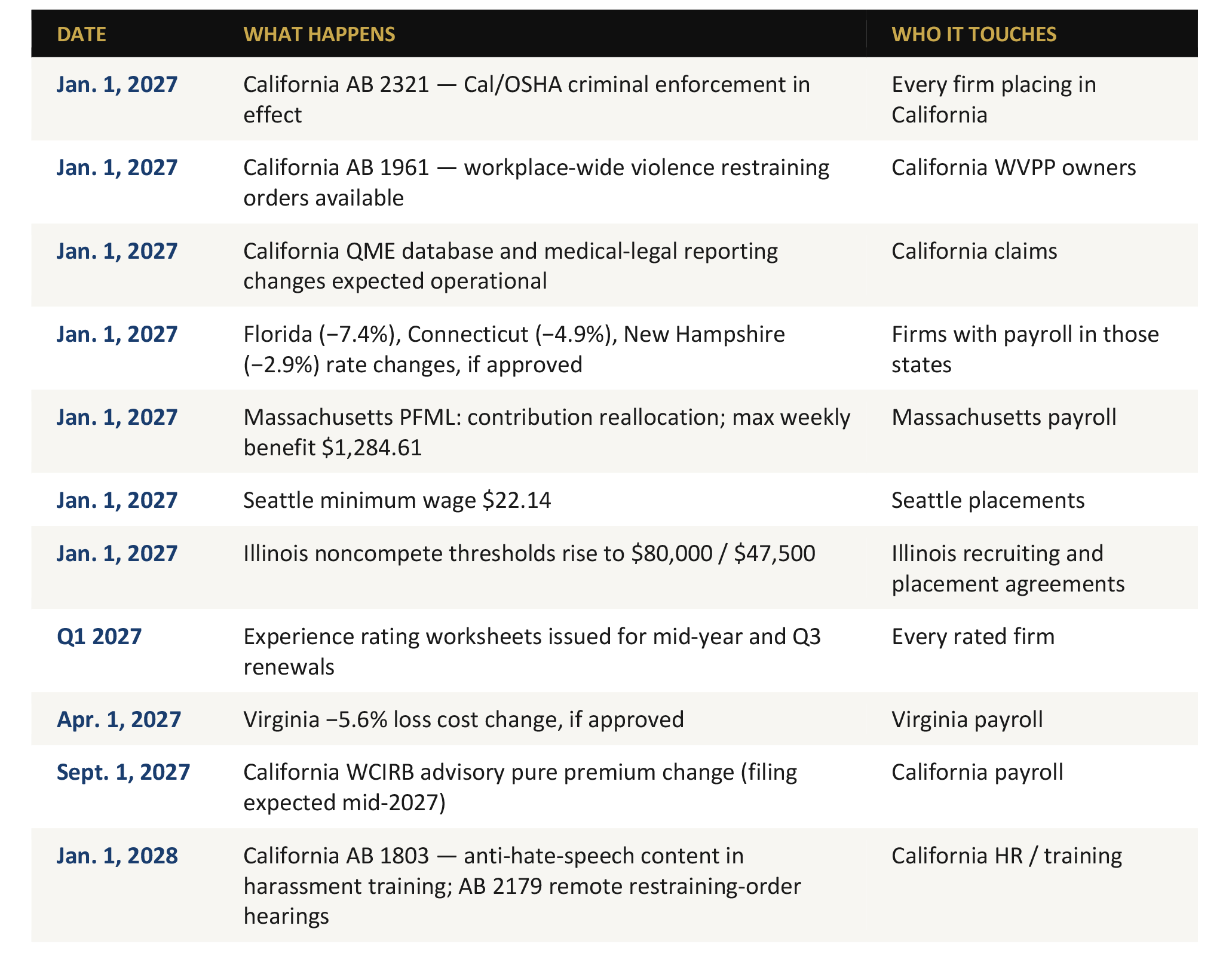
The 2027 Staffing Insurance Date Calendar
The dates that will touch a staffing firm’s insurance program or compliance obligations in 2027, in order.
What a Staffing Firm Should Walk Into Its 2027 Renewal With
If you do nothing else from this article, build this file by the end of Q1 and hand it to a broker who holds staffing-specialty appointments:
Three years of loss runs, valued within the last 60 days, with every open reserve reviewed and challenged where justified
Your projected 2027 experience mod, with the worksheet reconciled claim by claim
Trailing-twelve-month payroll by class code and by state, compared against current policy estimates, with every code that grew 20%+ flagged
A client site inventory by state — California payroll percentage known to the point
Every client service agreement reviewed for indemnity, insurance, alternate employer scheduling and safety allocation — with a list of the ones that need amendment
A written safety and onboarding program with dated records, nurse triage, and a return-to-work bench for temporary workers
State-fund accounts opened and stop-gap employers liability confirmed for any monopolistic-state exposure
A compliance calendar for EAD/TPS expirations, client report-time practices, PERM process controls, and drug-screen individual assessment
Employers liability limits reviewed against California and multi-state exposure
120-day renewal timeline with a known assigned-risk fallback
Frequently Asked Questions
Q: Why did my staffing workers comp premium go up when my state cut rates?
Statewide rate decreases are averages across all industries and are based on claim experience from two to three years earlier. A staffing firm’s premium is driven by its specific class codes (which skew toward higher-severity industrial, warehouse, construction and healthcare codes), its experience mod (which lags claims by two years), and the appetite of the specialty carriers that write staffing — which repriced in 2026 as reserve cushions shrank and medical severity rose 4%. The statewide rate can fall while every one of those three factors pushes a staffing renewal up.
Q: Which states are cutting workers comp rates for 2027?
As of October 2026, NCCI has proposed a 7.4% decrease in Florida (effective January 1, 2027, pending approval), a 5.6% decrease in Virginia (targeted April 1, 2027), and a 4.9% decrease in Connecticut (January 1, 2027); New Hampshire has approved a 2.9% decrease for January 1, 2027. Additional state filings will follow through late 2026 and early 2027.
Q: Is the workers comp market hardening in 2026?
Not in the headline numbers — premiums have declined for 18 straight quarters and private carriers remain profitable. But the underlying indicators turned in 2026: reserve redundancy fell to $14 billion (lowest since 2021), the accident-year combined ratio reached 102, medical and indemnity severity each rose 4%, the industry loss ratio hit a five-year high, and California is at a 127% combined ratio. Specialty staffing carriers responded to those indicators before the bureaus did, which is why staffing firms experienced a hardening market inside a soft one.
Q: How far ahead does the experience mod lag my claims?
The mod uses three policy years of data and excludes the most recently completed year. A claim that occurs in 2025 first affects the mod effective in 2027 and stays in it through 2029. Improvements made in 2026 generally do not appear until the 2028 mod.
Q: What should a staffing agency do if its workers comp carrier non-renews?
Treat the notice as a 60–90 day deadline and start immediately: assemble current loss runs, payroll by class and state, a worksite and screening description, and your safety program; confirm your broker holds staffing-specialty carrier appointments; and identify the assigned-risk option as a fallback. A non-renewal often signals a carrier-fit problem rather than an unplaceable account, but only if the submission reaches the right markets in time.
Q: Does workers comp cover wage-and-hour, PERM or I-9 claims against a staffing firm?
No. Workers’ compensation covers workplace injury and occupational disease. FLSA wage-and-hour claims, DOJ/EEOC immigration-related discrimination findings, I-9 and EAD violations, and most regulatory penalties are not covered by workers’ comp, and staffing EPLI policies generally exclude wage-and-hour. These are operational exposures the employer of record must manage directly.
Q: How does California AB 2321 affect staffing firms outside California?
AB 2321 applies to any employer with a worker in California, regardless of where the company is headquartered. A staffing firm based in another state that places a worker at a California client site is subject to Cal/OSHA jurisdiction, and after a serious injury both the agency and the host employer can be investigated. It takes effect January 1, 2027.
Q: What is the most important thing to do before a 2027 staffing workers comp renewal?
Start 120 days out with a complete submission: valued loss runs with reserves challenged, a projected mod, payroll by class code and state, a client site inventory, reviewed client contracts, and a documented safety program — delivered to a broker with staffing-specialty carrier appointments. The firms that got the best 2026 outcomes were the ones that controlled the timeline and the narrative instead of reacting to the carrier’s.
The Bottom Line
2026 was the year the workers’ compensation market split in two. The headline market kept cutting rates on the strength of a decade of favorable experience. The staffing market — concentrated in high-severity class codes, exposed to California, and underwritten by a small pool of specialty carriers watching their cushion shrink — started to turn. The gap between those two markets is the gap between what your CFO read and what your renewal said.
2027 will widen it. Medical severity is still rising, California is heading into a reform year, the reserve cushion that funded the rate cuts is at its lowest point in five years, and the legal definition of “employer” is being rewritten in real time. The eight pitfalls above are not predictions. They are the things that already cost staffing firms money this year — and every one of them has a Q1 action that changes the outcome.
Akker places workers’ compensation and specialty coverage for staffing firms nationwide, holds appointments with the specialty staffing programs that are still writing new business, and reviews mods, class codes, client contracts and multi-state exposure as part of every renewal. If your 2026 renewal came in higher than the headlines said it should, the explanation is in your file — and the review is free.