
California AB 2321: Cal/OSHA Gets Criminal Enforcement Power on January 1, 2027
On September 30, 2026, Governor Newsom signed Assembly Bill 2321, and on January 1, 2027, the way California handles a serious workplace injury changes. Until now, a serious injury at a California worksite meant a Cal/OSHA inspection, a citation, and a penalty. Starting in January, it can mean three parallel tracks at once: the ordinary inspection, a mandatory criminal investigation by Cal/OSHA’s Bureau of Investigations, and a referral to the county district attorney — with police and fire departments now required to call the DA directly from the scene. The bill also expands Labor Code §6425 so that a willful violation causing a serious injury (not just a death) can carry state prison time and fines of up to $1.5 million for a corporation or LLC, and it creates a new misdemeanor for interfering with a Cal/OSHA investigation. This applies to every employer with a worker in California. If you place workers at California client sites, it applies to you twice.
Quick Answer: What Does California AB 2321 Do?
QUICK ANSWER
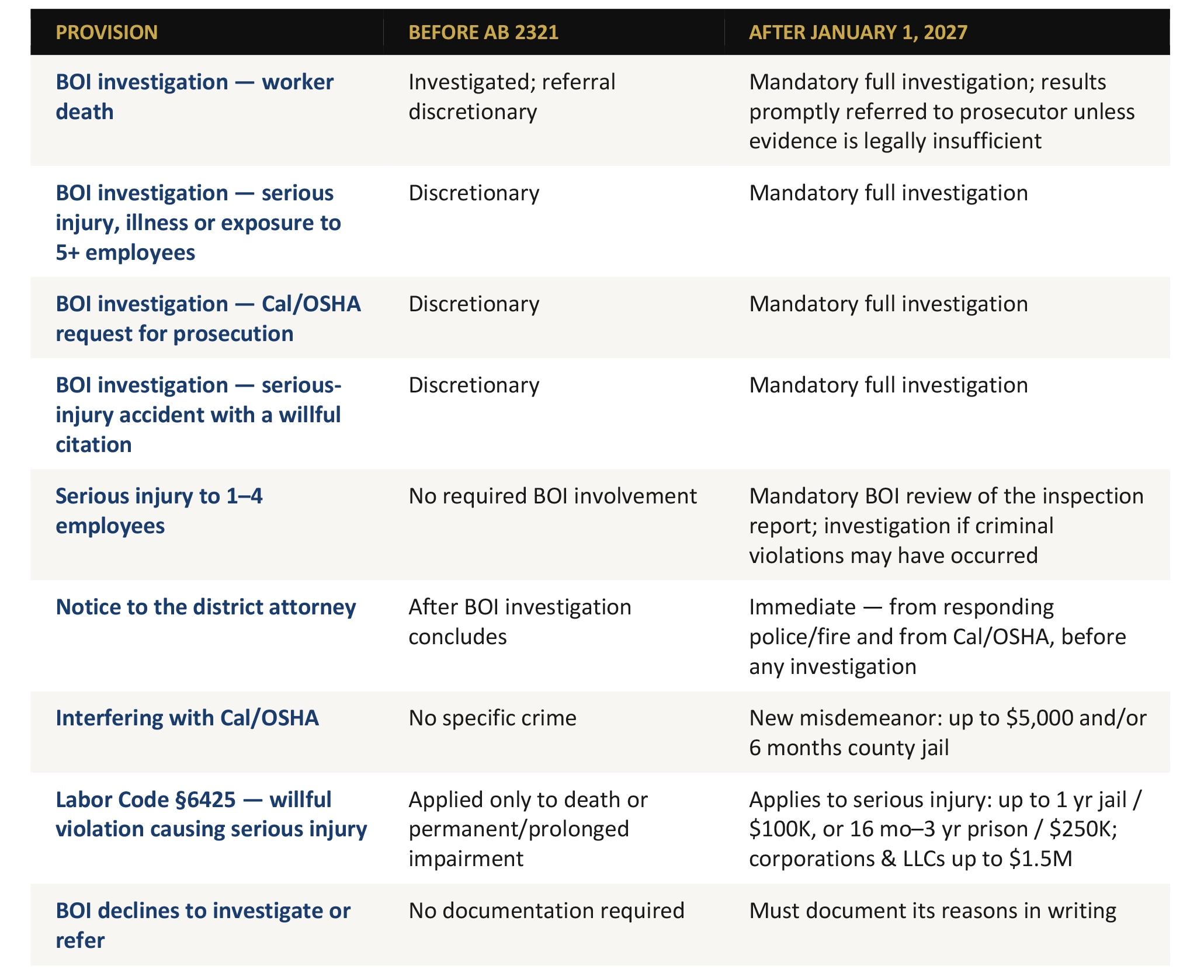
California Assembly Bill 2321, signed September 30, 2026 and effective January 1, 2027, expands the criminal enforcement authority of Cal/OSHA’s Bureau of Investigations. It makes BOI investigation mandatory for worker deaths, serious injuries, illnesses or exposures affecting five or more employees, Cal/OSHA requests for prosecution, and serious-injury accidents with a willful citation; requires BOI review of every serious-injury inspection report; requires police, fire and Cal/OSHA to immediately notify the county district attorney; creates a new misdemeanor (up to $5,000 and/or six months jail) for willfully interfering with Cal/OSHA; and expands Labor Code §6425 so willful violations causing serious injury carry up to three years in state prison, $250,000 in fines for individuals, and $1.5 million for corporations and LLCs. It applies to every employer with workers in California, including out-of-state companies and staffing agencies placing workers at California client sites.
What Changes on January 1, 2027?
The Bureau of Investigations has existed inside Cal/OSHA for years. Its job is to look at workplace accidents for criminal conduct and refer cases to prosecutors. Historically, it did not do much of that: according to the Assembly Floor Analysis, BOI referred only 1.7% of cases in its jurisdiction for criminal prosecution between 2019 and 2022. AB 2321 is the Legislature’s answer. It turns discretion into mandate, adds the district attorney to the first phone call, and raises the penalties for the cases that reach a courtroom.
WHAT “SERIOUS INJURY OR ILLNESS” MEANS IN CALIFORNIA
Under Labor Code §6302, a serious injury or illness is one that requires inpatient hospitalization for a reason other than observation or diagnostic testing, or that results in an amputation, the loss of an eye, or a serious degree of permanent disfigurement. It does not require death, and it does not require that the employer did anything wrong. A worker who is admitted overnight after a fall, a crush injury, or a chemical exposure meets the definition. California employers already have to report these to Cal/OSHA within eight hours. Starting in 2027, that same report starts the BOI clock.
Who Does AB 2321 Apply To?
Every employer with an employee working in California. It does not matter where the company is incorporated, where its headquarters is, or how many of its employees are in the state. A Georgia-based company with one remote technician in Fresno is subject to Cal/OSHA. A Texas manufacturer with a California distribution center is subject to it. A staffing agency in Florida that places a worker at a client site in Los Angeles is subject to it — and so is the client.
The industries that will feel it first are the ones where serious injuries happen: construction, manufacturing, warehousing and logistics, food processing, agriculture, oil and gas, utilities, and any operation with powered equipment, heights, confined spaces, or hazardous materials. But the law is not limited to them. A serious slip-and-fall in a retail stockroom, a forklift incident at a distribution center, or a chemical exposure in a lab triggers the same provisions.
The Three Parallel Tracks Every California Employer Now Faces
The practical change is that a serious workplace injury no longer produces one process. It can produce three at the same time, run by three different authorities with three different goals.
The Cal/OSHA Inspection
Civil. Regulatory. The process employers already know.
A compliance officer inspects the site, interviews workers and supervisors, reviews written programs and training records, and issues citations with civil penalties. Employers can appeal to the Occupational Safety and Health Appeals Board. This track does not change under AB 2321 — but what happens alongside it does.
The Bureau of Investigations Criminal Investigation
Criminal. Mandatory for covered incidents. Runs in parallel.
BOI investigators are peace officers. Their job is to determine whether a crime occurred — typically a willful violation of a safety order that caused the injury, or conduct that interfered with the investigation. They can interview the same witnesses, request the same documents, and reach different conclusions. Statements made to a Cal/OSHA compliance officer can end up in the BOI file.
The District Attorney
Criminal. Now notified immediately, not after the fact.
Under AB 2321, responding police and fire agencies must immediately notify both Cal/OSHA and the county DA. Cal/OSHA must notify BOI and the prosecutor regardless of how it learns of the accident. BOI must promptly refer investigation results to the prosecutor unless it finds evidence legally insufficient — and must document in writing why it declined. The prosecutor decides whether to charge the company, its managers, or both.
The point for business owners: the people on your site in the hours after a serious injury may include a compliance officer, a criminal investigator, and a deputy district attorney — and they will not all be there for the same reason.
The New Misdemeanor: What Counts as “Interfering” With Cal/OSHA?
AB 2321 creates a new misdemeanor for willfully resisting, preventing, impeding, or interfering with Cal/OSHA in the performance of its duties, or willfully violating a court order related to those duties. The penalty is up to $5,000, up to six months in county jail, or both.
The word that matters is willfully. Asking a compliance officer to wait while you call your attorney is not interference. Asking to see credentials is not interference. Declining to consent to a warrantless inspection and requiring a warrant is a right employers have had since 1978 and still have. What the statute targets is deliberate obstruction: instructing employees not to speak with investigators, removing or altering equipment or records after an incident, denying access after a warrant is presented, or coaching witnesses.
The practical risk is not the owner who deliberately hides something. It is the site supervisor who has never been trained on what to do when an investigator shows up, panics, and tells workers to go home. Under AB 2321, that supervisor’s instinct can become a criminal charge against the supervisor personally.
A NOTE ON RIGHTS
Employers retain their rights during Cal/OSHA activity, including the right to require a warrant for a non-consensual inspection, the right to have a representative accompany the inspector, the right to counsel, and the right to protect attorney-client privileged material. Fisher Phillips has already flagged a likely Fourth Amendment challenge to the interference provision. Exercising a right is not interference. Knowing the difference, and training supervisors on it, is the whole game.
Labor Code §6425: Why the Expanded Penalties Are the Bigger Story
The interference misdemeanor got the headlines. The §6425 expansion is what should get the board’s attention.
Before AB 2321, criminal liability under §6425 for a willful safety violation attached when the violation caused a worker’s death or permanent or prolonged bodily impairment. AB 2321 extends it to violations causing serious injury. The penalties:
• Up to one year in county jail, a fine of up to $100,000, or both; or
• 16 months, two years, or three years in state prison, a fine of up to $250,000, or both;
• For corporations and limited liability companies, fines under the first tier can reach $1.5 million.
A willful violation, in Cal/OSHA terms, is one where the employer knew the safety order applied and either intentionally violated it or showed plain indifference to it. The classic examples are the lockout/tagout procedure that everyone knows exists and nobody follows, the fall protection that was issued but never enforced, the machine guard that was removed to speed up production. Before 2027, that pattern plus a broken arm meant a willful citation and a six-figure civil penalty. After 2027, it means a mandatory criminal investigation and a potential felony.
If You Are a Staffing Agency Placing Workers in California
Staffing agencies sit in the most exposed position under this law, and most do not realize it. Here is why.
When a placed worker is seriously injured at a client site, Cal/OSHA’s long-standing position is that both the host employer and the staffing agency have obligations under the Labor Code — the host because it controls the site, the equipment and the day-to-day supervision; the agency because it is the employer of record and is responsible for ensuring its employees are placed in a safe environment and are trained for the work. Both can be cited. Both can be interviewed. And under AB 2321, both can be the subject of a BOI investigation.
The agency’s problem is that it usually does not have the facts. The supervisor who directed the task works for the client. The equipment belongs to the client. The site-specific training, if it happened, was given by the client. When a BOI investigator asks the agency what safety training the worker received before starting that job, the honest answer is often “we don’t know — the client was supposed to handle that.” That answer is not a defense. It is an admission.
• Your client service agreements need to define, in writing, who owns site-specific safety training, equipment inspection, lockout/tagout, fall protection, and incident reporting at every California site. Silence is the worst outcome.
• Require clients to notify you within hours of any injury to a placed worker, and to preserve video, equipment and records. You will need them for the comp claim and you may need them for the BOI.
• Keep your own records of general safety orientation for every placed worker — dated, signed, and specific to the hazards of the assignment category. If the BOI asks, you want to be able to produce it in a day.
• Train your branch managers and on-site coordinators on inspection response the same way you train your clients’ supervisors. They may be the first person from your company an investigator speaks to.
• Re-read the indemnity and hold-harmless language in every California client agreement. When a host employer is facing a criminal referral, the next document its lawyers open is the one that says who indemnifies whom.
• Confirm whether the host client is scheduled on your alternate employer endorsement and whether your employers liability limits are adequate for the exposure. Criminal fines are not insurable, but the civil claims that follow a criminal case are — if the policy is structured correctly.
If You Are a Host Employer Using Staffing Labor in California
• You control the site, so you will be the primary target of the inspection, the BOI investigation and any prosecution. A placed worker injured on your floor is your Cal/OSHA case.
• Site-specific training for every temp, documented the same way you document it for direct hires, is the single most important control. Cal/OSHA has cited host employers for assuming the agency trained the worker.
• Build the inspection response plan now: who meets the inspector, who calls counsel, who preserves evidence, who does not give statements. Then run it with your staffing vendor so both sides know the plan.
• Ask your staffing vendor what its own safety onboarding covers and get it in writing. If it is thin, require more or find a vendor whose program is real.
• Confirm you are scheduled on the vendor’s alternate employer endorsement and that your contract addresses indemnity for safety-related claims in both directions.
What Every California Employer Should Do Before January 1, 2027
Six moves, in order of how fast you can do them and how much they matter.
Write the Inspection Response Plan
The one-page document that stops a supervisor from becoming a defendant.
Who greets the investigator. Who calls counsel. Who accompanies the inspection. Who preserves video, equipment and records. Who does not give statements without counsel present. Which rights the company exercises and how. Print it, post it, train on it.
Train Supervisors on the Difference Between Rights and Interference
The misdemeanor is aimed at conduct, and conduct comes from untrained people.
Thirty minutes with every site supervisor on what they may do (ask for credentials, ask for a warrant, call the designated contact, accompany the inspector) and what they may not do (send workers home, remove equipment, alter records, tell anyone not to talk). Document the training.
Audit Your Willful Exposure
A willful citation is the gateway to §6425.
Pull your Cal/OSHA history. Any prior citation for a hazard that still exists is evidence of knowledge. Any written program that is not actually followed is evidence of plain indifference. Fix the gap between the binder and the floor before an investigator measures it.
Put Counsel on the Call Tree
Early counsel protects privilege and shapes what the investigators see.
Identify California workplace-safety counsel now, not after the ambulance leaves. Put the number in the response plan. The first statement given to a compliance officer may be the one read aloud in a BOI interview.
Fix the Documentation Chain for Every Temp and Contractor
Staffing agency and host employer, together.
Agree in writing who trains, who inspects, who reports, who preserves. Exchange training records. Make the agency’s general orientation and the host’s site-specific training two documented layers, not one assumption.
Review the Insurance Program Against the New Exposure
Criminal fines are not insurable. Everything around them can be.
Workers’ compensation and employers liability (Part Two) limits, the alternate employer endorsement, contractual liability under the general liability policy, and whether the D&O or management liability policy responds to defense costs for individual managers in a regulatory investigation. Ask the broker the question directly and get the answer in writing.
What This Means for Your Workers’ Compensation Program
AB 2321 does not change how a workers’ compensation claim is paid. It changes what else is happening while it is being paid. A serious injury that would once have been an indemnity claim and a civil citation now carries a criminal investigation alongside it, and the documents produced in that investigation — training records, inspection reports, supervisor statements — become part of the record the claim is adjusted against.
Two things follow. First, the quality of your safety documentation now matters in three forums instead of one. Second, employers liability coverage — Part Two of the workers’ compensation policy, which responds to claims outside the comp system — deserves a fresh look. Civil suits by injured workers alleging willful or intentional conduct, suits by family members, and third-party-over actions from host employers all become more likely when a criminal referral has already established a record. Standard $100,000/$500,000/$100,000 Part Two limits were set decades ago. They are not sized for a 2027 California exposure.
ON INSURABILITY
Criminal fines and penalties are generally uninsurable as a matter of public policy, and no workers’ compensation or liability policy will pay a §6425 fine. What insurance can address is the civil exposure that surrounds a criminal case: workers’ compensation benefits, employers liability claims, third-party suits, defense costs for individual managers under a management liability policy, and contractual indemnity obligations between staffing agencies and host employers. Whether any specific policy responds to any specific claim is determined by the policy as issued, not by this article.
Frequently Asked Questions
Q: What is California AB 2321?
AB 2321 is a California law signed by Governor Newsom on September 30, 2026 and effective January 1, 2027. It expands the criminal enforcement authority of Cal/OSHA’s Bureau of Investigations by making investigations mandatory for worker deaths, serious injuries/illnesses/exposures affecting five or more employees, Cal/OSHA requests for prosecution, and serious-injury accidents with willful citations; requires immediate notice to the county district attorney; creates a misdemeanor for interfering with Cal/OSHA; and expands Labor Code §6425 so willful violations causing serious injury carry felony-level penalties.
Q: When does AB 2321 take effect?
January 1, 2027.
Q: Does a single serious injury trigger a criminal investigation under AB 2321?
A single serious injury triggers a mandatory Bureau of Investigations review of the Cal/OSHA inspection report, and a full investigation if BOI finds that criminal violations may have occurred. A full investigation is automatically mandatory when the serious injury, illness or exposure affects five or more employees, when a worker dies, when Cal/OSHA requests prosecution, or when Cal/OSHA issues a willful citation for the accident.
Q: What is the penalty for interfering with Cal/OSHA under AB 2321?
Willfully resisting, preventing, impeding or interfering with Cal/OSHA in the performance of its duties, or willfully violating a related court order, is a misdemeanor punishable by a fine of up to $5,000, up to six months in county jail, or both.
Q: What are the new penalties under Labor Code 6425?
AB 2321 extends §6425 criminal liability from willful violations causing death or permanent impairment to willful violations causing serious injury. Penalties are up to one year in county jail and/or a fine up to $100,000, or 16 months to three years in state prison and/or a fine up to $250,000. For corporations and LLCs, the fine can reach $1.5 million.
Q: Does AB 2321 apply to out-of-state companies?
Yes. Cal/OSHA jurisdiction attaches to any employer with employees working in California, regardless of where the company is headquartered. An out-of-state company with a single California employee, or a staffing agency placing a worker at a California client site, is subject to the law.
Q: How does AB 2321 affect staffing agencies?
Both the staffing agency (employer of record) and the host employer (site controller) can be cited, interviewed and investigated after a serious injury to a placed worker. Agencies should define safety responsibilities in writing in every California client agreement, keep their own documented safety orientation records, require prompt incident notice and evidence preservation from clients, train branch staff on inspection response, and review indemnity language and alternate employer endorsements.
Q: Can insurance cover AB 2321 penalties?
Criminal fines and penalties are generally not insurable. Insurance can address the surrounding civil exposure: workers’ compensation benefits, employers liability claims, third-party suits, contractual indemnity between agencies and hosts, and in some cases defense costs for individual managers under a management liability policy. Coverage for any specific claim depends on the policy as issued.
The Bottom Line
For most of Cal/OSHA’s history, the worst realistic outcome of a serious workplace injury was a large civil penalty. AB 2321 changes that. From January 1, 2027, a serious injury in California brings a criminal investigator and a district attorney into the room alongside the compliance officer, and a willful violation that causes serious injury can end in state prison and a seven-figure corporate fine.
The employers who will handle this well are the ones who decided in advance who speaks, who calls counsel, what gets preserved, and what their supervisors are and are not allowed to do. The staffing agencies who will handle it well are the ones who stopped assuming the client was handling safety and put it in writing. None of that requires a new policy or a new budget. It requires doing it before January.
Akker places workers’ compensation and specialty coverage for staffing agencies and employers nationwide, including California, and reviews client agreements, employers liability limits and alternate employer endorsements against the exposure a law like this creates. If nobody has looked at your California program through the lens of AB 2321, that review is free.