
OSHA’s New Safety Champions Program:
What Every Staffing Agency Owner Needs to Know in 2026
On March 17, 2026, the U.S. Department of Labor officially announced OSHA’s new Safety Champions Program — a free, voluntary, self-guided framework designed to help employers build and strengthen workplace safety programs from the ground up. For most industries, this is interesting news. For staffing agencies, it’s something more: it’s a direct opportunity to reduce workers’ comp costs, lower your experience modification rate, and build the documented safety infrastructure that separates agencies that grow from agencies that get stuck.
This post breaks down exactly what the Safety Champions Program is, why OSHA specifically named staffing agencies in its core framework, and what participating means for your agency’s coverage and bottom line.
The Safety Champions Program is free. It is self-paced. OSHA named staffing agencies explicitly in the framework. If you place temporary workers, this program was built with you in mind.
What Is OSHA’s Safety Champions Program?
The Safety Champions Program is a new cooperative initiative launched by OSHA in early 2026. Unlike OSHA’s traditional enforcement-based approach — where agencies show up to inspect and issue citations — the Safety Champions Program is built around education, assistance, and voluntary participation.
The program’s stated goal is straightforward: prevent workplace injuries, illnesses, and fatalities by giving employers a structured, practical roadmap for building an effective safety and health program. It is not a replacement for OSHA compliance. It is a tool for getting there — and for going further.
OSHA Assistant Secretary David Keeling described the initiative as part of OSHA’s shift toward meeting employers “where they are” on their safety journey. The agency characterized itself as “constructively dissatisfied” with existing outreach programs and created Safety Champions as a next step in proactive employer engagement.
The Three Steps: How the Program Works
The Safety Champions Program is structured as three progressive, self-guided steps. Employers can move at their own pace and are not required to complete all three to participate or benefit.
Step 1: Introductory
At the introductory step, employers assess their current safety and health practices against OSHA’s Recommended Practices, identify gaps in their existing programs, and begin implementing basic safety program elements. This level is designed for organizations starting from scratch or looking to formalize what they already do informally.
Step 2: Intermediate
At the intermediate step, organizations implement more comprehensive safety initiatives, enhance worker participation, and develop more robust hazard prevention and control measures. This is where most staffing agencies will find the most immediately actionable work — building out pre-placement site assessment processes, formalizing return-to-work programs, and documenting host employer safety responsibilities in contracts.
Step 3: Advanced
At the advanced step, participants have integrated all seven core elements into their organizational culture and can demonstrate sustained commitment to safety excellence. Organizations at this level typically have strong safety metrics, continuous improvement processes, and documented worker engagement at all levels.
At any step, participants may request a Safety Champion Special Government Employee — an independent safety and health expert — to assess their program and provide technical guidance at no cost.
The 7 Core Elements — And Why Element 7 Matters Most for Staffing
The program is built around OSHA’s seven core elements of effective safety and health programs. For staffing agencies, the seventh element deserves special attention — it is the only element that explicitly names staffing agencies by name.
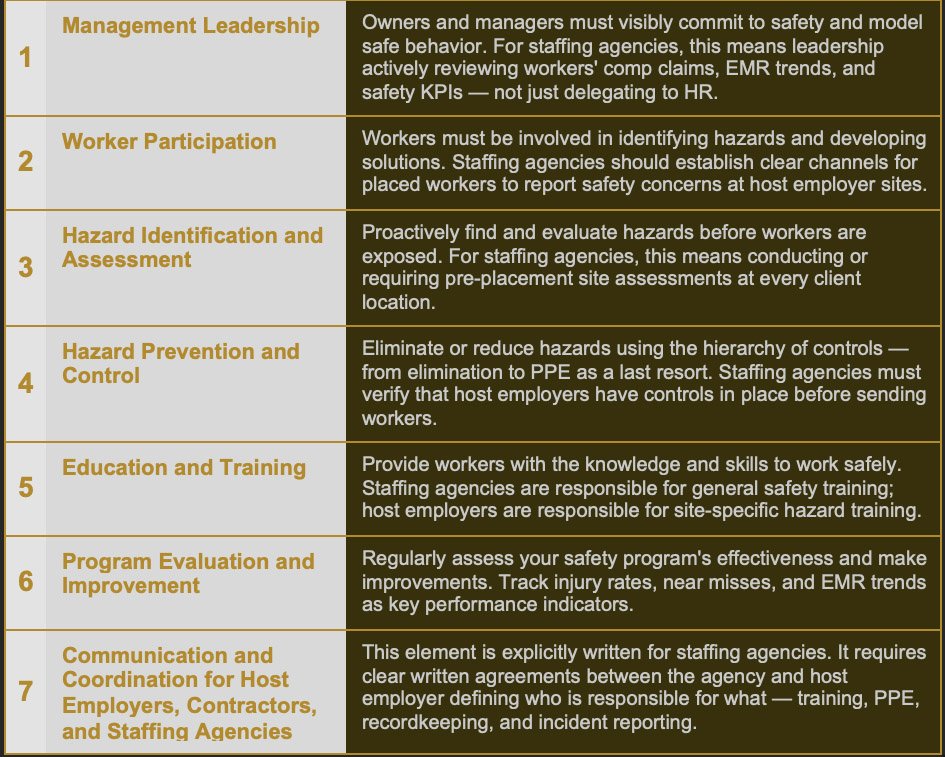
The fact that OSHA’s seventh core element explicitly calls out “communication and coordination for host employers, contractors, and staffing agencies” is not incidental. It reflects OSHA’s recognition that staffing agencies operate in a fundamentally different risk environment than traditional single-site employers — and that the shared responsibility between agency and host employer requires explicit documentation to function properly.
Why Staffing Agencies Face Unique Safety Challenges
Staffing agencies are joint employers under OSHA’s guidelines. This means that when a temporary worker placed by your agency is injured at a client’s facility, OSHA can — and regularly does — cite both the host employer and the staffing agency. Your agency shares responsibility for that worker’s safety even if you never set foot on the client’s worksite.
The statistics reinforce this. Temporary workers are injured at disproportionately higher rates than permanent employees across virtually every industry. The reasons are well-documented:
• Limited site familiarity: Temporary workers are placed in unfamiliar environments with equipment, chemicals, and procedures they have not been trained on.
• Onboarding gaps: Host employers frequently treat temp workers as “already trained” by the agency and skip site-specific safety orientation.
• Pressure to perform quickly: Temporary placements are often high-volume and fast-moving, creating pressure to get workers productive before safety protocols are fully communicated.
• Communication breakdowns: Incident recordkeeping, near-miss reporting, and return-to-work coordination between agency and host employer are frequently informal, undocumented, or inconsistent.
These gaps are exactly what the Safety Champions Program’s seventh element is designed to close — through written agreements, documented responsibilities, and clear communication protocols between your agency and every host employer you work with.
The Insurance Connection: How Safety Champions Directly Affects Your Workers’ Comp Premium
Participating in the Safety Champions Program is not just a compliance exercise. It has direct, measurable implications for your workers’ compensation costs — in three specific ways.
1. A Documented Safety Program Supports a Lower EMR
Your Experience Modification Rate — your EMR or ex-mod — is the multiplier that determines how much you pay for workers’ comp above or below the industry average. A well-documented safety program with pre-placement site assessments, written host employer agreements, and a formal return-to-work program directly reduces the frequency and severity of claims — which is exactly what drives your EMR down over time.
2. Proactive Documentation Protects You at Claims Time
When a worker is injured and a claim is filed, carriers and defense attorneys look for evidence that your agency took reasonable steps to ensure a safe placement. Written site assessment records, documented training confirmations, and signed host employer safety agreements are the difference between a defensible claim and an indefensible one. The Safety Champions framework gives you a structure for producing exactly that documentation.
3. A Strong Safety Program Keeps Carrier Options Open
Staffing agencies with high EMRs — particularly above 1.20 to 1.25 — begin to lose access to admitted carriers and get pushed into specialty or surplus lines markets with higher rates and narrower coverage terms. A demonstrated commitment to safety, backed by a program like Safety Champions, signals to underwriters that your agency is managing risk proactively. This keeps more markets available at renewal and creates leverage for better pricing.
A $75,000 workers’ comp claim adds an estimated $29,000 in extra premium over three renewal cycles due to EMR impact — on top of the claim cost itself. Prevention is not an HR topic. It is a financial one.
What Staffing Agencies Should Do Right Now
The Safety Champions Program is free, voluntary, and self-paced. There is no downside to participating and no penalty for starting at the introductory level. Here is what we recommend for staffing agency owners in 2026:
• Register for the program: Go to osha.gov/safety-champions to register. It takes minutes and immediately connects you to OSHA’s recommended practices framework.
• Conduct an honest gap assessment: Use the introductory step to evaluate where your current safety program actually stands against OSHA’s seven elements. Most staffing agencies will find the biggest gaps in Elements 3 (hazard identification at client sites) and 7 (written coordination with host employers).
• Formalize your host employer agreements: Every client relationship should have a written agreement that clearly specifies who is responsible for site-specific training, PPE, incident recordkeeping, and return-to-work coordination. Verbal agreements do not hold up in OSHA inspections or coverage disputes.
• Build or formalize a return-to-work program: Return-to-work is the single most effective lever for reducing EMR impact from claims. A documented light-duty program with signed job offers can reclassify lost-time claims as medical-only, dramatically reducing their EMR weight.
• Request a Safety Champion SGE assessment: OSHA will send an independent safety expert to assess your program at no cost. Use it. The feedback is confidential and not used for enforcement.
• Review your coverage alongside your safety program: Your workers’ comp policy, general liability, and staffing liability coverage should be reviewed in the context of your evolving safety program. Gaps in your safety documentation often correspond to gaps in your insurance coverage. This is where Akker can help.
The Bottom Line for Staffing Agency Owners
OSHA’s Safety Champions Program is the most staffing-agency-friendly initiative the agency has launched in years. It is free. It is voluntary. It is self-paced. And it explicitly names staffing agencies in its core framework because OSHA knows that the joint-employer structure creates unique safety responsibilities that require structured, documented management.
The agencies that engage with this program in 2026 will be building the safety infrastructure that lowers their EMR, keeps their carrier options open, and protects them from the joint-employer citations that are increasingly hitting staffing firms of all sizes.
The agencies that ignore it will keep finding out about their exposure the same way they always have — after something goes wrong.
Register for the Safety Champions Program at osha.gov/safety-champions. It’s free, it’s self-paced, and it may be the most cost-effective thing you do for your workers’ comp renewal this year.
Want a Free Coverage Review Alongside Your Safety Program?
At Akker, we specialize exclusively in staffing insurance. We review workers’ comp policies, EMR worksheets, host employer agreements, and coverage gaps — at no charge. If you’re building out your Safety Champions program and want to make sure your coverage matches your exposure, reach out.