
54% of Workers’ Comp Injuries Happen in the First Two Years on the Job
A new report from the Workers Compensation Research Institute analyzed 8 million workers’ compensation claims across 31 states from 2022 through 2024 -- and the headline finding should be on every business owner’s radar. Workers with less than two years on the job accounted for 54 percent of all WC injuries during the study period, despite representing roughly one-third of the total workforce. Nearly four in ten injuries occurred during the worker’s first year. Sixteen percent happened in the first three months alone. The data is clear: the highest-risk window in workers’ compensation is the period right after you hire someone.
About the WCRI Study
The Workers Compensation Research Institute is an independent, not-for-profit research organization that has produced authoritative WC data and analysis for more than 40 years. Their September 2026 study examined 8 million non-COVID-19 workers’ comp claims from injury years 2019 through 2024, across 31 states that collectively account for approximately 83 percent of all workers’ compensation benefits paid in the United States.
This is not a survey or a modeled estimate. It is the actual filed claim record of the American workforce across more than a decade and across virtually every major industry sector. The 54 percent figure represents what happened -- not a projection of what might happen.
The Core Finding: New Workers Are Getting Hurt at Twice the Rate Their Numbers Predict
Workers with less than two years on the job represent roughly one-third of the U.S. workforce. But they account for 54 percent of all workers’ comp injuries. That is a gap of more than 20 percentage points between their workforce share and their injury share -- meaning new workers generate WC claims at approximately 1.6 times the rate the rest of the workforce does.
When you look at even shorter tenure windows, the concentration gets more pronounced.
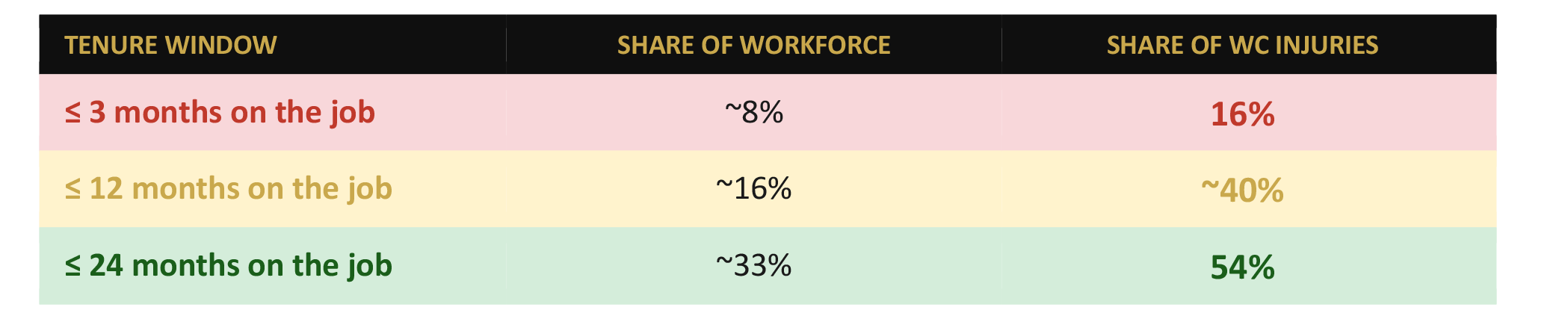
Every bracket tells the same story: the shorter the tenure, the greater the disproportionate injury burden. Workers in their first three months on the job account for 16 percent of all WC injuries while representing only about 8 percent of the workforce -- a 2:1 disproportion at the most acute exposure point.
WHAT THIS MEANS IN PLAIN TERMS
If you hire 10 new employees this year and one of them gets hurt on the job, the WCRI data tells you that injury is more likely to happen in the first 90 days than at any other point. Not because your new employees are careless -- but because unfamiliarity with equipment, procedures, coworkers, and the specific physical demands of a job creates a statistically elevated injury window that only time and experience close. Your WC premium, your experience modification rate, and your bottom line are all shaped by how you manage that window.
Why New Workers Get Hurt More: The Mechanics of the Risk Window
Unfamiliarity with Equipment and Physical Demands
A new employee operating machinery, tools, or physical equipment they have not worked with before -- even if they have experience in the same general trade -- is at elevated injury risk until they develop the specific familiarity that safety instinct requires. Knowing how to operate a forklift is different from knowing how that specific forklift behaves on that specific floor surface, around those specific obstacles, at the pace that business demands.
No Established Communication Patterns with Coworkers and Supervisors
Experienced workers protect each other through informal communication -- a nod, a warning, a habitual positioning relative to equipment -- that new workers have not yet built with their team. The informal safety network that develops in a stable workforce over months and years does not exist for workers in their first quarter on the job. That absence is invisible until something goes wrong.
Physical Conditioning for the Specific Demands of the Job
Even physically fit new workers are not conditioned for the specific repetitive demands of a new role. Muscles, joints, and movement patterns that prevent injury from repetitive tasks -- lifting, carrying, rotating, climbing -- develop over weeks and months. A worker who is very fit in general terms may still sustain a musculoskeletal injury in the first quarter because their body has not yet adapted to what this specific job asks of it every day.
Onboarding Quality Determines How Fast the Risk Window Closes
The WCRI data showed an encouraging trend in one specific window: claims involving workers with less than three months of tenure fell from 18.4 percent of all claims in 2022 to 14.4 percent in 2024 -- below the pre-pandemic baseline of 15.7 percent in 2019. The researchers attribute this partly to improved onboarding practices as businesses responded to the pandemic-era hiring surge with more structured new-worker training. Businesses that invest in thorough, documented, site-specific onboarding see measurable reductions in new-worker claim frequency.
Industry Breakdown: Where New-Worker Injuries Are Most Concentrated
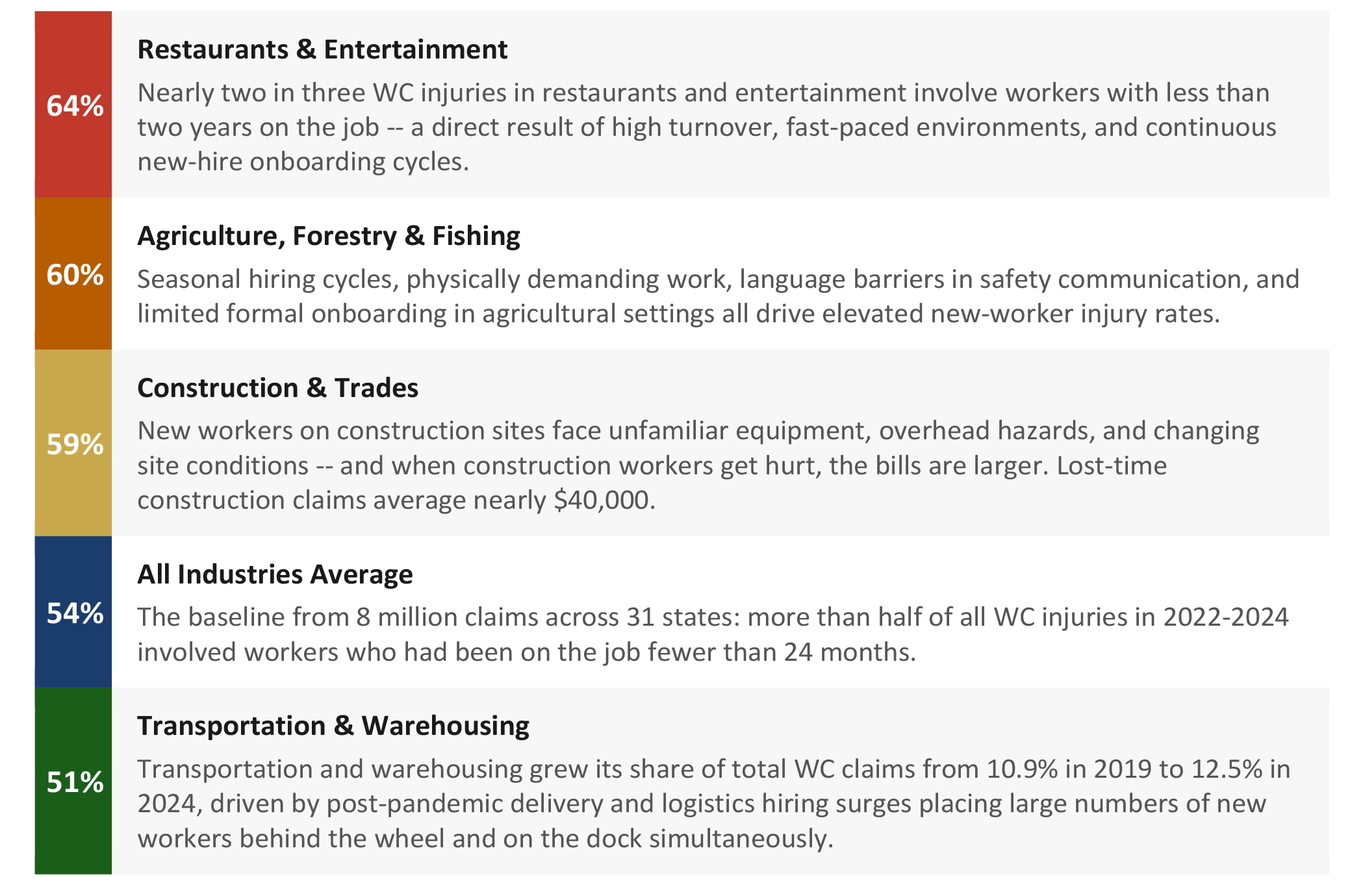
The WCRI data breaks the new-worker injury concentration down by industry sector. If your business operates in any of these verticals, you are operating in the highest-exposure segment of the WC landscape.
CONSTRUCTION: HIGH FREQUENCY AND HIGH COST
Construction and mining carried the highest average claim costs of any sector in the WCRI study. For lost-time construction claims -- those involving more than seven days out of work -- average medical payments were $22,752 and indemnity benefits were $16,830 at 12 months after injury. Combined, those payments approached $40,000, compared with approximately $25,000 across all industries for the same lost-time threshold. Construction claims cost 60% more than the all-industry average -- and 59% of those claims involve workers with less than two years of tenure. The combination of elevated frequency and elevated cost makes the new-worker risk window in construction one of the most significant WC exposure concentrations in any industry.
What This Data Means for Your WC Premium and Your Experience Mod
Workers’ compensation premium is not a fixed cost. It is a direct function of your payroll, your class codes, and your experience modification rate -- the EMR that reflects your actual loss history relative to your industry average. Every WC claim that gets filed, paid, and reported to NCCI enters your EMR calculation and affects your premium for three consecutive policy years.
New-worker injuries -- the claims concentrated in that first 90-day to 24-month window -- are the claims most likely to affect your EMR. They tend to be more severe because the injured worker has less familiarity with the specific physical demands of the job and less access to the informal coworker safety network that catches problems before they become injuries. They are also the claims least likely to have been prevented through the kind of systematic safety investment that only develops with workforce stability over time.
THE THREE-YEAR PREMIUM IMPACT
A significant new-worker injury in year one -- a construction fall, a musculoskeletal injury in a warehouse, a vehicle accident in the first week of driving a new route -- enters your EMR calculation and stays there for three consecutive renewal cycles. On a $100,000 annual WC premium, a mod increase of 0.15 points adds $15,000 to your annual premium. Over three years, a single bad claims period costs $45,000 in premium surcharges on top of whatever the claim itself cost to resolve. The new-worker risk window is not just a safety issue. It is a three-year financial exposure.
5 Actions Every Business Can Take to Reduce New-Worker WC Risk
Build a Documented Site-Specific Onboarding Safety Protocol
A generic safety orientation is not what the WCRI data calls for. The businesses that saw declining new-worker injury rates invested in onboarding that addressed the specific hazards of the specific job at the specific location where the worker would be assigned. Document the orientation, have the worker sign it, and keep the record. That documentation is both a prevention tool and a claims defense if a dispute arises about whether the worker was trained.
Track WC Claims by Employee Tenure Internally
Most businesses track WC claims by incident type and cost but not by tenure at time of injury. Building a simple internal spreadsheet that records how long each injured worker had been on the job when the injury occurred tells you exactly where your risk window is concentrated. If your claims cluster in months one through six, your onboarding protocol is the target. If they cluster in months six through eighteen, the issue is likely the transition from supervised to unsupervised work.
Establish a Return-to-Work Protocol Before a Claim Happens
Early return to work on modified duty is the single most effective tool for reducing WC claim severity. A worker who returns to light duty within two to three weeks of a soft-tissue injury costs significantly less in indemnity than one who remains fully off work for months. The protocol needs to be in place, communicated to supervisors, and confirmed with your WC carrier before the claim occurs -- not improvised afterward.
Review Your WC Class Codes Before Every Renewal
New hires often perform work that spans multiple class codes -- and an incorrect class code assignment means you are either paying the wrong premium or, worse, your claim at audit will generate a retroactive surcharge because the carrier reclassifies the work. Review your class code schedule with your WC broker before every renewal and whenever you add a new type of work or a new type of employee. Misclassification is one of the most common and most expensive WC administration errors.
Ask Your WC Broker Specifically How Your Policy Addresses New-Worker Risk
A general commercial WC policy and a program specifically designed for your industry’s new-worker risk profile are not the same product. Ask your broker: does this carrier have experience in our industry? Do they have claims data showing how new-worker injuries are trending in our class codes? Do they have a return-to-work program? Do they have loss control resources for new-hire onboarding? If your broker cannot answer those questions specifically, you may be in a general commercial WC market that was not built for your actual risk profile.
Frequently Asked Questions
Q: Why do workers in their first two years on the job get hurt so much more often?
New workers face a combination of unfamiliarity with specific equipment, procedures, and the physical demands of the job, combined with less-developed communication patterns with supervisors and coworkers who can warn them about site-specific hazards. Even experienced workers in their trade face a new-worker risk window when they change employers, because the specific configuration of a new workplace -- its equipment, its pace, its layout, its culture -- is genuinely new. The WCRI data shows this pattern consistently across all major industries and all tenure definitions studied.
Q: How does a workers’ comp claim from a new employee affect my insurance premium?
Every WC claim that is filed and paid enters your experience modification rate -- the EMR or mod -- and affects your WC premium for three consecutive renewal cycles. A significant injury claim from a new employee can add 10-20% or more to your annual premium for three years. On a $100,000 annual WC premium, a 0.15-point mod increase adds $15,000 per year -- $45,000 over the three-year cycle. This is why new-worker safety investment pays off financially, not just operationally.
Q: What is an experience modification rate and how is it calculated?
Your experience modification rate -- called the EMR or mod -- is a multiplier calculated by NCCI (the National Council on Compensation Insurance) that is applied to your base WC premium at renewal. It compares your actual WC losses over the most recent three completed policy years to the expected losses for a business of your size and class code. A mod of 1.0 is average. A mod below 1.0 gives you a premium credit. A mod above 1.0 adds a surcharge. New-worker injuries that generate significant claims push the mod above 1.0 and raise your premium across three consecutive renewals.
Q: Which industries have the highest concentration of new-worker WC injuries?
According to the WCRI 2026 study, restaurants and entertainment have the highest concentration at 64% -- nearly two in three WC injuries involve workers with less than two years of tenure. Agriculture, forestry, and fishing is next at 60%, followed by construction and trades at 59%. The all-industry average is 54%. Transportation and warehousing came in at 51% but saw its share of total WC claims grow significantly from 2019 to 2024, driven by last-mile and delivery sector hiring.
Q: What is the most effective thing a business can do to reduce new-worker WC injuries?
The WCRI data points to structured, documented, site-specific onboarding as the most consistent differentiator. The study showed that the very-early-tenure injury rate (first 90 days) declined meaningfully from 2022 to 2024, falling below the pre-pandemic baseline -- a period when many businesses upgraded their new-hire onboarding in response to the pandemic hiring surge. Generic safety orientations have less impact than training that addresses the specific hazards of the specific job at the specific location where the worker will actually be working.
The Bottom Line
The WCRI study analyzed 8 million WC claims across 31 states and returned a clear finding: the first two years on the job are the highest-risk period in workers’ compensation, in every major industry, without exception. New workers generate more than half of all WC injuries despite representing only a third of the workforce.
For business owners, this is both a safety imperative and a financial one. Every new hire is your highest WC exposure. Every onboarding gap is a potential claim. Every claim is a three-year premium event. The businesses that manage this window well -- with documented site-specific onboarding, return-to-work protocols, correct class code management, and a WC program built for their actual risk profile -- pay less for WC over time and spend less time managing the aftermath of preventable injuries.
The question is not whether your new workers are at elevated risk. The WCRI data answers that. The question is whether your WC program and your safety practices are built to address it.