
January 1, 2027 Is Right Around the Corner: Why Staffing Agency Owners Cannot Wait
January 1 is the single largest insurance renewal date in the staffing industry. More staffing agencies have January 1 effective dates on their workers’ compensation, general liability, EPLI, and professional liability policies than any other date on the calendar. And every year, without exception, a significant number of those agencies wait until October or November to start the process -- and pay for it with fewer options, higher premiums, and rushed coverage decisions. If your staffing agency insurance renews on January 1, 2027, the time to start is now. This guide explains why timing matters, what the submission process looks like, and exactly what documents you need to give your broker the best possible shot at a competitive renewal.
Why January 1 Is the Most Dangerous Renewal Date in Staffing
January 1 effective dates are the norm in the staffing industry because most agencies either started their policies at the beginning of a calendar year or aligned their renewal to the calendar year for accounting purposes. The problem is that everyone with a January 1 effective date is competing for the same underwriter attention at the same time -- in October and November -- when carriers are processing the largest submission volume of the year.
WHAT HAPPENS WHEN YOU WAIT TOO LONG
Carriers and their underwriters have limited capacity. A submission that arrives in mid-November for a January 1 effective date is competing with dozens of other submissions for the same underwriter's desk. Underwriters prioritize submissions based on completeness and timing. An incomplete submission that arrives late gets pushed to the back. A complete submission that arrives in September or October gets the underwriter's full attention, more thorough pricing, and in many cases better terms. Waiting until the last 60 days before a January 1 effective date is one of the most common and most expensive mistakes staffing agency owners make at renewal.
Late submissions also limit your options. Specialty carriers that write staffing accounts -- particularly those covering workers’ comp for industrial, healthcare, and construction placements -- require more underwriting time than standard program carriers. They need to evaluate your loss history, assess your client mix, review your payroll by class code, and in some cases run the account past reinsurance. That process takes time. Giving a specialty market 30 days to respond is not the same as giving them 90 days.
The agencies that consistently get the best renewal pricing are the ones that start the process in September. They give their broker time to approach multiple markets, compare options on equal footing, and negotiate from a position of choice rather than necessity.
The January 1, 2027 Countdown: Your Renewal Timeline
Here is the timeline every staffing agency owner with a January 1 effective date should be working against right now.
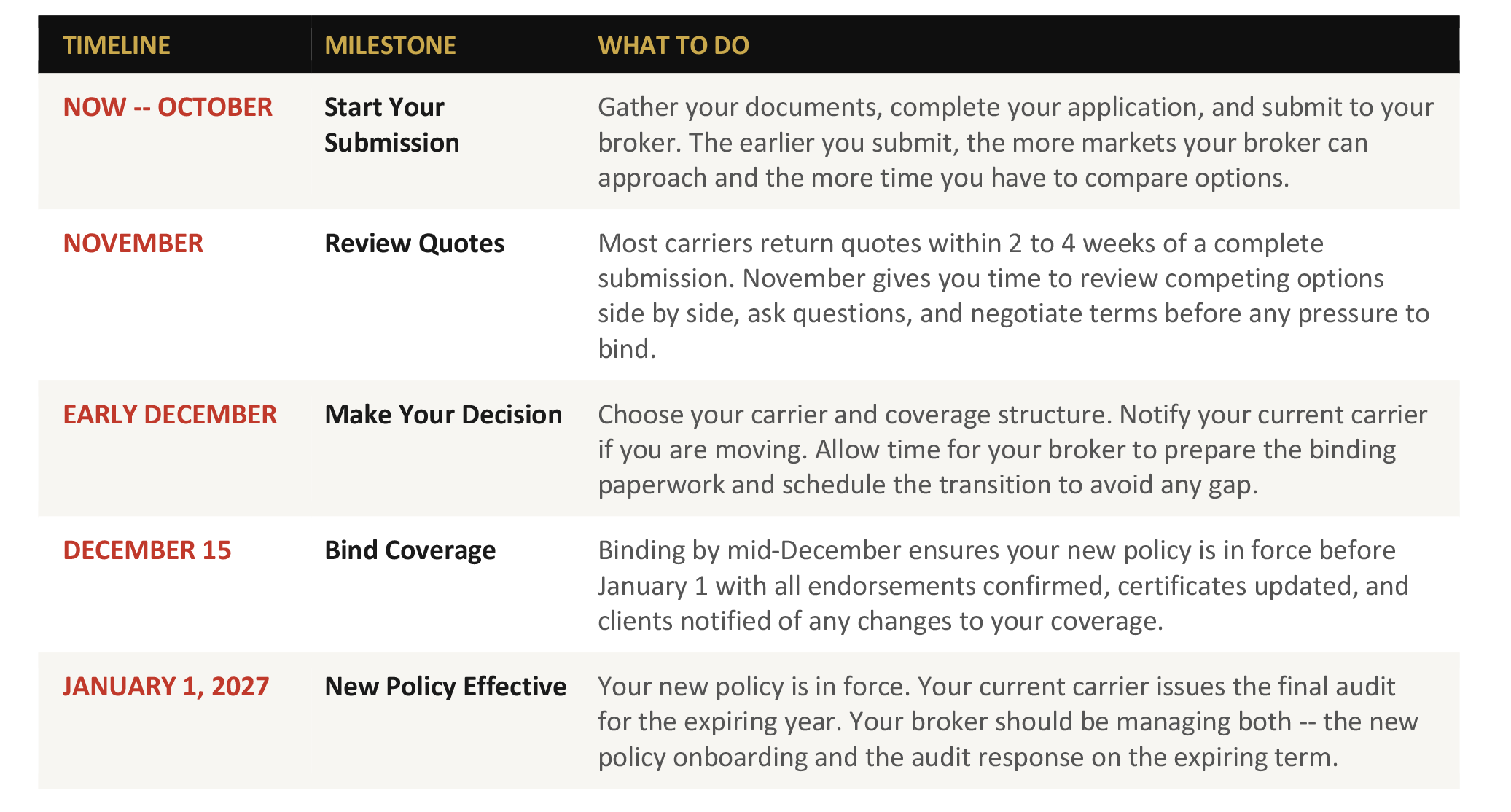
THE COST OF WAITING: A REAL EXAMPLE
A staffing agency with $2 million in annual WC premium that waits until November 15 to start their January 1 renewal process: their broker has 6 weeks to get the submission together, approach markets, receive quotes, and bind coverage. Two specialty carriers that could have offered competitive pricing decline to quote because they cannot complete underwriting by December 31. The agency ends up with one quote from their current carrier at a 12% increase and no leverage to negotiate. A September submission to the same broker for the same account produces quotes from three carriers -- and the agency binds at a 4% decrease. The timeline is the strategy.
The 6 Documents Every Staffing Agency Needs for a Complete Submission
A complete submission is what separates the agencies that get quoted from the ones that get deferred. Every document below serves a specific purpose for the underwriter. Missing any one of them slows the process or results in a request for additional information that adds days or weeks to your timeline.
Completed Staffing Insurance Application
Your signed application is the starting point for every carrier submission. It covers your operations, payroll by class code, states you operate in, number of in-house vs temporary employees, and types of clients you place with. Carriers will not quote without it.
Current Policy Declarations Page and Full Policy Copy
Your existing policy copy tells the incoming carrier exactly what you have -- coverages, limits, carriers, endorsements, exclusions, and premium. It also confirms your current effective and expiration dates so the new policy can be structured to line up properly.
Loss Runs for the Prior 3 to 5 Years
Loss runs are your complete claim history -- every claim that was opened during each policy year, the date of loss, the type of claim, the amount paid, and the current reserve on any open claims. Most carriers require a minimum of 3 years. 5 years is ideal. Your current carrier is required to provide them upon request -- usually within 10 business days.
IRS Form 941 for the Last 4 Quarters
The 941 is the quarterly payroll tax return your company files with the IRS. Carriers use it to verify actual payroll -- because WC premium is calculated on payroll, not on estimates. Providing 4 quarters of 941s gives the underwriter confidence that the payroll figure on your application is accurate and that your account will not produce a large audit adjustment.
Blank Client Agreement / Staffing Services Agreement
Your standard client contract tells the underwriter how your business operates -- how you define the employment relationship with temporary workers, what safety obligations your clients accept, whether you require certificates of insurance from clients, and what indemnification language protects your agency. A strong client agreement improves your underwriting profile.
Company Employee Handbook
Your handbook demonstrates that your agency has documented employment policies covering workplace safety, injury reporting, harassment and discrimination, drug-free workplace, and return to work. Carriers -- especially those writing EPLI -- want to see that your agency has a formal documented framework for managing employment practices risk.
A Closer Look: Why Carriers Require IRS Form 941
The 941 requirement surprises many staffing agency owners who have never been asked for it before. Here is exactly why carriers need it and what they use it for.
Workers’ Compensation Premium Is Calculated on Actual Payroll
Your WC premium is not a flat fee. It is calculated by multiplying the applicable rate per $100 of payroll by your actual payroll in each class code. At the end of the policy year, your carrier conducts an audit to reconcile the premium you paid against your actual payroll. If actual payroll was higher than estimated, you owe additional premium. If it was lower, you receive a credit.
The 941 Verifies That Your Payroll Estimate Is Accurate
A staffing agency application that reports $3 million in WC-covered payroll but 941s that show $5 million in total payroll creates a significant discrepancy -- and raises a red flag for the underwriter. Either the payroll estimate is wrong, or there are workers being paid who are not reflected in the WC submission. Four quarters of 941s give the underwriter a verified, IRS-filed record of what your total payroll actually was for the prior year. It is the most objective payroll verification document available.
It Also Confirms Your Business Is Operating as Described
A startup staffing agency applying for coverage with a $5 million payroll estimate but 941s showing $500,000 in actual payroll presents a risk profile that does not match its application. Carriers use the 941s to verify that the business is actually operating at the scale it claims -- which affects both pricing and underwriting decisions.
How Akker's Specialty Markets Work for Staffing Agencies
Not every WC and liability carrier writes staffing accounts. Standard commercial markets often decline staffing submissions because the employer-of-record structure, the multi-location client exposure, and the diverse class code mix create complexity that standard markets are not equipped to evaluate correctly.
Akker has spent 15 years building relationships with A+ rated specialty carriers that underwrite staffing accounts as their core business -- not as a side market. These are carriers whose underwriters understand the difference between a light industrial staffing firm and a healthcare staffing firm, whose claims teams know how to manage split-employer WC claims at client sites, and whose program structures are built around the realities of staffing firm operations.
WHAT AKKER SUBMITS YOUR ACCOUNT TO
When Akker receives your complete submission package, we approach multiple specialty staffing markets simultaneously -- not sequentially. You get competing quotes from carriers who actually want your business and have the expertise to price it correctly. We compare them side by side on coverage terms, not just premium, and present you with a clear recommendation based on your specific operation and loss history. One submission. Multiple markets. Your broker managing all of it.
For staffing agencies with complex loss histories, elevated EMRs, or challenging class code mixes -- excavation, industrial, healthcare, parcel delivery -- Akker also has access to specialty program markets that standard staffing brokers cannot reach. If you have been declined by a standard market or told your account is uninsurable, it is worth having a specialist look at it before accepting that as the final answer.
Frequently Asked Questions
Q: When should a staffing agency start their January 1 insurance renewal?
September is the ideal starting point for a January 1 effective date. This gives your broker 90+ days to approach multiple markets, receive and compare quotes, negotiate terms, and bind coverage without any time pressure. Starting in October is still manageable. Starting in November significantly limits your options and your leverage. Starting in December puts you at risk of a coverage gap or a forced renewal with your current carrier on their terms.
Q: How do I get my loss runs from my current carrier?
Contact your current insurance carrier directly and request loss runs for the prior 3 to 5 policy years. You can make this request yourself or through your broker -- carriers are required to provide loss runs within a reasonable timeframe, typically 10 business days. Request them in writing (email is fine) and ask for them to be provided in PDF format. Loss runs show every claim that was opened, the date of loss, the claim type, the amount paid to date, and the current reserve on any open claims.
Q: What is an IRS Form 941 and why does my insurance carrier need it?
IRS Form 941 is the Employer's Quarterly Federal Tax Return that your business files each quarter reporting total wages paid, federal income tax withheld, and Social Security and Medicare taxes. Workers’ compensation carriers use your 941s to verify that the payroll reported on your insurance application matches what you actually paid employees during the year. It is the most reliable third-party payroll verification document available because it is filed with the IRS under penalty of perjury.
Q: What coverages does a staffing agency typically need at renewal?
A complete staffing insurance program typically includes Workers’ Compensation (covering temporary and in-house employees), General Liability (covering third-party bodily injury and property damage), Professional Liability/E&O (covering claims arising from the placement of workers), Employment Practices Liability (covering discrimination, harassment, and wrongful termination claims from employees, temps, and applicants), and optionally an Umbrella/Excess policy for additional limits. Most enterprise clients and contracts require all of these coverages before a staffing firm can begin placements.
Q: Can Akker help staffing agencies with elevated EMRs or prior claims?
Yes. Akker has access to specialty staffing markets that evaluate accounts holistically -- not just on their EMR. An elevated experience modification rate combined with a documented safety improvement program, declining claim frequency, and strong client contracts is a very different risk profile from an elevated EMR with no changes in safety practices. We present the full picture to carriers who have the underwriting expertise to understand it. If you have been declined or surcharged heavily by a standard market, contact Akker before accepting that as your only option.
The Bottom Line: January 1, 2027 Is Closer Than You Think
September 22, 2026 is exactly 100 days before January 1, 2027. If your staffing agency insurance renews on January 1 -- your WC, your GL, your EPLI, your E&O -- the window to get the best possible renewal outcome is open right now and it closes faster than most agency owners expect.
The agencies that start in September get multiple quotes, real competition, and time to make a thoughtful decision. The agencies that start in December get whatever their current carrier offers them.
Your submission package is the foundation of your renewal. Gather the six documents. Engage a specialist broker who has access to the right markets. Give the process the time it deserves.