
What Every Film and Event Equipment Rental House Needs to Know About Insurance in 2026
If you own a camera rental house, a grip and lighting company, an AV production equipment company, or an event staging and audio rental operation, your insurance program is not the same as a standard commercial property policy. The gear you rent out goes on film sets, concert stages, and event venues across the country. It travels in vans, sits on location trucks, passes through the hands of dozens of different productions and event crews, and comes back in conditions ranging from perfect to destroyed. The insurance that protects your business must be built specifically for how rental companies actually operate -- not for how a general commercial property underwriter imagines they do. This guide covers every coverage type a film and event equipment rental house needs in 2026, the gaps that generate denied claims, and the documentation practices that protect your inventory when something goes wrong.
Why Standard Commercial Property Insurance Falls Short for Rental Houses
Standard commercial property insurance is designed to protect a business's assets at a fixed, known location. Equipment rental houses do not operate that way. Your inventory is constantly in motion -- checked out to productions, loaded into vehicles, on location at addresses you did not pre-specify, at festivals, concerts, event venues, and film sets in conditions your underwriter never anticipated when the policy was written.
The coverage that applies to inventory you own and store in your facility is fundamentally different from the coverage that applies to that same inventory once it leaves your dock and enters a client's hands. Standard commercial property policies frequently exclude property in transit, property in the custody of third parties, and property at unnamed locations. If your policy was not specifically written to follow your inventory wherever it goes, the coverage stops at your door.
THE INLAND MARINE SOLUTION FOR RENTAL HOUSES
The correct policy structure for an equipment rental house is an inland marine policy -- sometimes called an equipment floater or a dealer's floater for rental operations. Inland marine insurance was specifically designed for property that moves from location to location: it follows the equipment into the client's custody, through transit, on location, and back. A correctly written inland marine policy for a rental house should cover your inventory at your facility, in transit, at any location where it is being used by a client, and in storage anywhere. It should be written on a replacement cost basis -- not actual cash value -- so that a stolen or destroyed camera is replaced at today's market value, not depreciated value.
The 6 Essential Coverages Every Film and Event Rental House Needs
Inland Marine -- Dealer's Floater (Equipment Rental) Your primary property coverage, covering all owned inventory whether on-site, in transit, or in the custody of clients. Written on replacement cost basis. Should include worldwide or at minimum US and Canada territory coverage if any clients take gear internationally. Per-item sublimits must reflect your highest-value individual pieces -- a $200K camera body needs a per-item limit that covers full replacement, not shared with a $500 reflector.
General Liability -- Commercial Operations Covers third-party bodily injury and property damage arising from your rental operations -- a client injured by improperly maintained equipment, a studio visitor who trips in your facility, or a fire traced back to your equipment at a venue. Rental houses are frequently named in claims by their clients' clients: if a production uses your lighting rig and a set fire results in damage to the location, your GL exposure follows. Minimum $1M per occurrence, $2M aggregate, with most larger clients requiring higher limits.
Third-Party Property Damage / Loss of Use When your rented equipment damages property that neither you nor your client owns -- a location's flooring damaged by your generator, a venue's wall damaged by your rigging. Loss of Use coverage pays the property owner's losses from not being able to use the damaged property while it is being repaired. Standard GL covers the damage itself; Loss of Use is frequently a separate sublimit that rental houses often miss.
Hired and Non-Owned Auto Liability Covers liability arising from vehicles used in your rental operations that are not owned by your company -- clients who pick up gear in their own vehicles, employees using personal vehicles for delivery runs, and contracted delivery drivers. If a client damages another vehicle while transporting your rented equipment in their own van, your Non-Owned Auto coverage responds to the liability exposure.
Workers Compensation -- Owned and Leased Employees Covers your own employees -- the prep technicians, rental coordinators, delivery drivers, and warehouse staff who operate your rental house day to day. If you use subcontractors or freelance delivery drivers, your WC policy may need to be structured to address their classification. A rental house employee injured while loading a grip truck onto a production or delivering gear to a set has a WC claim against your policy.
Umbrella / Excess Liability Additional limits above your GL, Auto, and WC policies. Major production companies, streaming platforms, studios, and event venues regularly require vendors -- including equipment rental houses -- to carry umbrella limits of $5M to $10M as a condition of doing business. If you want to rent to Netflix, Amazon, or major touring acts, your umbrella limit is part of your qualification, not an optional add-on.
WHAT THE 2026 RENTAL MARKET LOOKS LIKE
The camera equipment rental market reached $1.03 billion in 2025 and is projected to nearly double by 2033, driven by the explosive growth of mirrorless and cinema camera adoption, LED virtual production volumes, and platform-enabled content creation. Equipment damage disputes account for nearly 20% of all film equipment insurance claims -- a figure that reflects the mismatch between how productions understand their coverage and what rental houses actually need from a COI. Rental companies that have insurance programs built specifically for their operations -- with Loss Payee endorsements, replacement cost coverage, and transit protection -- recover successfully from these disputes. Those relying on standard commercial policies frequently do not.
The Loss Payee Requirement -- From the Rental House Perspective
Every production renting equipment from your house must provide a Certificate of Insurance that names you as Loss Payee on their equipment coverage. This is not a formality. Loss Payee means that in the event of a covered equipment loss, the insurance claim payment goes directly to you -- the owner of the gear -- not to the production renting it.
Without a properly executed Loss Payee endorsement on the production's policy, you have no direct right to the insurance payment. The production receives the payment and then -- if they choose -- pays you for the damaged or stolen equipment. If the production is insolvent, in dispute, or has spent the payment, you pursue them through civil court. Loss Payee eliminates that risk by making you a first-party recipient of the claim proceeds.
What a Valid COI Must Show Before You Release Equipment
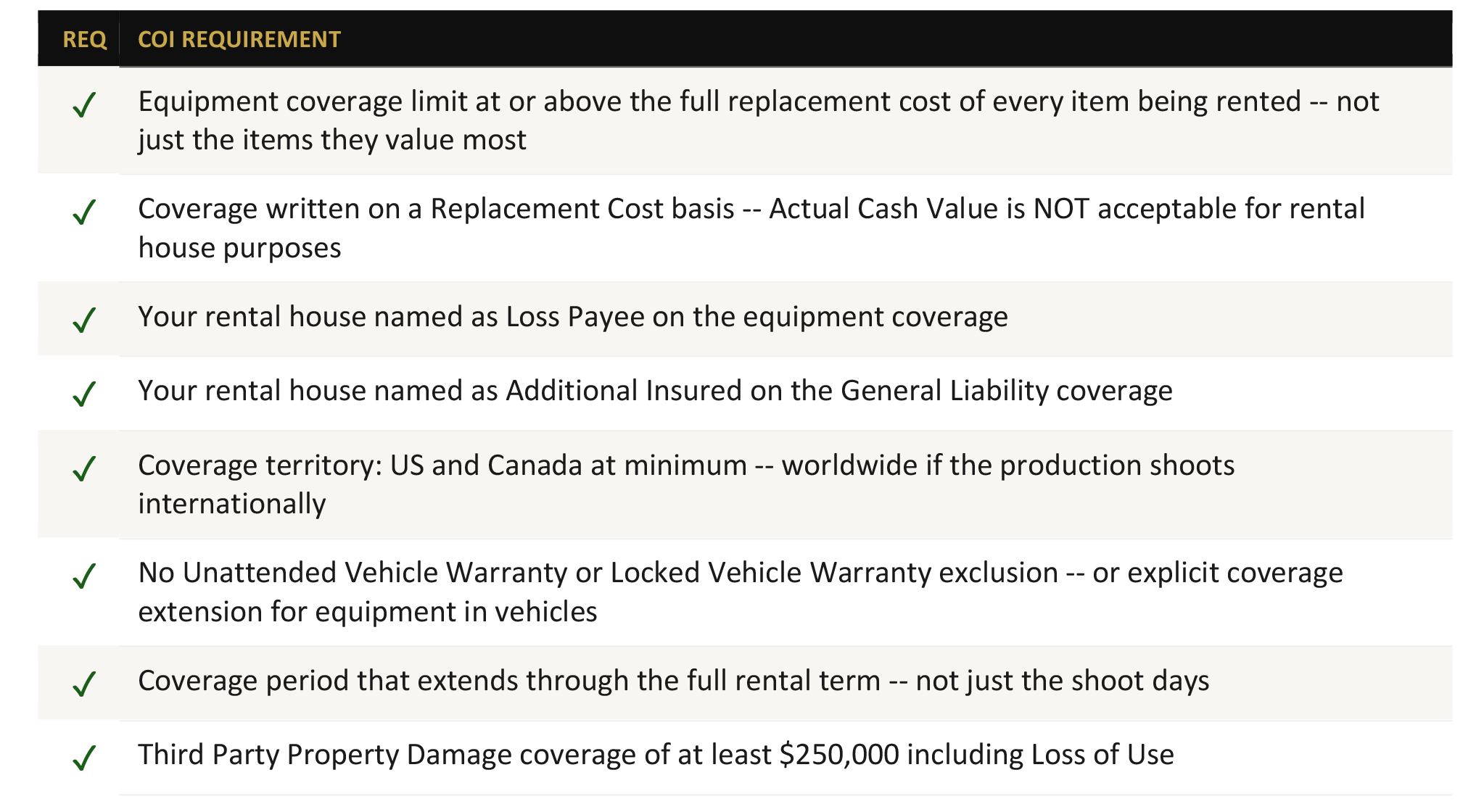
Before releasing any gear to a client, require a Certificate of Insurance that confirms the following, in writing, from the client's carrier:
THE 15% WAIVER CHARGE OPTION
Some rental houses charge an insurance waiver fee -- typically 10% to 15% of the rental cost with a deductible -- when a client cannot provide a valid COI. This is a revenue model, not a protection model. If a client takes $100,000 worth of camera equipment on a 10-day rental and pays a 15% waiver fee on a $5,000 rental, you have collected $750 but absorbed $100,000 in uninsured exposure. The waiver fee rarely covers the actual replacement cost exposure it is meant to offset. Require COIs -- do not waive them.
Documentation Practices That Protect Your Inventory
Maintain a Complete, Current Equipment Schedule
Your inland marine policy insures a schedule of equipment -- specific items with specific replacement values. If you add a new camera body, lens, or lighting fixture and it is not on the schedule, it may not be covered or may be underinsured. Update your equipment schedule every time you make a significant acquisition, disposal, or revaluation. Your broker should be requesting an updated schedule at every renewal.
Conduct a Detailed Condition Check-Out and Check-In for Every Rental
Document the condition of every piece of equipment leaving your facility with a written condition report, photographs of any pre-existing damage, and a signature from the client acknowledging the equipment condition at pick-up. The same check-in process on return creates the documentation needed to establish that damage occurred during the rental and was not pre-existing. Without this documentation, damage disputes become a credibility contest.
Require COI Receipt 48 to 72 Hours Before Equipment Release
Do not accept a COI at the dock when the grip truck is being loaded. Requiring the COI 48 to 72 hours before scheduled pick-up gives you time to review it with your broker, identify deficiencies, and request corrections before the production is under time pressure. A COI with a missing Loss Payee or an inadequate equipment limit cannot be corrected at 7am on shoot day.
Maintain a COI Log by Client and by Policy Period
Track every COI you receive -- client name, production name, policy carrier, policy number, equipment limit, effective and expiration dates, and whether Loss Payee and Additional Insured endorsements are confirmed. Review the log against your active rentals regularly. An equipment rental that extends past the COI expiration date is an uninsured rental from the coverage gap forward.
Photograph Every Rental Condition and Maintain a Digital Archive
Time-stamped photographs of equipment condition at check-out and check-in, stored in a retrievable digital archive, are the single most effective evidence in any damage dispute or insurance claim. A photograph showing pristine equipment at check-out and damage at check-in, with the rental agreement, the COI, and the condition report, gives your insurance carrier a complete claim package.
Frequently Asked Questions
Q: What type of insurance does a film equipment rental house need?
A film equipment rental house needs at minimum: an inland marine policy (dealer's floater) written on replacement cost basis covering inventory on-premises, in transit, and in the custody of clients; commercial general liability with at least $1M per occurrence; third-party property damage including loss of use; hired and non-owned auto liability; workers compensation for all employees; and an umbrella policy for additional limits required by major clients. Standard commercial property insurance does not adequately cover inventory in clients' custody or in transit.
Q: What is a Loss Payee and why does it matter for rental houses?
A Loss Payee endorsement on a client's insurance policy gives the rental house a direct right to receive claim proceeds in the event of a covered equipment loss. Without Loss Payee status, the insurance payment goes to the client -- the production company -- and the rental house must rely on the client to pay them from those proceeds. Loss Payee ensures the rental house is paid first, directly by the carrier, without depending on the client's financial condition or willingness to pay.
Q: What should a rental house require on a production's COI before releasing equipment?
A rental house COI should confirm equipment coverage at or above full replacement cost written on a replacement cost basis (not actual cash value), the rental house named as Loss Payee on equipment and Additional Insured on general liability, coverage territory including all states and countries where the production shoots, no unattended vehicle warranty, third-party property damage of at least $250,000, and a coverage period that spans the full rental term. Collect the COI 48 to 72 hours before equipment is released -- not at the dock on pick-up day.
Q: Does a rental house need separate insurance for equipment in clients' custody?
Your inland marine policy should cover your equipment in clients' custody as part of its structure. However, the client's own production insurance is still required because their coverage is primary for any loss that occurs during the rental. Your inland marine policy provides a backstop if the client's coverage is inadequate or disputed. This is why both Loss Payee status on the client's policy AND your own inland marine policy are necessary -- they protect you from different failure points.
The Bottom Line
Film and event equipment rental houses operate in one of the most complex property insurance environments in any industry. Your inventory leaves your control daily, travels to unspecified locations, passes through dozens of hands, and faces risks ranging from accidental damage to fraud to catastrophic loss. The insurance program that protects your business must be specifically designed for that reality -- not adapted from a general commercial property policy that was never built for it.
The rental houses that recover successfully from significant equipment losses are the ones that had the right inland marine structure, collected COIs with Loss Payee endorsements before releasing gear, maintained detailed condition documentation, and worked with a broker who understands the film and event equipment rental industry specifically. Getting one of those wrong is expensive. Getting them all right is what separates a claim that gets paid from one that gets disputed.