
FILM ERRORS & OMISSIONS INSURANCE
The Complete Guide for Independent Filmmakers & Producers
What Is Film E&O Insurance — and Why Does It Matter?
You spent two years making your film. You found the locations, cast the talent, raised the money, survived the shoot, and finished the edit. You have a screener that people love. A distributor is interested. And then the question comes:
The Question Every Distributor Asks First - "Where is your E&O policy?"
Errors and Omissions insurance — known in the industry as E&O — is professional liability coverage for filmmakers and production companies. It protects you against claims arising from the content of your film itself. Not equipment damage. Not on-set injuries. Not weather delays. The content.
E&O covers the legal costs and financial damages that result from third-party claims that your film:
• Infringed on someone else's copyright
• Defamed a real person or company
• Invaded someone's right of privacy or publicity
• Used trademarked names, logos, or branded items without permission
• Incorporated music, artwork, or footage without a proper license
• Used a title that conflicts with an existing trademark
• Made false claims about a real person, place, or event
Without E&O insurance, your film cannot be distributed. Period. Netflix won't accept it. Amazon won't stream it. No legitimate domestic or international distributor will touch it. It is the one insurance coverage that gatekeeps your film's entire commercial future — and it is also the one coverage most independent filmmakers are completely unprepared for.
This guide walks you through everything you need to know about E&O insurance — what it covers, what distributors require, how to get it, what the clearance process looks like, and the mistakes that kill films at the finish line.
What E&O Insurance Covers
E&O insurance is designed to protect filmmakers from claims they never saw coming. The law around content liability is complex, expansive, and unforgiving. Here is a breakdown of the major categories of coverage:
1. Copyright Infringement
If your film uses a clip, photograph, piece of artwork, song, script passage, or any other creative work owned by someone else — without a proper license — you are exposed to copyright infringement claims. These claims can arise from an oversight as minor as forgetting to clear a song used in the background of a party scene, or using two seconds of news footage without a license.
Real-World Example - Steven Spielberg's Amistad faced a copyright infringement lawsuit seven weeks before its 1997 release when author Barbara Chase-Riboud alleged that DreamWorks copied original scenes, characters, and plot devices from her novel. The lawsuit threatened to delay or block the film's debut entirely. E&O coverage helped manage the legal exposure.
Copyright infringement is the most common source of E&O claims in the independent film world. It can arrive months or years after distribution begins, when someone finally sees your finished film and recognizes their work.
2. Defamation — Libel and Slander
Defamation occurs when your film makes a false statement of fact about a real, identifiable person that damages their reputation. In documentary filmmaking especially, this is a persistent risk. A filmmaker who implies — even subtly — that a real individual committed a crime, engaged in unethical behavior, or is connected to a scandal can face a defamation lawsuit even if that individual is not named directly.
E&O covers the legal defense costs and any damages awarded in defamation claims. Importantly, it covers you even when you believe your film is factually accurate — because truth is a defense, but it must be proven in court, and that legal battle can cost hundreds of thousands of dollars before a verdict is ever reached.
3. Invasion of Privacy and Right of Publicity
Every person has a legal right to control how their name, image, likeness, and voice are used — especially in commercial contexts. If your film uses footage of a real person without their consent, you may face a right of publicity claim. If your film reveals private facts about a real person that were not matters of public record, you may face a privacy invasion claim.
This is particularly relevant for documentary filmmakers who film in public places, conduct interviews, or use archival footage. E&O covers claims from individuals who allege your film violated their privacy or publicity rights.
4. Trademark Infringement
Your film's title can infringe on a trademark. A product shown on screen can trigger a claim from the brand owner. A company name used in your screenplay can invite legal action. E&O covers claims arising from unauthorized use of trademarks within your film's content — not just in marketing materials.
Title clearance — discussed at length in the next section — is the primary tool for avoiding trademark-based E&O claims before they occur.
5. Music Licensing Violations
Music is one of the single most complex and highest-risk elements in any film. E&O covers claims arising from music used in your film without proper synchronization and master-use licenses. However — and this is critical — E&O does not replace music licensing. It covers the legal fallout if a licensing problem surfaces after distribution. Carriers will scrutinize your music cue sheet during the underwriting process and may decline coverage or exclude specific songs if clearances are missing.
6. Errors in the Chain of Title
Chain of title refers to the documented legal ownership of your film's underlying rights — the script, source material, life rights, and the film itself. If there are gaps or defects in your chain of title, a distributor cannot legally sell your film. E&O underwriters require a complete chain of title review before issuing a policy, and any errors uncovered during that review must be corrected before coverage can begin.
Clearance Procedures Every Filmmaker Must Complete
E&O carriers will not issue a policy on a film that has not been properly cleared. Clearance is the process of identifying every element in your film that could give rise to a legal claim — and either securing the rights to use it legally, or removing it from the film entirely. Here is what the clearance process looks like in practice.
Script Clearance
Script clearance should begin before you shoot a single frame. A qualified entertainment attorney or clearance service reviews your screenplay and flags:
• Real names given to fictional characters
• Real companies, organizations, or institutions depicted in the story
• Real events used as plot elements
• Potentially defamatory dialogue or storylines
• Any factual assertions about real people that could be challenged
• Titles that may conflict with existing trademarks or registered films
Script clearance is not the same as a legal opinion that your film is "cleared." It is a risk assessment — a map of the legal exposure in your screenplay that guides your production and post-production decisions.
Chain of Title Documentation
Chain of title is the paper trail that proves you legally own the right to make your film. A complete chain of title file typically includes:
1. The original screenplay option or purchase agreement
2. Any underlying literary rights agreements (for adaptations)
3. Life rights agreements (if the film is based on a real person)
4. Assignment agreements transferring rights to the production entity
5. Copyright registration certificates for the screenplay and the film
6. Any co-production agreements or joint venture agreements
7. WGA registration (if applicable)
8. A legal opinion letter from an entertainment attorney confirming chain of title
⚠ Do Not Start Post-Production Without This - E&O carriers require a complete chain of title before they will even quote your film. If you discover a gap in your chain of title during post-production — for example, a co-writer who was never paid out or an option that expired before you exercised it — fixing it retroactively is expensive, time-consuming, and sometimes impossible. Start building your chain of title file on Day One of pre-production.
Location and Property Releases
Every identifiable location filmed in your movie requires a location release — a signed agreement from the property owner granting you permission to film there and to use that footage in distribution. Without signed releases, your film may be blocked from distribution if a property owner asserts an unauthorized use claim.
This applies to:
• Residential homes and apartments
• Commercial storefronts and businesses
• Private institutional buildings
• Any privately-owned outdoor space
Public streets and government-owned spaces typically require filming permits rather than releases, but documentation of those permits should be retained in your production file.
Talent Releases
Every person who appears in your film — cast, crew appearing on camera, interviewees, and even background extras — should have a signed talent release. This release grants you the right to use their name, image, likeness, and performance in your film and in promotion of the film.
For documentary subjects, releases should explicitly cover:
• The right to edit and combine footage
• The right to use excerpts out of their original context
• The right to distribute internationally
• The right to use the footage in trailers and promotional materials
⚠ Verbal Agreements Are Not Releases - A handshake, an email exchange, or a verbal agreement is not a signed release. E&O carriers and distributors require documentary evidence. If a subject later claims they did not consent to a specific scene or use of their footage, a signed release is your only protection.
Music Clearance and Cue Sheets
Music clearance is one of the most technically demanding and frequently mishandled elements of film production. Every piece of music in your film — including music heard in the background of a scene, music playing from a radio or TV, songs sung by characters, and end credits music — requires two separate licenses:
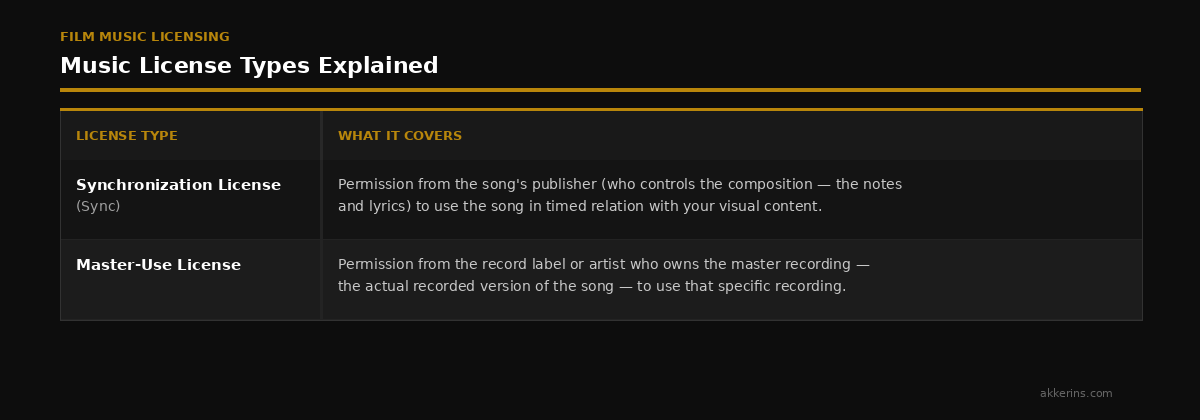
You need both licenses for every piece of commercially recorded music in your film. Many independent filmmakers secure the sync license but forget the master-use license — or assume that licensing a cover version of a song eliminates the need for a sync license on the original composition. These assumptions are wrong and expensive.
Your music supervisor or clearance attorney should provide you with a fully executed music cue sheet — a complete list of every piece of music in your film, its timestamp, duration, composer, publisher, and the license obtained — before you apply for E&O insurance. Carriers review this document closely.
The Festival Exception - Many filmmakers mistakenly believe that a festival screening license covers all music in their film for all future uses. It does not. A festival music license is typically limited to that specific festival screening. Once you pursue distribution, you must secure full synchronization and master-use licenses for every piece of music in the film.
Artwork, Footage, and Third-Party Content Clearances
Beyond music, any of the following in your film may require clearance:
• Paintings, photographs, or sculptures visible on camera
• Archival news footage or historical film clips
• Television or movie clips used within your film ("fair use" is not a guarantee)
• Newspaper or magazine articles or covers shown on screen
• Logos, product labels, or branded signage
• Computer or phone screens showing copyrighted software or websites
• Books or manuscripts whose covers are legible on camera
The "fair use" doctrine — which allows limited use of copyrighted material for commentary, criticism, or parody — is not a blanket clearance strategy. Whether a specific use qualifies as fair use is a legal determination that requires an attorney's opinion and can only be definitively settled in court. E&O carriers require documented clearances, not fair use arguments.
Title Clearance: Protecting Your Film's Name
The title of your film is the first element that distributors, audiences, and potential plaintiffs see. A film title can infringe on an existing trademark, conflict with the title of a prior film or television series, or violate the MPAA title registration system. Title clearance should happen early — before you begin marketing the film — and it requires more than a quick Google search.
The MPAA Title Registration Bureau
The Motion Picture Association maintains a Title Registration Bureau that allows member companies — primarily major studios — to register film titles and protect them from use by other member companies. While independent filmmakers are not typically MPAA members, distributors who acquire independent films often are. If a major studio has registered your film's title, your distributor may be blocked from releasing under that name.
Your entertainment attorney can conduct a title search through the MPAA bureau as part of the overall clearance process.
Trademark Searches
A formal title clearance includes a trademark search in the U.S. Patent and Trademark Office (USPTO) database as well as common-law trademark databases. The search looks for:
• Registered trademarks in Class 41 (entertainment services) and related classes that are identical or confusingly similar to your title
• Common-law trademarks established through commercial use in the entertainment industry
• Existing film and television titles registered with the MPAA or in wide distribution
A title that is clear today may not be clear in six months. Title clearance searches should be conducted as close as possible to your release or distribution date.
International Title Considerations
If your film is being distributed internationally — including to streaming platforms that operate globally — your title must be cleared in key territories. A title that is free of conflicts in the United States may conflict with a registered trademark in France, Germany, or the United Kingdom. International sales agents and foreign distributors will conduct their own title reviews and may require you to use a different title in certain territories.
The E&O Underwriter's Title Review - Every E&O carrier will conduct its own title review as part of the underwriting process. If a carrier flags a potential conflict your clearance attorney missed, they may decline to include title coverage, require a title change before issuing the policy, or include a specific title exclusion in the policy. This is one reason why professional clearance services — not informal internet searches — are required.
Music Licensing: The Most Common E&O Landmine
Music is where the most independent film E&O problems originate. The combination of technical licensing complexity, high clearance costs, and the assumption that "short clips are fine" creates a perfect storm for uncleared music problems at the distribution stage. Here is what you need to know.
The Two-License Requirement in Practice
Every commercially released song requires two separate licenses from two separate parties. The publisher controls the sync license. The record label — or in many cases, the artist directly — controls the master license. These are two completely different negotiations, two different contracts, and two different fees.
When you license a famous song from a major label, the sync and master fees can run anywhere from $5,000 to $50,000 or more for a single use in a feature film. For an independent production with a limited music budget, this creates an enormous practical challenge — which is why so many filmmakers turn to:
• Original compositions (music written and recorded specifically for the film)
• Music libraries offering blanket or flat-fee licenses
• Emerging artists offering favorable rates in exchange for exposure
• Public domain music (music whose copyright has expired)
Public Domain Music: What It Is — and What It Is Not
Music enters the public domain when its copyright expires. In the United States, musical compositions published before 1928 are generally in the public domain, meaning you can use the sheet music freely. However:
⚠ Public Domain Composition Does Not Mean Free Recording - A specific recording of a public domain song — for example, a 1960 jazz orchestra performance of a song from the 1920s — is still protected by copyright. The composition is public domain, but the recording is not. To use that specific recording, you still need a master-use license from whoever owns it. This is one of the most common music clearance mistakes in independent film.
Classical music, folk songs, and jazz standards are frequent casualties of this misunderstanding. A production may use what they believe is "free" public domain music and discover at the distribution stage that the specific recording they used is still under copyright.
The Music Cue Sheet
A music cue sheet is a complete record of every piece of music in your film, including:
• The exact title and duration of each musical cue
• The name of the composer and lyricist
• The name of the music publisher (sync rights holder)
• The name of the recording artist and record label (master rights holder)
• The timecode start and end for each cue
• The license type and license document reference for each cue
E&O carriers require a music cue sheet. Distributors require a music cue sheet. Performing rights organizations (ASCAP, BMI, SESAC) use cue sheets to track royalty payments. If you do not have a complete, accurate cue sheet, you will be delayed at the distribution stage — and you may face claims from publishers and labels who discover their music was used without a license.
Music Clearance for Documentaries
Documentary filmmakers face additional music clearance complexity because documentary footage often captures music incidentally — a song playing at a bar, a busker performing on a street corner, a wedding band in the background of a reception. These "incidental" uses are not automatically cleared.
The practical solutions for documentary filmmakers include:
• Obtaining blanket location releases that specifically address ambient music
• Securing licenses for any music that is clearly audible and recognizable
• Re-editing footage to minimize incidental music exposure
• Replacing background music in post-production with licensed or original music
• Obtaining a legal opinion from an entertainment attorney on de minimis use arguments for very brief, barely audible incidental music
What Major Distributors Require for E&O
Every major distributor and streaming platform has specific E&O requirements that must be satisfied before they will accept delivery of your film. Understanding these requirements before you go into post-production — not after you have a distribution offer on the table — can save you months of delay and significant expense.
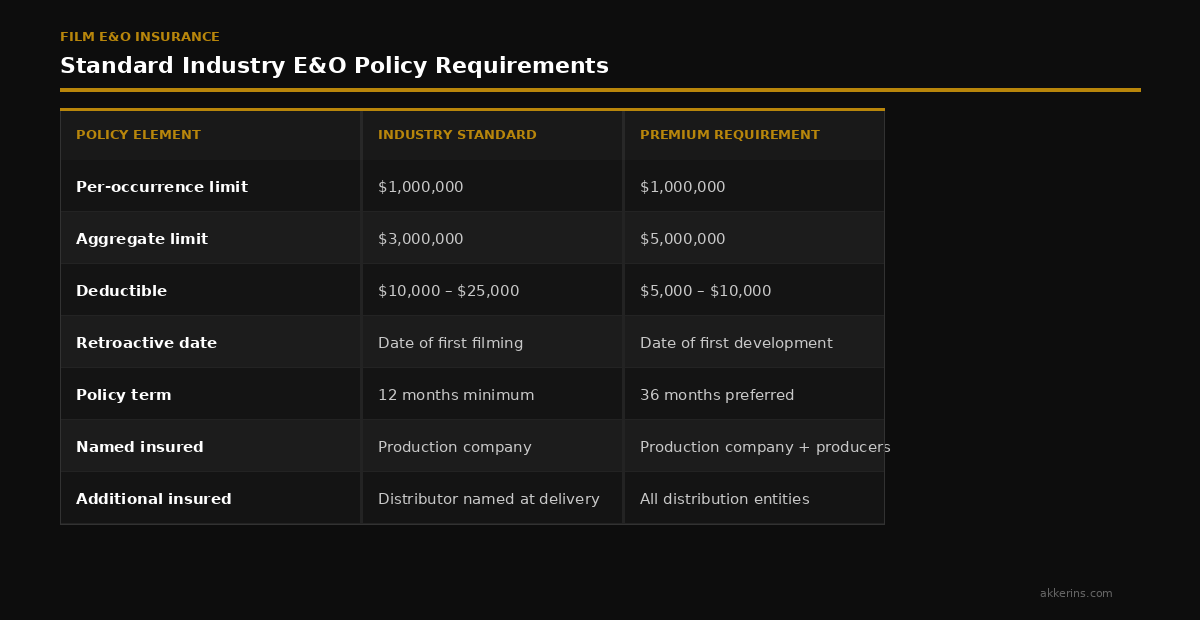
Standard Industry E&O Policy Requirements
Netflix Requirements
Netflix is among the most rigorous distributors when it comes to E&O and clearance documentation. Their standard delivery requirements include:
• A minimum $1M per-claim / $3M aggregate E&O policy
• A legal opinion letter from a qualified entertainment attorney confirming chain of title and clearance status
• Complete music cue sheets with documentation of all licenses
• A full chain of title file including copyright registration
• Signed releases for all identifiable individuals appearing in the film
• Title clearance documentation
• A materials and music rights warranty stating that all rights are cleared for worldwide distribution
Netflix typically requires that all clearance work be completed and documented before the policy is issued — meaning you cannot simply obtain E&O coverage and assume Netflix will accept your documentation. The underlying clearance work must be air-tight.
Amazon Prime Video Requirements
Amazon's E&O and clearance requirements are similar to Netflix in scope, with particular emphasis on:
• Worldwide distribution rights confirmation
• Digital distribution platform rights clearance (streaming platforms require broader rights than theatrical)
• Music clearance documentation covering digital streaming use (some old music licenses predate streaming and do not cover it)
• Technical delivery specs compliance, which intersects with chain of title for title card accuracy
⚠ Streaming Music Licensing Gap - Many independent films cleared music for theatrical and DVD distribution in the 1990s and 2000s and are now trying to put those films on streaming platforms. Those old licenses often do not include digital streaming rights, which were not contemplated when the license was written. If you are distributing an older film, a complete music license audit is required before streaming distribution.
Hulu, Apple TV+, and Specialty Streamers
Hulu, Apple TV+, Criterion Channel, MUBI, Shudder, and similar streaming platforms generally require the same core E&O documentation as Netflix and Amazon, though specific limits and documentation requirements may vary. Your entertainment attorney or sales agent can provide platform-specific delivery requirements for any platform you are targeting.
Traditional Theatrical and Festival Distribution
For theatrical releases, the distributor's requirements mirror the streaming platforms in most respects. For major international markets — the United Kingdom, France, Germany, Australia, Japan — you will need documentation confirming clearances extend to those territories.
Film festivals typically do not require E&O insurance for festival screenings, but many major festivals (Sundance, SXSW, Tribeca) strongly recommend it. If you receive a distribution offer at a festival, the distribution company will require E&O as part of the deal, and having coverage already in place speeds the delivery process considerably.
International Sales Agents - If you are working with an international sales agent to sell your film to foreign distributors, the agent will require E&O insurance as a condition of representation. Foreign broadcasters — particularly in the UK, Germany, and France — may have specific clearance requirements beyond U.S. standards, particularly around privacy laws and the right of publicity in those jurisdictions.
The 10 Most Common E&O Mistakes Independent Filmmakers Make
After years of working with independent filmmakers and production companies on film insurance, these are the mistakes we see most often — and the ones that cost the most to fix.
Mistake #1: Waiting Until Distribution to Think About E&O
E&O is not something you buy at the end of the process. The underwriting process takes time — typically two to four weeks for a straightforward submission, longer for complex documentaries or films with clearance issues. If you have a distribution offer on the table with a 30-day delivery deadline and you have not started the E&O process yet, you are in trouble.
The right time to start your E&O process is six to eight weeks before you plan to deliver your film to a distributor. The right time to begin building your clearance file is during pre-production.
Mistake #2: Assuming Fair Use Covers Everything
"Fair use" is one of the most misunderstood concepts in entertainment law. Fair use is a legal defense, not a clearance strategy. It protects certain limited uses of copyrighted material for purposes of commentary, criticism, news reporting, or parody — but whether a specific use qualifies as fair use is a factual and legal determination that can only be made definitively by a court.
E&O carriers do not accept fair use arguments in place of clearances. If you have a piece of music, footage, or artwork in your film that you believe is covered by fair use, you need a legal opinion letter from an entertainment attorney specifically analyzing that use. The carrier will review that opinion as part of the underwriting process.
Mistake #3: Missing the Master Recording License
As discussed in the music section, this is the single most common music clearance error. A filmmaker licenses the composition (sync license) but does not obtain a separate license for the specific recording they used. The composition publisher is paid. The record label is not. The film is flagged at delivery.
Mistake #4: Using Crowd-Funded or Stock Music Without Checking License Scope
Not all music library licenses are equal. Many stock music platforms offer "royalty-free" licenses that are actually quite limited — covering only specific types of use (online video only, not theatrical; commercial use only for videos under a certain length; personal use only). A filmmaker who buys a $49 stock music license and uses that music in a theatrically distributed feature film may discover that their license does not cover that use.
Before committing to any piece of music for your film, confirm with the licensing platform or music supervisor that the license covers your intended distribution — including streaming, theatrical, broadcast, and international.
Mistake #5: Incomplete or Missing Talent Releases
This is especially common in documentary filmmaking, where subjects may be interviewed informally before a formal production structure is in place. A filmmaker may have filmed fifty hours of interviews over two years and have signed releases from only half their subjects — often the ones who were filmed last, after the production became more formalized.
Going back to obtain missing releases after the film is complete is difficult, expensive, and sometimes impossible. Some subjects may have died. Others may refuse to sign once they have seen the final film. Others may demand payment in exchange for a release.
Mistake #6: Failing to Register Copyright in the Film
Copyright registration is not required for copyright protection in the United States — your film is protected by copyright from the moment it is fixed in a tangible medium. But copyright registration provides benefits that are critical for E&O purposes: it creates a public record of your ownership, it is required to file a copyright infringement lawsuit, and it entitles you to statutory damages if you prevail in an infringement action.
E&O carriers typically require evidence of copyright registration or a copyright registration application as part of the underwriting process. File the registration as soon as your film is in a completed or near-completed form.
Mistake #7: Gaps in Chain of Title
Chain of title gaps are one of the most serious and hardest-to-fix E&O problems. Common gaps include:
• A co-writer who contributed to the screenplay but never signed an assignment agreement
• A script option that expired before the producer exercised it and was never formally renewed
• Underlying rights (a novel, a true story, a real person's life rights) that were optioned but never purchased
• A prior version of the script registered under a different title
• Assignment documents that were signed but never notarized as required in some jurisdictions
Fixing chain of title gaps often requires tracking down people who may be difficult to find, negotiating agreements under pressure, and paying fees that are far higher than they would have been if addressed earlier. Start your chain of title file on Day One.
Mistake #8: Not Addressing Brand Logos and Signage
If a character in your film is visibly wearing clothing with a brand logo, if a storefront sign with a trademarked name is prominent in the frame, or if a product on set has a clearly legible brand name — that may create a trademark issue. Film production companies have two tools for managing this risk: either obscure or remove the branding in post-production, or obtain a clearance or product placement agreement with the brand owner.
This is one of the reasons many productions use generic or fictional branded products on set — it eliminates the clearance burden entirely.
Mistake #9: Incorrect Additional Insured Endorsements
When a distributor accepts your film, they will require that they be added as an additional insured on your E&O policy. This requires a formal endorsement from your insurance carrier — not just a certificate of insurance. Many filmmakers provide a certificate of insurance naming the distributor and assume that is sufficient. It is not. The carrier must issue a formal additional insured endorsement.
Building in time for this endorsement process — which typically takes a few business days — is important if you have a tight delivery deadline.
Mistake #10: Buying the Wrong Policy for International Distribution
A U.S.-only E&O policy does not cover claims arising from distribution in foreign territories. If you plan to distribute your film internationally — which streaming essentially guarantees — you need a policy that covers worldwide distribution.
Review the territorial scope of any E&O policy you are considering carefully. Ask your broker specifically: Does this policy cover claims arising from distribution in the UK, the EU, Canada, Australia, and other major markets? If the answer is no, you need a broader policy.
The E&O Application Process: What to Expect
Understanding how the E&O application process works helps you plan your production timeline and avoid the delays that kill distribution deals.
What the Application Requires
A standard E&O application for a feature film will ask for:
• A complete synopsis or description of the film
• A list of all clearance work completed, with documentation
• Confirmation of chain of title and copyright registration
• A music cue sheet
• Confirmation of all releases obtained (talent, locations)
• A summary of any prior or pending claims related to the film
• A legal opinion letter (required by some carriers)
• The film's production budget and distribution plan
The Underwriting Timeline
For a straightforward narrative feature with clean clearances, E&O underwriting typically takes one to four days. Complex documentaries with many subjects, films with music clearance questions, or films based on real events may take four to eight weeks or longer.
Factors that slow the underwriting process:
• Missing or incomplete clearance documentation
• Music cue sheets with unlicensed or disputed music
• Chain of title gaps that require additional documentation
• Subjects of the film who have not signed releases
• Prior claims or demands related to the film
What the Policy Looks Like
A standard film E&O policy typically provides:
• $1 million per-claim coverage with a $3 million aggregate limit
• A deductible of $10,000 to $25,000 per claim
• A retroactive date going back to the date filming began
• A one to three year policy term
• The ability to add distributors as additional insureds as they come on board
Working With a Specialist Broker
E&O insurance for film is a specialty product. Not every insurance broker has the market access and expertise to place film E&O effectively. Working with a broker who specializes in entertainment insurance — and who has relationships with the carriers that underwrite film E&O — ensures you are getting the right coverage at the best available pricing, and that any coverage issues are identified and resolved before they become delivery problems.
Contact our team at Akker, LLC. We would love to help with your E&O Insurance.