
California Staffing Agencies Have 5 Days to Comply.
Everything You Need to Know About the March 30, 2026 Deadline Under California Labor Code § 1555
DEADLINE: March 30, 2026 — 6 days from today. California Labor Code § 1555 requires all employers to give every existing employee the opportunity to name an emergency contact and make a notification election before this date. Failure to comply carries penalties of $500 per employee per day, up to $10,000 per employee.
A new California law with a hard deadline less than one week away is sitting in the blind spot of thousands of staffing agencies operating in the state. California Senate Bill 294 — the Workplace Know Your Rights Act — went into effect January 1, 2026, and carries a specific compliance deadline of March 30, 2026 that applies to every existing California employee on your payroll.
For staffing agencies, this law creates a compliance challenge that is significantly more complex than it is for a traditional single-site employer. Your workers are distributed across dozens or hundreds of client sites. They perform duties offsite and in the field. You are the employer of record for all of them — which means the compliance responsibility sits with you, not with your clients.
This post explains exactly what the law requires, where it comes from, what the penalties look like in real dollars, why staffing agencies face unique exposure, and what you need to do before March 30.
The Law: What Is California SB 294 and Where Did It Come From?
California Senate Bill 294, known as the Workplace Know Your Rights Act, was signed into law in 2025 and took effect January 1, 2026. It was passed in the context of significant public concern about immigration enforcement actions at California worksites, and is designed to ensure that workers know their rights if they are detained or arrested while at work or performing job duties.
The bill creates two separate employer obligations under the California Labor Code. The first — an annual written notice of workplace rights — had an initial deadline of February 1, 2026. The second — the emergency contact and notification election requirement under Labor Code § 1555 — has a deadline of March 30, 2026.
Here are the complete key facts of the law:
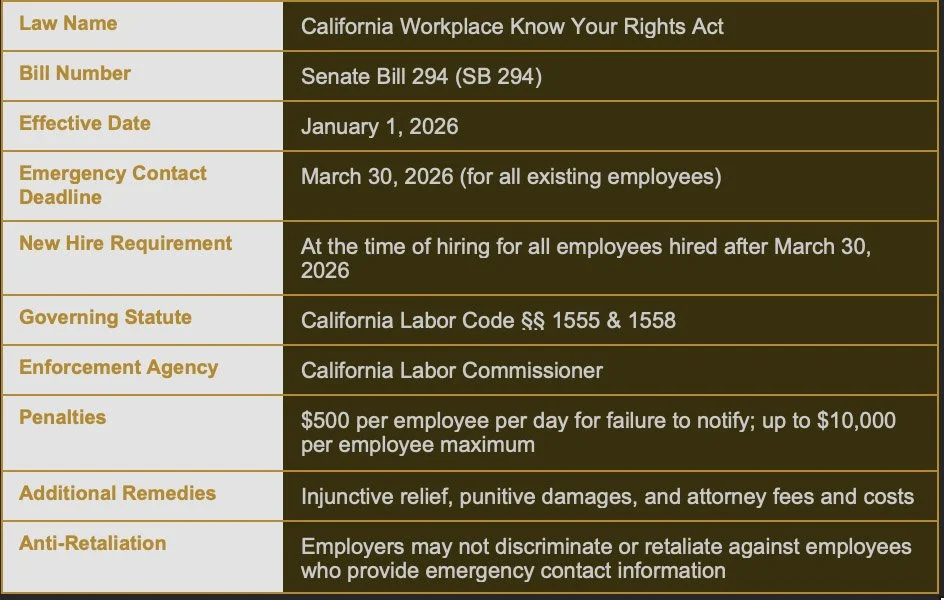
"An employer shall provide an employee the opportunity to name an emergency contact no later than March 30, 2026, for an existing employee, and at the time of hiring for a new employee hired after March 30, 2026." — California Labor Code § 1555(b), added by SB 294 (Stats. 2025, Ch. 667, Sec. 1)
What Exactly Does the Law Require?
SB 294’s emergency contact provisions under Labor Code § 1555 create two distinct obligations for employers. It is important to understand that these are separate requirements — completing one does not satisfy the other.
Obligation 1: Provide the opportunity to name an emergency contact
By March 30, 2026, every California employer must give every current employee the opportunity to designate an emergency contact. This is not optional for the employer to offer — it is mandatory. And critically, a standard HR emergency contact field in your HRIS system almost certainly does not satisfy this requirement on its own.
Obligation 2: Provide the notification election
Separately and additionally, each employee must be given the opportunity to indicate whether they want that emergency contact to be notified if the employee is arrested or detained. This is the election that Section 1555 specifically governs, and it must include the following scenarios:
• Arrest or detention at the worksite: If the employee has made the election, the employer must notify the designated contact. No qualifier on actual knowledge — if it happened at your site, you must notify.
• Arrest or detention during work hours or while performing job duties offsite: The employer must notify the designated contact only if the employer has actual knowledge of the arrest or detention.
The distinction between the two scenarios matters for staffing agencies specifically. When your placed workers are performing duties at a client’s site, the client may have actual knowledge of an arrest before you do. You need a defined communication protocol with each client site that ensures you receive timely notification so you can fulfill your obligation.
The key compliance gap most employers miss: a standard HRIS emergency contact field stores a name and phone number but does NOT include the yes/no notification election indicator required by Section 1555. You need both the designation AND the election to be compliant.
The Penalties: What Non-Compliance Actually Costs
The penalties under California Labor Code § 1558 are structured to escalate quickly with workforce size. Here is what non-compliance looks like in real numbers for staffing agencies:
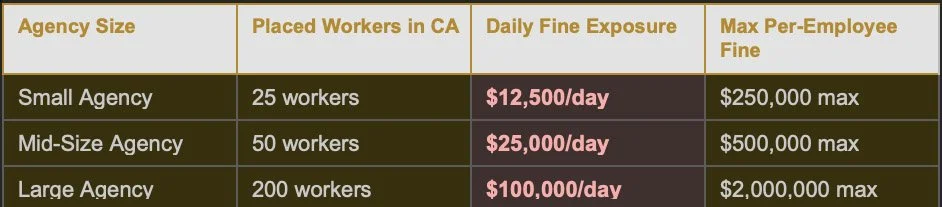
These are not theoretical maximums. The California Labor Commissioner is the enforcement agency, and penalties under this law are in addition to potential injunctive relief, punitive damages, and attorney fees and costs. A class action brought on behalf of a group of workers who were never given the opportunity to designate an emergency contact could aggregate penalties across your entire California workforce.
Additionally, the law includes an explicit anti-retaliation provision. Employers may not discriminate or retaliate against employees who provide emergency contact information or because an employee’s contact was notified of an arrest. Any adverse employment action following an employee’s exercise of these rights creates additional legal exposure.
For a staffing agency with 50 placed workers in California, non-compliance carries a daily penalty exposure of $25,000. For an agency with 200 placed workers, that number is $100,000 per day. The March 30 deadline is not a soft deadline.
Why This Hits Staffing Agencies Harder Than Most Employers
For a traditional employer with workers in a single location, compliance with SB 294 is relatively straightforward: update the onboarding paperwork, distribute the form, collect the election, file it. For staffing agencies, the compliance challenge is layered.
You are the employer of record for every placed worker
This is the most important point. Regardless of how many client sites your workers are placed at, you remain the employer of record under California law. The compliance obligation under Labor Code § 1555 rests with you — not with the host employer or client. The client is not responsible for collecting this information or making this election available on your behalf unless you have a specific contractual arrangement that says otherwise. Assuming your clients are handling it is not a compliance strategy.
Workers are distributed and hard to reach simultaneously
Contacting 50 or 100 or 200 placed workers across multiple client sites to distribute and collect a form before a hard deadline requires a coordinated process that most staffing agencies have not built. Email may not reach field workers. Client site supervisors may not pass along communications. You need a direct, documented outreach process that reaches every California worker on your payroll before March 30.
Field and offsite workers create actual knowledge complexity
The “actual knowledge” standard for offsite arrests creates a specific operational challenge for staffing agencies. If one of your placed workers is detained during work hours at a location where your agency has no direct presence, who learns about it first — the client, the worker’s supervisor, or your agency? You need a defined escalation workflow that ensures your agency receives timely notification so you can fulfill the obligation to contact the designated emergency contact if the worker has made that election.
New hire onboarding process must be updated permanently
After March 30, 2026, the requirement continues for all new hires — the emergency contact opportunity and notification election must be provided at the time of hiring. Every California onboarding packet must be updated to include this form going forward. This is not a one-time compliance task. It is a permanent change to your California onboarding process.
"SB 294 runs on two timelines. The annual Workplace Know Your Rights notice (February 1, 2026, and annually thereafter) is a distribution and recordkeeping process. The March 30, 2026 deadline under Labor Code section 1555(b) is a separate data-collection obligation." — VertiSource HR, March 2026
The Two SB 294 Deadlines: Don’t Confuse Them
Many employers who have already complied with the February 1, 2026 annual notice requirement believe they are fully compliant with SB 294. They are not. The two obligations are separate.
• February 1, 2026 (annual, ongoing): Distribute the California Labor Commissioner’s stand-alone Workplace Know Your Rights notice to all current employees and provide it to new hires upon hire. This must be done annually. The Labor Commissioner posts the required notice — in English and Spanish — at dir.ca.gov.
• March 30, 2026 (one-time for existing employees, then at hire for new employees): Give every employee the opportunity to designate an emergency contact AND make the arrest/detention notification election under Labor Code § 1555. Collect, store, and date-stamp the completed forms.
Completing the February 1 notice distribution does not check the March 30 box. These are independent compliance obligations with separate documentation requirements and separate penalty structures.
Your 7-Step Compliance Action Plan Before March 30
Send a written notice to ALL California employees immediately — today if possible. The notice must explain their right to name an emergency contact and to indicate whether that contact should be notified if they are arrested or detained at the worksite, during work hours, or while performing job duties offsite.
Distribute an emergency contact form that includes BOTH fields: (a) the emergency contact’s name and contact information, and (b) a separate yes/no election for arrest/detention notification. A standard HR emergency contact field does NOT satisfy Section 1555 on its own — you need the explicit notification election.
Update your California onboarding packet to include the Section 1555 emergency contact form and notification election for all new hires going forward.
Document everything. Keep the completed forms in each employee’s personnel file. Date-stamp when each form was distributed and when it was returned. If an employee declines to designate a contact, document that too.
Train your supervisors and managers on the notification protocol. If a placed worker is arrested or detained at a client’s site or during work hours, who in your organization is responsible for notifying the emergency contact? That escalation path must be defined in writing before March 30.
Review your HRIS system. If your HR platform has an emergency contact field, verify that it also captures the arrest/detention notification election. If it does not, add a custom field, a supplemental form, or a manual recordkeeping process before the deadline.
Confirm compliance across all California client sites. As the employer of record, your compliance obligation extends to every placed worker in California regardless of which client site they are assigned to. Do not assume client sites are handling this on your behalf.
Documentation is your protection. An employer who distributed the form, collected the election, and can produce a dated record for each employee has a defensible compliance position. An employer who assumed a client site handled it has nothing.
Resources: Where to Get the Required Forms
The California Labor Commissioner has published the required Workplace Know Your Rights notice in English and Spanish. It is available at the California Department of Industrial Relations website at dir.ca.gov.
For the Section 1555 emergency contact and notification election form, the California Employers Association has published a ready-to-use form in both English and Spanish. Several employment law firms including Payne & Fears, DLA Piper, and Goodwin Law have also published compliance checklists and model forms that employers can reference.
The full text of SB 294 is available through the California Legislative Information portal at leginfo.legislature.ca.gov. Labor Code § 1555 and § 1558 contain the specific emergency contact and penalty provisions.
The California Labor Commissioner’s model notice must be provided in the language the employee understands if a translation is available on the Labor Commissioner’s website. Check dir.ca.gov for available language translations before distributing.
The Bottom Line for California Staffing Agencies
March 30, 2026 is six days away. That is not enough time to design a process from scratch, research the law, build the forms, and reach every California worker on your payroll — unless you start today.
The compliance steps are not complicated. Send a written notice. Distribute the form. Collect the election. Store the records. Update your onboarding process. Train your supervisors. The challenge for staffing agencies is the logistics of doing all of that across a distributed workforce before a hard deadline.
The penalty exposure for non-compliance is real, it accrues daily, and it is not insurable. For a staffing agency with 50 California workers, a week of non-compliance past the March 30 deadline costs $175,000 in statutory penalties. That is not a rounding error in a compliance budget.
Start today. Send the notice today. Get the forms out today. Document everything. March 30 is Sunday — your last business day to confirm compliance is Friday, March 28, 2026.
Questions About Your Staffing Insurance Coverage in California?
🌐 akkerins.com/staffinginsurance
📞 912-247-3075