
Why Is Workers’ Comp So Expensive for Home Health Agencies -- And How to Fix It
If you run a home health agency, a skilled nursing facility, or a senior care operation, you already know that workers’ compensation is one of your largest and most unpredictable operating expenses. Your premium seems high every year. Your rates go up even when you have a good claims year. And no matter how careful your caregivers are, the injuries keep coming. There is a reason for all of this -- and it is not that your carrier is simply overcharging you. The cost drivers in home health WC are structural, specific, and manageable. This guide explains exactly why home health workers’ comp is expensive, what is driving your rates, and the seven proven strategies that home health agencies use to bring those costs down.
The Short Answer: Caregivers Work in Uncontrolled Environments
Every other type of workers’ compensation risk is priced based on a workplace the employer controls. A construction contractor controls the job site. A manufacturer controls the factory floor. A restaurant controls the kitchen. But a home health agency does not control where its caregivers work. Your employees work in private residences -- and every private residence is a different, unpredictable environment.
The homeowner controls the condition of the floors, the stairways, the lighting, the furniture arrangement, and the behavior of pets and family members. The client’s cognitive state affects the interaction. The home may not have proper lift equipment. The bathroom may not have grab bars. The patient may resist care. The front steps may be icy or broken.
WHY CARRIERS PRICE HOME HEALTH WC SO HIGH
Every new client home is a new risk exposure that neither the agency nor the carrier can inspect, control, or remediate. Unlike a controlled workplace where an OSHA inspection and a safety program can predictably reduce hazards, home health care operates in an environment that resets with every new client. Carriers price this fundamental unpredictability into the rate -- and that is why home health WC rates are among the highest in the NCCI classification system, even for agencies with excellent safety programs.
This does not mean you are helpless against rising WC costs. It means the strategies that work for home health agencies are different from the strategies that work for manufacturers or contractors. The fixes exist -- they are just specific to your industry.
The 6 Structural Cost Drivers in Home Health Workers’ Comp
Cost Driver 1: Patient Handling Injuries -- The #1 Claim Category
Musculoskeletal injuries from lifting, transferring, repositioning, and assisting patients are the single most expensive claim category in home health WC. A caregiver who injures her back while transferring a patient from bed to wheelchair generates a claim that can develop into a six-figure reserve when surgery, physical therapy, and lost wages are factored in over a two-to-three-year period.
Unlike hospital or nursing facility settings where mechanical lifts and lift teams are standard, home health caregivers frequently work alone with no mechanical lift equipment available. The patient’s home may not accommodate the equipment even if it exists. Every transfer is a manual handling event.
Cost Driver 2: Slip, Trip, and Fall Hazards -- New Environment Every Day
A home health caregiver enters a different home on every shift. Wet floors, loose rugs, poor lighting, cluttered hallways, uneven thresholds, and broken steps are common hazards across the hundreds of homes your caregivers enter every week. Your agency cannot inspect every home before every shift, and even if you could, the conditions change. A client who spills water on the kitchen floor between visits does not call the agency to report it.
Cost Driver 3: Behavioral and Assault Risk from Clients
Clients with dementia, cognitive impairment, psychiatric conditions, or substance use disorders can behave unpredictably. Caregiver assault by a client -- scratching, biting, hitting, or pushing -- is a documented and underreported injury category in home health. These incidents are often not reported because caregivers feel responsible for the client and do not want to create documentation that could affect the client’s care plan. Unreported injuries become late-reported claims, which are dramatically more expensive.
Cost Driver 4: Driving Exposure Between Clients
Home health caregivers travel between client homes, and that driving exposure sits under your WC policy through employer liability. A caregiver injured in a car accident while traveling between client assignments generates a WC claim in most states. If your caregivers use personal vehicles and you have not documented your drive-between-clients policy clearly, your WC exposure may be broader than your policy was priced to cover.
Cost Driver 5: Late-Reported Claims That Develop Expensively
Home health has one of the highest rates of late-reported WC claims of any industry. Caregivers are often part-time workers who do not understand their WC rights, are hesitant to report injuries to supervisors they interact with in a personal and intimate context, or do not realize that the injury they sustained is work-related. Late-reported claims -- those reported more than seven days after the incident -- consistently cost 30 to 50 percent more than claims reported within 24 hours, because the medical condition has worsened, treatment has been delayed, and the employer has lost the ability to direct care.
Cost Driver 6: Experience Modification Rate Compounding Over Time
Every claim your agency reports affects your experience modification rate for three full policy years. A bad claims year in 2024 raises your EMR in 2025, 2026, and 2027 -- meaning you pay a higher premium surcharge for three years on a single cluster of claims. Agencies that allow their EMR to drift above 1.25 can see premium surcharges of 25 percent or more on top of already-high base rates, creating a compounding cost spiral that takes years to reverse.
Understanding Your Home Health WC Class Codes
Class codes are the foundation of your WC premium calculation. The wrong code -- or a mix of codes that does not accurately reflect what your employees do -- can result in a significant retroactive premium adjustment at your annual audit.
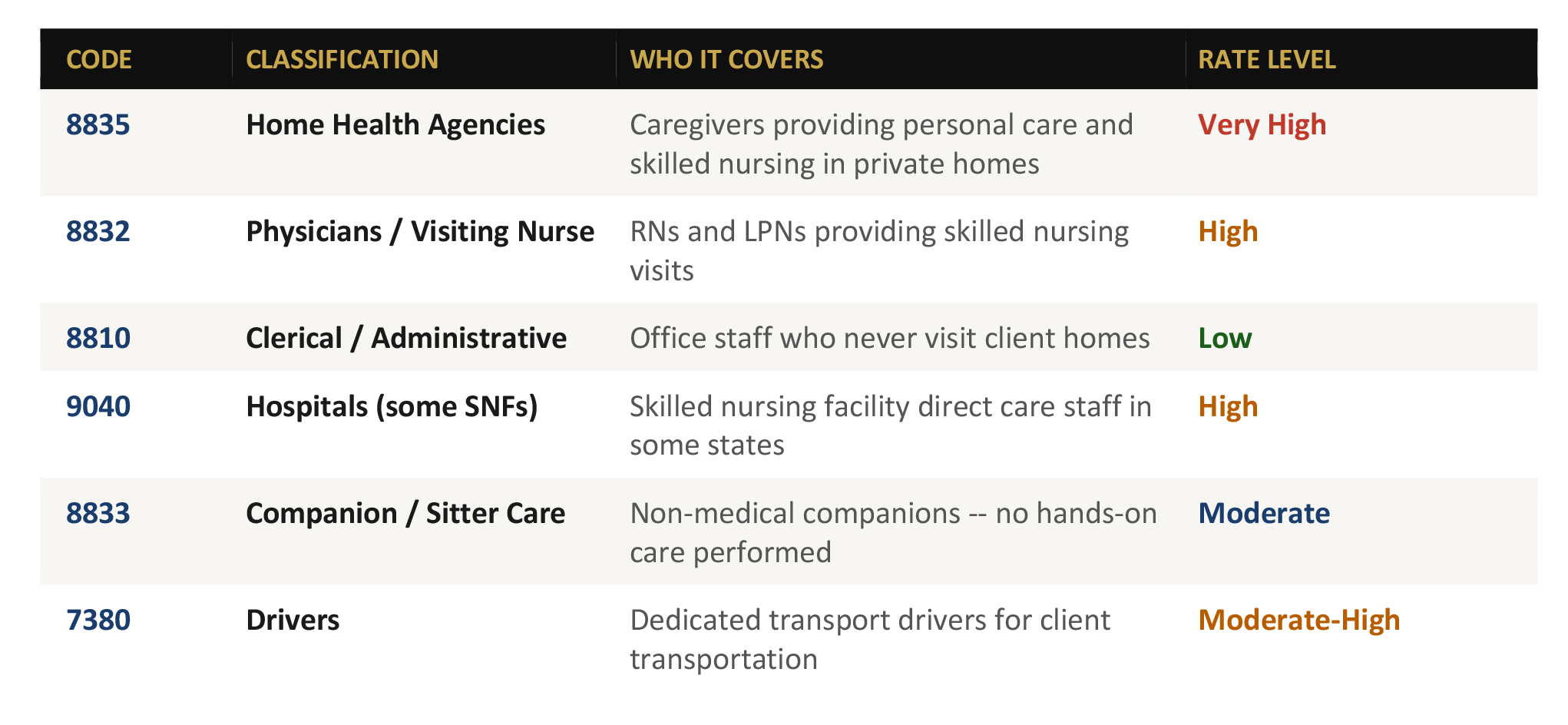
IMPORTANT: CLERICAL STAFF MUST BE SPLIT OUT
One of the most common and most expensive home health audit errors is lumping all employees under a single high-rated class code. Every employee who works exclusively in the office -- scheduling coordinators, billing staff, HR, management -- should be classified under 8810 (Clerical). Carriers will separate these at audit and recalculate your premium, but only if you have documented the split. Without documentation, the auditor may apply the highest applicable code to the entire payroll.
7 Proven Strategies to Lower Your Home Health WC Premium
These strategies are not theoretical. They are the specific actions that home health agencies with declining WC costs have in common. None of them require significant capital investment. All of them require consistent execution.
Implement a 24-Hour Injury Reporting Protocol -- No Exceptions -Claims reported within 24 hours cost 20 to 40 percent less than claims reported after one week. Build a one-page reporting workflow every supervisor can complete in the first hour after any incident. Late reporting is the single most expensive mistake home health agencies make.
Conduct a Home Safety Assessment Before Every New Client Admission - A structured pre-admission home visit that documents floor conditions, stairway safety, lift equipment availability, pet and behavioral risk, and lighting creates a defensible record that the agency identified and addressed hazards before placing a caregiver. It also gives you grounds to require modifications as a condition of service acceptance.
Require Safe Patient Handling Training for Every Caregiver - Body mechanics training, two-caregiver lift protocols for bariatric patients, and the proper use of gait belts and transfer boards reduce musculoskeletal injury frequency more than any other single intervention in home health. Document completion of training for every employee before their first client assignment.
Establish a Return-to-Work Program for Injured Caregivers - Open WC claims are the primary driver of EMR increases. A structured return-to-work program that brings injured caregivers back to modified duty -- office work, phone intake, scheduling support -- while they recover closes claims faster, reduces indemnity payments, and protects the agency from EMR surcharges. Even a two-week reduction in a caregiver’s lost-time period materially reduces claim cost.
Separate Your Class Codes at Audit -- Document the Split Year-Round - Maintain a payroll spreadsheet that separates every employee by their actual job duties throughout the year. When the auditor arrives, the documentation is ready. Do not allow your auditor to reclassify office staff into field care codes because you cannot demonstrate the separation.
Work With a Broker Who Specializes in Home Health Carrier Markets - Not every WC carrier writes home health. The carriers that do specialize in it have different underwriting criteria, different loss control programs, and different rate structures. A generalist broker who submits your account to a standard market will often get a declination or an uncompetitive rate. A specialist broker with access to the right program carriers can place the same account at materially better terms.
Review Your EMR Worksheet at Every Renewal and Dispute Errors - Your EMR is calculated by NCCI based on your loss history from your prior carriers. Errors in the EMR worksheet -- miscoded claims, claims attributed to the wrong policy year, medical-only claims that should be excluded -- are more common than most agencies realize. Request your EMR worksheet from your carrier at every renewal and review it line by line with your broker. A single corrected claim can move your EMR by several points.
How Your Experience Modification Rate Is Calculated -- and Why It Compounds
Your experience modification rate (EMR) is the multiplier applied to your base WC premium. A 1.0 means you are average for your classification. A 0.85 means your losses are 15 percent better than expected -- and your premium is reduced by 15 percent. A 1.25 means your losses are 25 percent worse than expected -- and your premium is increased by 25 percent.
The EMR is calculated by comparing your actual losses over a three-year period to what was expected for an agency of your size and classification. The calculation excludes the most recent completed policy year and includes the three years before that. This means every claims decision you make today affects your premium for the next three renewal cycles.
THE COMPOUNDING EFFECT -- WHY ONE BAD YEAR COSTS YOU THREE TIMES
A single severe claim in policy year 2024 enters your EMR calculation in 2026 and stays there through 2028. If that claim adds 0.15 points to your EMR and your base premium is $500,000, you pay $75,000 more per year for three years -- $225,000 total for one claim. This is why claims management is not just a cost control strategy. It is a three-year financial exposure management strategy. Every day an open claim stays open, it develops reserve dollars that your EMR will carry for years.
Frequently Asked Questions
Q: What is the NCCI class code for home health aides?
The primary NCCI workers compensation class code for home health aides who provide personal care services in private residences is 8835 -- Home Health Agencies and Public Health Nursing. This is one of the highest-rated codes in the NCCI manual because it reflects the uncontrolled environment risk inherent in home-based care. Companion care workers who perform no skilled nursing or hands-on physical care may qualify under 8833, which carries a lower rate. Proper classification is critical -- using the wrong code can result in a large retroactive premium adjustment at your year-end audit.
Q: How can a home health agency lower its workers comp premium?
The most impactful actions are: implementing a 24-hour injury reporting protocol (late-reported claims cost 30 to 50 percent more), conducting pre-admission home safety assessments, requiring safe patient handling training for every caregiver, establishing a return-to-work program for injured employees, separating clerical payroll from field care payroll at audit, working with a broker who specializes in home health carrier markets, and reviewing your EMR worksheet at every renewal to dispute any errors.
Q: Why do home health WC rates go up even in years with no claims?
WC base rates in your state are set by NCCI based on statewide loss cost data for your classification code. If home health agencies across your state have a high-claim year, base rates can increase for every home health agency -- including yours -- even if you had zero claims. This is why working with a specialist broker who can access program carriers with their own loss experience separate from the general market matters so much for home health agencies.
Q: Does workers comp cover a caregiver injured driving between clients?
In most states, yes. An employee injured while traveling between client assignments during their work shift is covered under workers compensation. Commuting to the first assignment or from the last assignment is typically not covered -- but travel between client homes during the workday generally is. If your caregivers use personal vehicles for client-to-client travel, your WC policy should reflect that exposure and your broker should have addressed it in your coverage structure.
Q: What is the difference between home health workers comp and skilled nursing facility workers comp?
Home health workers comp covers employees who provide care in private residences -- an uncontrolled environment with a wide range of physical hazards. Skilled nursing facility (SNF) workers comp covers employees who provide care in a controlled institutional setting where the agency can implement safety programs, mechanical lift requirements, and environmental controls. SNF rates are generally lower than home health rates for the same type of caregiver because the work environment is more predictable and more manageable.
The Bottom Line
Home health workers’ compensation is expensive because the risk is real. Caregivers work alone, in environments they do not control, with patients whose conditions and behavior cannot be fully predicted. The costs are structural -- but they are not fixed.
The agencies that consistently lower their WC costs do not do it by hoping for fewer claims. They do it by reporting injuries faster, assessing home environments before caregivers enter them, building return-to-work programs that close claims quickly, separating their class codes accurately, and working with brokers who know which carriers price home health risk most competitively.
The premium you pay today is the result of decisions made over the last three years. The premium you pay three years from now will be the result of decisions you make today.