
OSHA’s New Psychological Safety Enforcement: What Every Staffing Firm Must Do Now
OSHA just expanded its enforcement framework beyond physical hazards. Stress, burnout, and workplace anxiety are now recognized components of workplace safety — and staffing firms that ignore this shift are walking into a liability exposure most of their insurance policies were never designed to cover.
What Just Changed and Why It Matters
For decades, OSHA enforcement focused on what you could see and measure: fall hazards, equipment guarding, chemical exposure, electrical safety. The General Duty Clause — the foundational enforcement tool that requires employers to maintain a workplace free from recognized hazards — was applied almost exclusively to physical dangers.
That era is ending.
Since releasing a formal mental health fact sheet in 2024, OSHA has made psychological safety an explicit part of its modern workplace safety framework. Stress, anxiety, and burnout are now classified as recognized workplace hazards under the General Duty Clause — meaning OSHA does not need a specific standard to exist before citing an employer for failing to address them.
WHAT IS THE GENERAL DUTY CLAUSE?
Section 5(a)(1) of the Occupational Safety and Health Act requires every employer to furnish a place of employment that is free from recognized hazards that are causing or likely to cause death or serious physical harm. OSHA has consistently applied this clause to hazards beyond those covered by specific standards — and psychological hazards are now on that list.
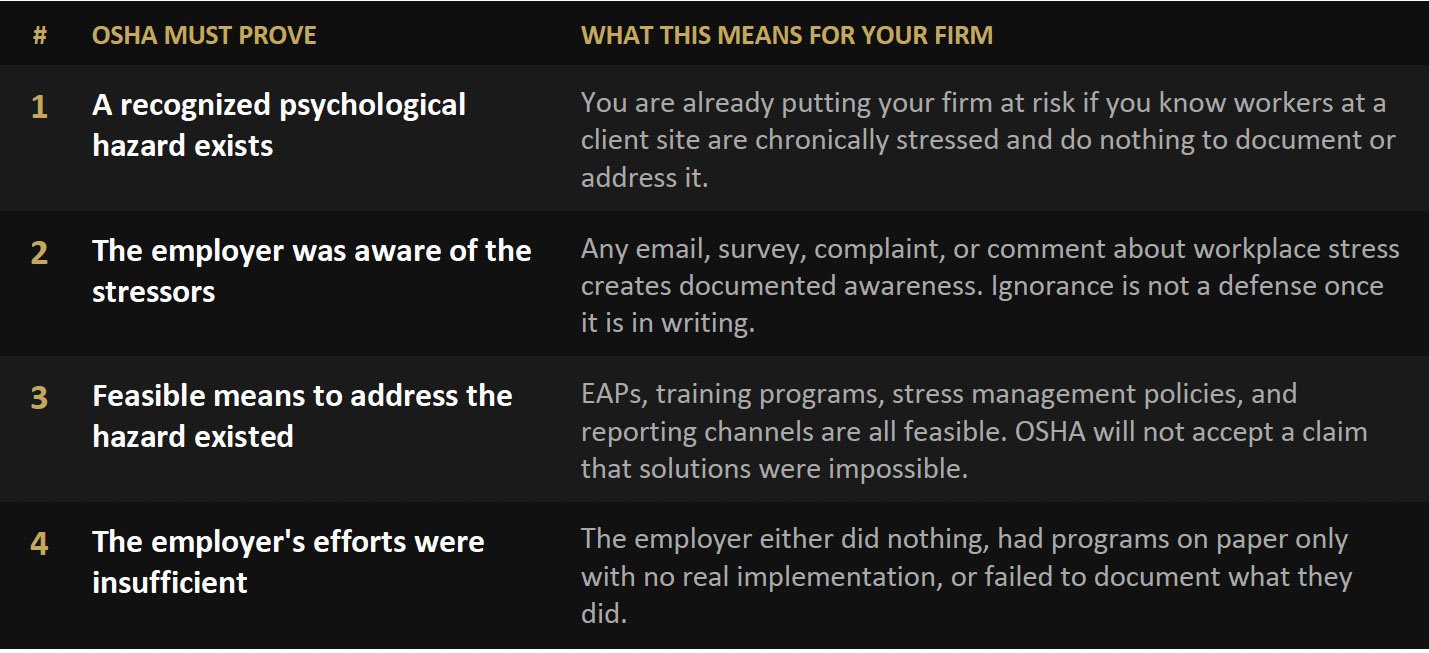
The 4 Elements OSHA Must Prove to Cite Your Firm
To issue a General Duty Clause citation for a psychological hazard, OSHA must establish all four of the following elements. Understanding each one reveals exactly where your firm's exposure lies.
THE CRITICAL INSIGHT FOR STAFFING FIRMS
You do not need to be cited directly to face financial consequences. When a placed worker develops a stress-related or psychological injury at a client site, the Workers’ Compensation claim flows through YOUR policy as the employer of record — regardless of who supervised the work. The OSHA investigation can name both the staffing firm and the client. Your defense depends entirely on what you documented before the incident.
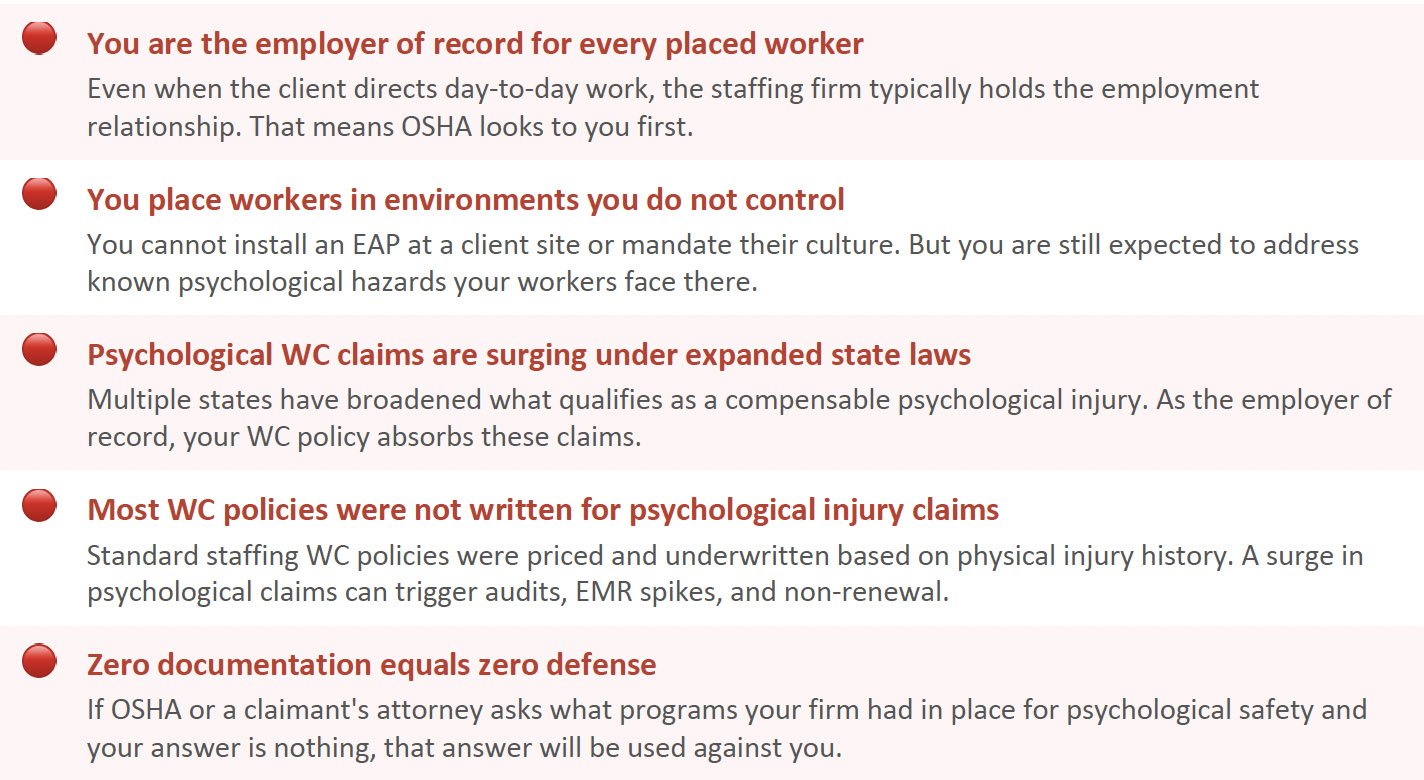
Why Staffing Firms Face Unique Exposure Under This Framework
Most employers only have to manage psychological hazards in their own facilities under their own supervision. Staffing firms face a fundamentally different risk structure that multiplies exposure at every level.
10 Steps Every Staffing Firm Must Take Now
The following steps represent a practical, documented approach to reducing your OSHA exposure, protecting your Workers’ Comp claims history, and building a defensible paper trail if a psychological injury claim is ever filed.
STEP 1 | Establish and Document a Written Psychological Safety Policy
Create a formal written policy that acknowledges psychological hazards as workplace safety concerns
State clearly that your firm is committed to identifying and addressing stress, burnout, and anxiety-related hazards
Include the policy in your employee handbook and require all placed workers to acknowledge receipt in writing
Review and update the policy annually and document each review
STEP 2 | Implement an Employee Assistance Program (EAP)
Select an EAP provider that offers mental health counseling, crisis support, and wellness resources
Communicate EAP availability to every placed worker at orientation and in placement paperwork
Ensure workers know EAP access is confidential and does not affect their employment status
Document that EAP was communicated to each worker and keep records by placement
STEP 3 | Conduct Pre-Placement Psychological Hazard Orientation
Before placing any worker at a new client site, review the site for known psychological stressors: workload, supervision style, harassment history, pace of work
Include psychological hazard awareness in your standard pre-placement safety orientation
Train workers to recognize signs of excessive stress and how to report concerns to your firm directly
Document the orientation with signed acknowledgment from every placed worker
STEP 4 | Conduct Client Site Psychological Hazard Assessments
Before executing a staffing agreement with any client, request or conduct a brief psychological hazard assessment of the work environment
Ask clients directly: What is the typical workload pace? Are there known retention or turnover issues driven by work stress? Has the company had any OSHA complaints involving workplace conditions?
Document your assessment findings in writing and retain them
For high-risk environments (hospitals, warehouses, call centers), conduct more formal assessments using OSHA’s mental health guidance tools
STEP 5 | Include Psychological Hazard Obligations in Client Contracts
Add a clause to every staffing agreement requiring the client to maintain a psychologically safe work environment for placed workers
Require the client to report any workplace incident or complaint involving a placed worker’s mental health or stress-related condition within 24 hours
Include a right-to-remove clause allowing your firm to withdraw placed workers from any environment where psychological safety concerns are not addressed
Require the client to provide your firm with access to conduct psychological hazard reviews upon request
STEP 6 | Train Supervisors and Recruiters on Psychological Safety
Provide annual training to all internal staff, recruiters, and account managers on recognizing signs of worker burnout, stress, and psychological distress
Train your team on how to respond when a placed worker raises a mental health concern
Document all training sessions with attendance records and training materials
Include psychological safety topics in your new recruiter onboarding program
STEP 7 | Establish a Formal Incident and Near-Miss Reporting System
Create a dedicated reporting channel for placed workers to report psychological hazard concerns confidentially
Respond to every report in writing and document the steps taken to address the concern
Track psychological hazard reports by client site to identify patterns that may require intervention or contract termination
Retain all incident reports for a minimum of five years
STEP 8 | Review and Update Your WC Policy for Psychological Injury Exposure
Ask your broker specifically whether your WC policy covers psychological injury claims and under what conditions
Understand which states you are placing workers in that have expanded compensable psychological injury definitions
Review your policy limits and confirm they are adequate for psychological injury claims, which can be more expensive than physical injury claims due to extended treatment duration
Discuss with your broker whether Employment Practices Liability coverage should be added to address EEOC claims that may arise alongside OSHA investigations
STEP 9 | Build a Documentation Infrastructure That Protects You in Litigation
Maintain a centralized file for every placed worker documenting: pre-placement orientation, EAP communication, any psychological hazard disclosures, and incident reports
Retain client site assessment records, contract psychological safety clauses, and any client non-compliance communications
If you ever take action in response to a psychological hazard report, document the action in writing the same day
Never rely on verbal communication alone for anything related to psychological safety — put it in writing every time
STEP 10 | Work with a Staffing Insurance Specialist to Audit Your Full Exposure
Have a specialist broker review your complete coverage stack against the specific psychological injury and OSHA General Duty Clause exposure your firm carries
Ask your broker to walk through your EMR history and flag any psychological injury claims that are already affecting your premium
Request a contractual risk transfer review to ensure your client agreements are shifting appropriate liability back to the client
Schedule an annual coverage review as OSHA’s psychological safety enforcement framework continues to evolve
Risk Management Quick Reference Guide
Use this reference to build your firm’s psychological safety risk management program. Each checklist corresponds to a specific workstream your firm should implement and document.
PLACEMENT OPERATIONS CHECKLIST
☐ Written psychological safety policy in place and distributed to all placed workers
☐ EAP provider selected, contracted, and communicated to every worker at orientation
☐ Pre-placement psychological hazard orientation delivered and documented for every worker
☐ Placed worker signed acknowledgment of psychological safety policy and EAP access on file
☐ Psychological hazard section included in all pre-placement safety orientations
☐ Reporting channel established for workers to raise psychological safety concerns confidentially
CLIENT CONTRACT CHECKLIST
☐ Psychological safety obligation clause included in all staffing agreements
☐ 24-hour incident reporting requirement for mental health and stress-related complaints
☐ Right-to-remove clause in every contract for psychologically unsafe client environments
☐ Client site psychological hazard assessment completed and documented before first placement
☐ Client EMR and safety history reviewed before accepting high-volume or high-risk placements
☐ Annual contract review to update psychological safety language as OSHA guidance evolves
INSURANCE COVERAGE CHECKLIST
☐ WC policy reviewed for psychological injury coverage by state
☐ All states where workers are placed confirmed to be covered including monopolistic states
☐ Policy limits reviewed and confirmed adequate for psychological injury claim exposure
☐ Employment Practices Liability (EPL) coverage in place
☐ Staffing Liability and Professional Liability (E&O) reviewed for psychological injury exclusions
DOCUMENTATION RETENTION CHECKLIST
☐ Pre-placement orientation records retained for minimum 5 years per worker
☐ EAP communication records retained for minimum 5 years per worker
☐ Client site assessment records retained for life of client relationship plus 5 years
☐ All psychological hazard incident reports retained minimum 5 years
☐ All worker complaints and your written responses retained minimum 5 years
☐ Training records for internal staff on psychological safety retained minimum 5 years
The Bottom Line
OSHA’s expansion of the General Duty Clause to cover psychological hazards is not a future threat. It is the current enforcement environment. Staffing firms that treat it as someone else’s problem — because the workers are at the client’s site, under the client’s supervision, in the client’s facility — are making a dangerous assumption.
You are the employer of record. OSHA knows it. Plaintiffs’ attorneys know it. Your carriers know it. The only question is whether you know it well enough to have built the documentation infrastructure to defend your firm when a claim arrives.
The ten steps in this guide are not a compliance burden. They are a risk management investment that lowers your EMR, reduces your WC premiums, strengthens your client contracts, and builds the paper trail that separates firms that survive psychological injury claims from those that do not.