
California Workers Comp Medical Costs Rise Sharply After Pandemic Suppression:
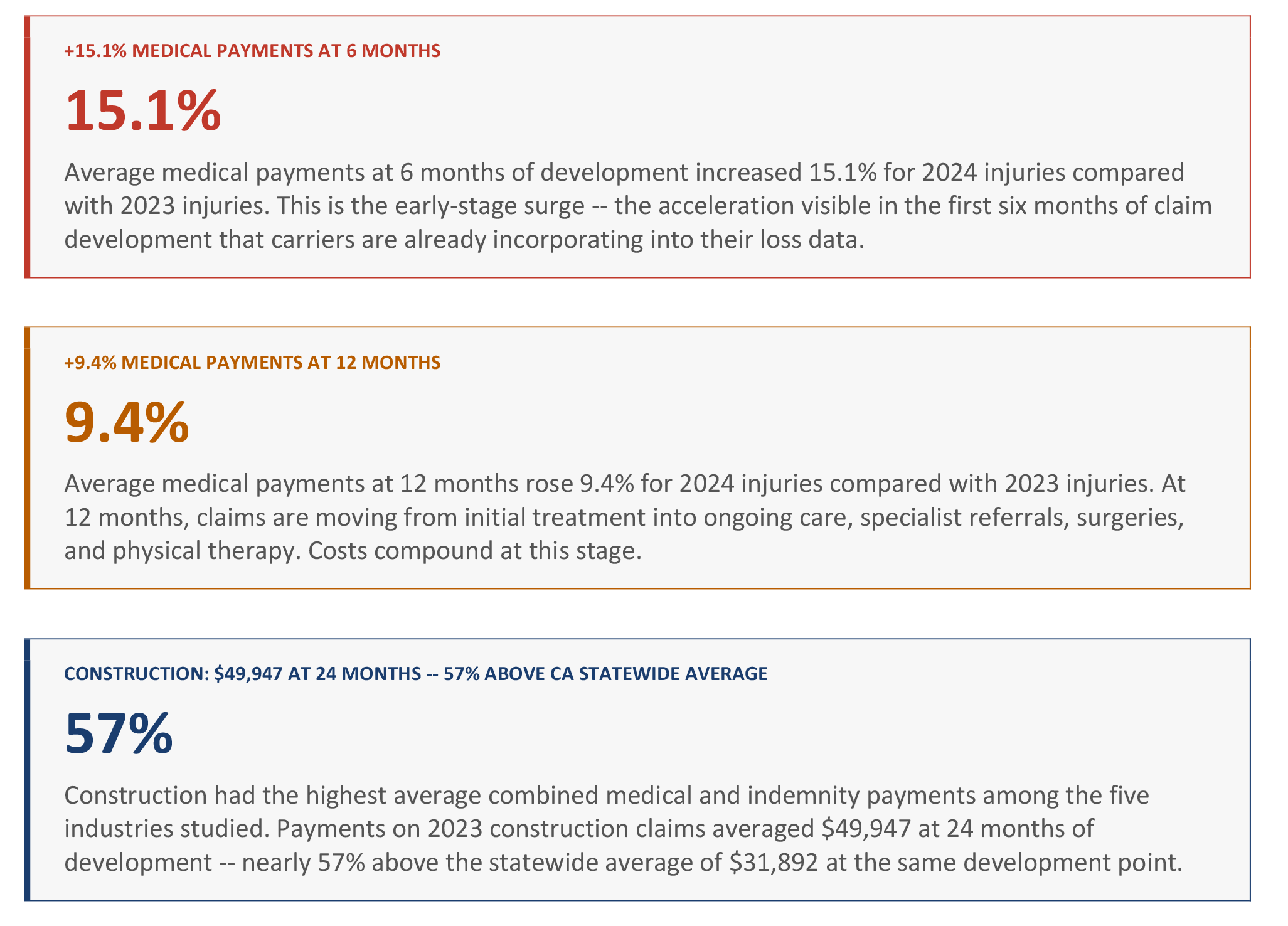
California Workers’ Compensation medical costs are accelerating sharply after years of pandemic-related suppression. A study released September 17, 2026 by the California Workers’ Compensation Institute found that average medical payments on California WC claims rose 15.1% at six months of development and 9.4% at twelve months for 2024 injuries compared with 2023. The pandemic temporarily moderated average medical payments through the influx of relatively low-cost COVID-19 claims -- but the CWCI confirmed that suppression did not change the long-term upward trend. The trend is back. And for California employers and staffing firms heading into renewal season, the implications are direct and immediate.
What the CWCI Study Found
The California Workers’ Compensation Institute analyzed insured and self-insured indemnity claims from accident years 2016 through 2025 -- a ten-year dataset covering the pre-pandemic baseline, the pandemic disruption, and the post-pandemic trajectory. The findings confirm two things that California employers and risk managers need to understand before their next WC renewal.
THE PANDEMIC SUPPRESSION EXPLAINED -- AND WHY IT IS NOW OVER
The CWCI study found that the influx of relatively low-cost COVID-19 claims temporarily moderated average medical payments during the pandemic. COVID-19 claims were more numerous than typical indemnity claims but carried lower average medical costs -- pulling the overall average down and masking the underlying upward trend. The study confirmed the pandemic disruption did not change the long-term trajectory. Once COVID-19 claim volume normalized, the underlying trend in rising medical severity reasserted itself -- with 2024 now showing the steepest single-year increase in the study period.
Indemnity payments -- the wage replacement component of WC claims -- also increased in every accident year at each development interval examined, reflecting changes in benefit levels and claim characteristics. Medical costs are not the only driver of California WC cost growth heading into 2026 renewals.
How Rising Medical Costs Affect Your WC Premium and EMR
The Direct Connection to Carrier Pricing
California workers’ compensation pure premium rates are set by the Workers’ Compensation Insurance Rating Bureau of California based on actual statewide loss cost data. When average medical payments rise significantly across the entire California WC system -- as the CWCI study confirms -- that data feeds directly into the WCIRB’s pure premium rate recommendations.
Rate changes typically lag the underlying loss data by one to two years because of the time required to collect, analyze, and reflect claims data in rate filings. This means the 15.1% surge in six-month medical payments on 2024 claims is entering the data pipeline now and will influence rate recommendations in 2026 and 2027. California employers renewing their WC policies in the next twelve months are renewing into a rising rate environment.
The EMR Connection
The experience modification rate compares an employer’s actual losses to the losses expected for their industry and payroll size. When statewide medical severity rises, the expected loss tables that underpin EMR calculations are recalculated accordingly. This means rising medical costs affect not just current claims but the benchmark against which all of an employer’s historical claims are measured.
Open claims from accident years 2022, 2023, and 2024 are still developing. The CWCI data confirms those claims are developing more expensively than the baseline assumptions at the time they were opened. Carriers are watching reserves grow on open claims and adjusting renewal pricing to reflect those development patterns.
WHY OPEN CLAIMS MATTER MORE THAN CLOSED ONES
Your EMR is calculated based on all claims within the experience period -- typically the three to five policy years preceding the current year, excluding the most recent year. Claims that are still open and developing are valued at their current reserves -- not their final paid amounts. Rising medical severity means those open reserves are growing, which affects your EMR calculation at every renewal until those claims close. California employers with open construction, manufacturing, or field-service claims from 2022-2024 should review those reserves before their next renewal.
Why Staffing Firms Face Compounded California WC Exposure
Staffing firms placing workers in California carry WC exposure as employer of record for every placed worker. Every California WC claim filed by a placed worker flows through the staffing firm’s WC policy -- not the client’s. As medical severity rises across the California WC system, the reserve and development exposure on each open California claim in a staffing firm’s loss history grows with it.
For staffing firms with high-volume California placements in construction, warehouse, healthcare, or manufacturing -- all industries with above-average medical severity -- the combination of rising statewide costs and employer-of-record liability creates a compounding premium pressure that intensifies at each renewal.
5 Steps to Protect Your California WC Costs Before Renewal
These five steps apply to every California employer and staffing firm with WC exposure in the state. The most effective time to take them is before the renewal conversation begins -- not during it.
Review Every Open California WC Claim With Your Agent Before Renewal - Rising medical severity means open reserves are developing higher than when claims were first reported. Request a current loss run and review every open California claim with your agent. Understand what the current reserve is and what development pattern the carrier is projecting.
Implement or Strengthen a Return-to-Work Program - Medical payments rise fastest when injured workers remain off work for extended periods. A structured return-to-work program that brings workers back to modified duty as soon as medically appropriate reduces both the duration and the total medical development of open claims.
Audit Your California WC Class Codes Before Renewal - Incorrect class codes produce incorrect expected loss baselines, which distort your EMR in ways that are not corrected until the carrier conducts an audit -- which may happen after your renewal. Verify that every class code on your California WC policy reflects what your workers actually do.
Ask About Pay-As-You-Go WC for California Placements - As California WC premiums rise, Pay-As-You-Go Workers’ Compensation ties your premium payments to actual payroll rather than estimated payroll. It eliminates large premium deposits, reduces the risk of audit surprises, and improves cash flow as costs increase.
Request a Comprehensive Loss Run Analysis Before Your Renewal Conversation - Walk into your renewal conversation knowing your numbers. A loss run analysis prepared before the carrier presents their renewal terms lets you understand your own experience, identify which claims are driving your EMR, and evaluate whether the renewal pricing accurately reflects your risk profile.
Frequently Asked Questions
Q: Why are California workers comp medical costs rising so sharply in 2026?
The CWCI study confirmed that COVID-19 claims temporarily moderated average medical payments during the pandemic because they were more numerous but lower-cost than typical indemnity claims. That moderating effect has ended as COVID claim volume normalized. The underlying long-term upward trend in California WC medical costs reasserted itself -- and 2024 shows the steepest single-year increase in the ten-year CWCI study period.
Q: How do rising medical costs affect my WC renewal premium in California?
California WC pure premium rates are set by the WCIRB based on statewide loss cost data. When average medical payments rise materially -- as confirmed by the CWCI study -- that data enters the rate-setting pipeline and drives base rate recommendations higher. Rate changes typically follow the loss data with a one-to-two year lag, meaning 2024 data is influencing 2026-2027 renewals now.
Q: What is the average California workers comp claim cost for construction?
The CWCI study found that average combined medical and indemnity payments on 2023 construction claims reached $49,947 at 24 months of development -- nearly 57% above the statewide average of $31,892 at the same development point. Construction had the highest average payments of any of the five industries studied.
Q: How does California WC medical severity affect my experience modification rate?
Your EMR is calculated by comparing your actual losses to expected losses for your industry and payroll. Expected loss tables are updated based on statewide medical severity data. Rising severity raises both your actual claim costs and the expected loss baseline -- which changes the EMR calculation in ways that can take multiple renewal years to fully stabilize.
Q: What should staffing firms doing California placements do to protect their WC costs?
Review open California claims with your agent before renewal to understand current reserves. Implement a return-to-work program to reduce claim duration and medical development. Audit class codes for California placements to ensure correct expected loss baselines. Consider Pay-As-You-Go WC to manage cash flow as premiums rise. Request a comprehensive loss run analysis before your renewal conversation begins.
The Bottom Line
The California WC medical cost surge confirmed by the CWCI in September 2026 is not a temporary anomaly. It is the resumption of a long-term trend that was interrupted -- not reversed -- by the pandemic. The 15.1% increase at six months and the 9.4% increase at twelve months for 2024 injuries are already in the data pipeline that will drive California WC renewals through 2027.
California employers and staffing firms that review their open claims, strengthen their return-to-work programs, and walk into renewal conversations prepared will be in a better position to manage the cost increase than those who do not. The renewal is coming. The data has already moved.